Baldwin County Logged 198 New Business Registrations in November, a Slight Dip From October
Baldwin County logged 198 new business registrations in November 2022, down 7% from October, with Fairhope leading all cities.
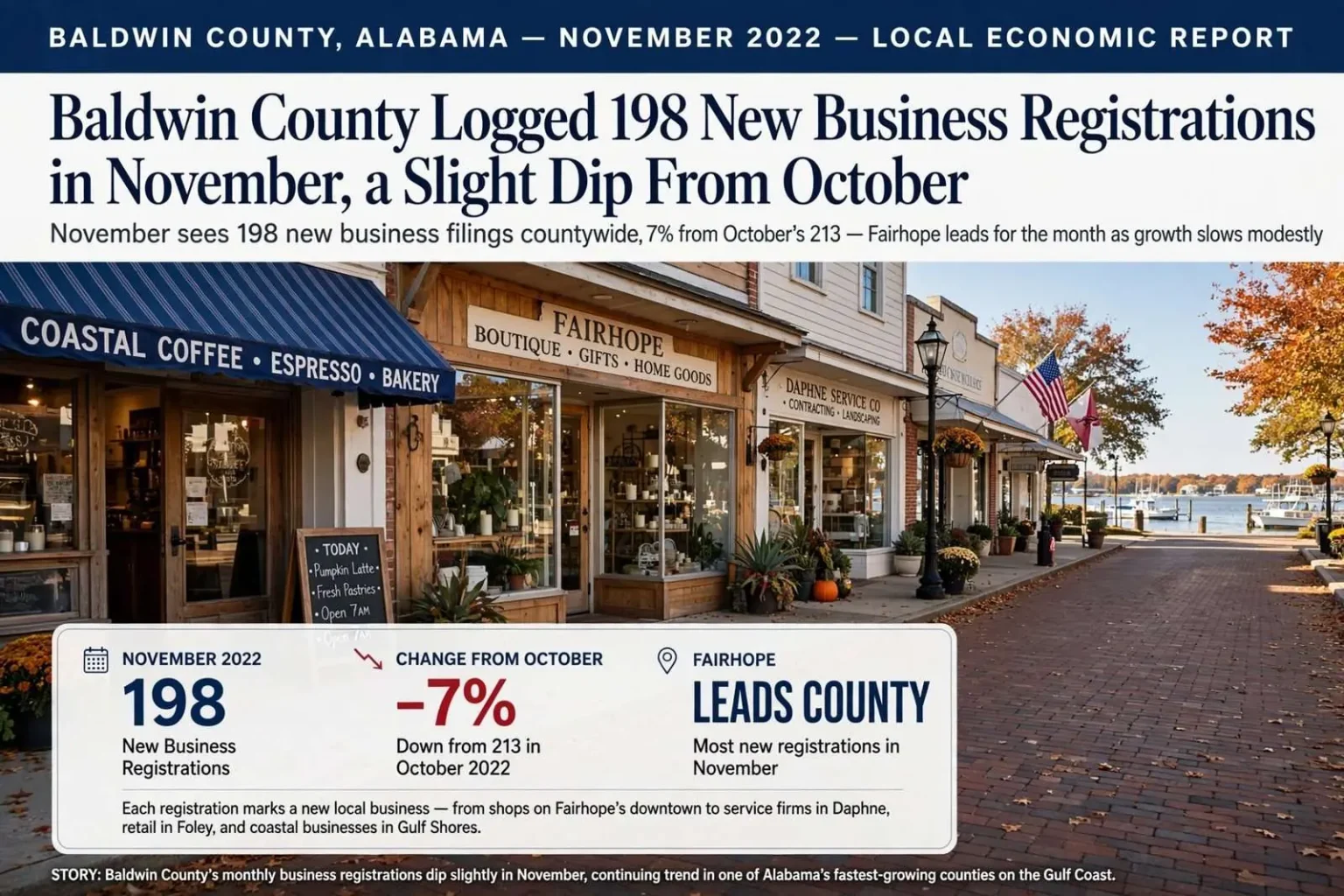
BALDWIN COUNTY, Ala. — New business registrations across Baldwin County’s cities slowed modestly in November 2022, with 198 businesses registered during the month — about seven percent fewer than the 213 recorded the month before. The dip was small in a county accustomed to growth, but it marked a pause in the steady drumbeat of new ventures that has accompanied Baldwin’s rise as one of Alabama’s fastest-growing regions.
Fairhope led the county, registering the most new businesses of any city in Baldwin during November and continuing its role as one of the fastest-growing commercial centers on Alabama’s Gulf Coast. The monthly figures track business registrations filed in Baldwin County’s municipalities and offer a rough gauge of local entrepreneurial activity — an imperfect but useful signal of where the county’s commercial energy is heading.
Registration counts are the first footnote of every business story: the day a new venture becomes official. Behind each entry is a decision by someone to put capital and confidence into a specific street corner in a specific town — a restaurant on Fairhope’s Eastern Shore, a service business in Daphne, a shop in Foley or Gulf Shores. Aggregated by month, the totals trace the rhythm of that confidence across the county.
Fairhope’s Continued Pull
Fairhope topping the monthly list surprises no one who has watched the city grow. Perched on the bluff above Mobile Bay, the city has spent two decades converting its postcard downtown and desirable address into a commercial engine, drawing boutiques, restaurants, professional offices and service businesses that serve not only residents but the surrounding stretch of the Eastern Shore.
The city’s growth has fed itself in the familiar way: new rooftops bring new customers, new customers bring new businesses, and new businesses make the city more attractive to the next wave of residents. Fairhope’s population growth has been among the steepest in Baldwin County, and its downtown — one of the most walked in Alabama — anchors a retail and dining scene that pulls shoppers from Daphne, Spanish Fort and beyond.
For November’s registrants, the city offered the same calculation that has drawn thousands of businesses before them: a prosperous customer base, a distinctive downtown, and a location at the center of the county’s population growth. The registration total simply made official what the construction cranes and leased storefronts already showed.
A County Built on New Businesses
Small business drives Alabama’s economy, and Baldwin County illustrates the point with particular clarity. More than 99 percent of Alabama’s businesses are considered small businesses, and more than 47 percent of the state’s employees work for one, according to the U.S. Small Business Administration. In Baldwin’s cities, where independent restaurants, contractors, marinas and shops line the commercial corridors, those statistics take on visible form.
The county’s growth has made it a proving ground for entrepreneurship. Decades of steady in-migration — retirees, remote workers, families relocating from Mobile and beyond — have made Baldwin one of the state’s quickest-growing counties, and each new household arrives with needs that someone in the county eventually decides to meet. Landscaping crews, medical practices, coffee shops and construction firms all trace their origin to a registration filing like November’s 198.
Research also suggests locally owned firms keep more money at home: a Civic Economics study found that $100 spent at a locally owned business returns $47 to the local economy, compared with just $13 for spending at non-local businesses. The difference lies in what economists call the local multiplier — locally owned firms hire local accountants and printers, bank locally, sponsor the youth league and keep their profits in the community rather than wiring them to a distant headquarters.
That multiplier is why the registration count matters beyond the raw number. Each of November’s 198 filings represents a business that, if it survives its first years, becomes a node in that local network — an employer, a customer of other local businesses, a taxpayer supporting Baldwin’s schools and services. Communities that grow their base of independent businesses compound the effect; communities that rely mostly on national chains capture only the smaller share.
The economics of the modern South have shifted in Baldwin’s favor on this front. The county’s growth has produced enough density of customers to support specialized independent businesses that smaller markets cannot — the niche retailer, the chef-driven restaurant, the boutique fitness studio. November’s registrations feed that ecosystem, and the ecosystem in turn makes the county more attractive to the next wave of entrepreneurs.
Reading a Monthly Downtick
A seven percent monthly decline is noise as much as signal. Business registration counts bounce around month to date with seasonality, holidays and the calendar of entrepreneurial decision-making; November sits between the back-to-school push and the new-year surge that typically follows January 1, when resolutions and tax-year planning produce a fresh crop of filings. A single month’s dip says little until it becomes a pattern.
What the total does confirm is the underlying scale: nearly 200 new businesses in one month, in a county of roughly a quarter-million residents, is a pace most Alabama counties never approach. Even with the monthly decline, the county’s yearly run of registrations points to thousands of new ventures annually — the statistical shadow of the growth visible along U.S. 98, Alabama 59 and the Foley-to-Fairhope corridor.
Observers of Baldwin’s economy watch the registration figures the way farmers watch rainfall — individually unremarkable, cumulatively decisive. The county’s municipalities compete for retail rooftops and commercial investment, and each monthly count shuffles the leaderboard: Fairhope this month, Daphne or Foley the next, Gulf Shores and Orange Beach surging with the tourist seasons that define their calendars.
The Rest of the County’s Field
Baldwin’s city map stretches from Spanish Fort and Daphne on the Eastern Shore, through central county communities like Loxley, Robertsdale and Summerdale, down to the beach cities of Gulf Shores and Orange Beach and the agricultural heartland around Foley and Elberta. Each corridor generates its own registrations — a bait and tackle shop on the coast, a winery in the county’s agritourism belt, a professional office near the Interstate 10 interchanges.
The county’s geography gives its entrepreneurs multiple markets in one jurisdiction. The Mobile metropolitan commuter belt on the east, the tourist economy on the south, and the farm-and-factory economy of the central and northern county each support distinct business mixes. That diversity smooths the county’s totals — when tourism cools in winter, year-round residential commerce keeps the counts moving, and vice versa.
November’s figures also reflect the county’s infrastructure story. The widening of Alabama 59, the growth around the Beach Express and the expansion of utility capacity across the county have opened corridors for commercial development that barely existed a decade ago. Registration counts follow roads and rooftops, and Baldwin has added both faster than nearly any county in the state.
What It Means for Residents
For the people who live and work in Baldwin County, the registration numbers translate into concrete daily realities: more choices for dining and shopping, more competition for contractors and services, more local employers beyond the county’s tourism and manufacturing anchors. They also translate into pressures — hiring competition among small businesses, demand for commercial space that pushes rents upward, and the traffic that follows every new rooftop and storefront.
Local governments track the trend closely because it drives their budgets. Business registrations become occupational and sales tax revenue, which funds the schools, roads and public safety that new residents demand. A county adding businesses at Baldwin’s pace must add classrooms, deputies and lanes to match, and the registration counts offer one of the earliest readings of how much growth is coming.
For aspiring entrepreneurs, the monthly figures carry a message of their own. Baldwin’s market keeps expanding, but so does its competition — the county’s easy-entry, low-barrier sectors, from food service to home services, are crowded with newcomers, and success increasingly depends on finding the gap the last registrant missed. The Civic Economics math offers the compass: businesses that root themselves in the community, hire locally and buy locally capture the loyalty that the multiplier creates.
The Year Ahead
The question raised by November’s dip — whether the registration pace cools or rebounds — will answer itself in the winter counts. January’s filings typically surge as new-year ventures file their paperwork, and Baldwin’s growth trajectory suggests the county’s underlying demand has not diminished. The seven percent monthly decline is worth noting precisely because the county’s norm has been growth; a flat or falling annual total would be the real news.
What is already clear from the data is the county’s commercial direction. Baldwin continues to add businesses at one of the fastest rates in Alabama, led by a Fairhope that has become the model of a small Southern city converting growth into a vibrant local economy. The 198 registrations of November 2022 are one month’s installment on that longer story — slightly fewer than the month before, but hundreds of new local businesses deeper than the year before, each one a bet that Baldwin County’s future will be worth it.