Gun-Rights Group BamaCarry Endorses Austin Sidwell in Alabama CD-1 Primary
BamaCarry, Alabama's largest gun-rights organization, has endorsed Austin Sidwell in the Republican primary for the state's 1st Congressional District.
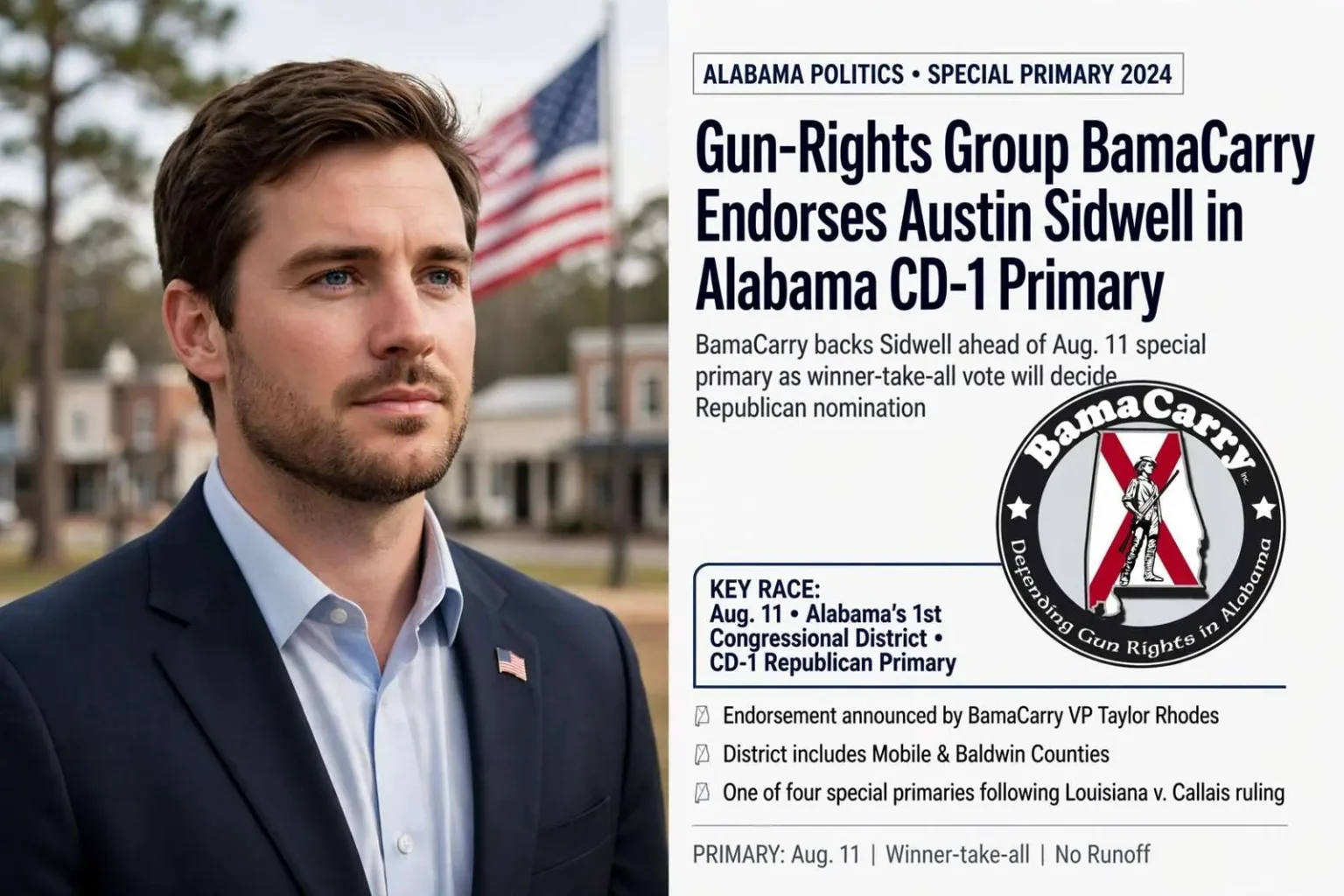
BamaCarry, Alabama’s largest state-based Second Amendment advocacy organization, has announced its endorsement of Austin Sidwell in his bid for the Republican nomination in Alabama’s 1st Congressional District. The endorsement puts one of the state’s most active gun-rights groups behind Sidwell in a special primary that will effectively decide the congressional seat, given the district’s Republican lean.
The CD-1 primary is one of four special primary elections being decided by winner-take-all vote on Aug. 11, a result of a special legislative session earlier this year. The elections use previously barred district maps that were restored following the U.S. Supreme Court’s 6-3 ruling in Louisiana v. Callais, which held that race-based redistricting is unconstitutional.
The map ruling reshaped Alabama’s congressional landscape. Under the restored districts, Republicans are widely expected to prevail in both CD-1 and CD-2 in the 6-1 Republican-leaning map, a shift from the 5-2 map used in the 2024 election. That arithmetic makes the Aug. 11 Republican primaries — winner-take-all, with no runoff — the decisive contests in the districts that matter most.
BamaCarry Vice President Taylor Rhodes said the organization’s support for Sidwell was unequivocal. “I’m certain he is the pro-gun choice in this race,” Rhodes said. “BamaCarry is proud to endorse a candidate in Alabama’s First Congressional District who will put gun owners first and never back down to the pressures of the DC Swamp.”
The Endorsement’s Weight in a Special Primary
Endorsements from single-issue organizations carry particular force in low-turnout special elections, where the voters who show up tend to feel strongly about the issues those groups represent. A grassroots network like BamaCarry’s brings not just a statement of support but a communications channel to members across the district — emails, social media outreach and word of mouth among the activists most likely to vote on a Tuesday in August.
Alabama’s First Congressional District stretches across the state’s southern tier, taking in Mobile and Baldwin counties and communities along the Florida line. The district’s voters have historically favored Republican candidates in federal races, and the restored map kept that orientation intact, which is why the Republican primary is treated as the real election by campaigns and observers alike.
Gun politics has long been a reliable organizing issue in south Alabama, where hunting and sporting shooting traditions run deep and where the state’s elected officials have generally competed to demonstrate their Second Amendment credentials. Alabama’s own record — including its adoption of permitless carry — reflects a Legislature responsive to the advocacy of groups like BamaCarry, which lobbies in Montgomery and tracks legislators’ votes.
Sidwell’s Response
Sidwell welcomed the endorsement in a written statement. “Gun owners, veterans, supporters know where I stand on the right to bear arms. There is no need for any government oversight on how someone chooses to protect their family,” he said. “This election is critical because it’s rebalanced our rights as Alabamians to vote for people with our ideals and beliefs. The Constitution gives states the right to decide voting districts, just as the Constitution gives us all the right to protect ourselves and our family. We can’t let government rule our lives. We need to take back government and make it work for us.”
The statement framed the election through the same constitutional lens the organization applies to its advocacy — treating the district maps and the right to bear arms as parts of a single argument about federal overreach and states’ authority. That framing aligns Sidwell closely with the group’s base, for whom Second Amendment questions are often the first filter applied to any candidate.
In a field contest decided on a single day with no runoff, positioning matters. A candidate consolidating the support of committed single-issue voters can outperform better-funded rivals whose support is broader but shallower, and organizations like BamaCarry work to convert their endorsement lists directly into votes on Election Day.
The Unusual Election Calendar
The Aug. 11 special primaries grew out of the state’s court-ordered redistricting saga, which ended with the Supreme Court’s decision in Louisiana v. Callais and the restoration of maps Alabama had drawn after the 2020 census. Because the restored map changed district lines after a regularly scheduled election cycle, the state turned to special elections to seat representatives in the affected districts for the remainder of the term.
Winner-take-all rules mean there is no second round. Whoever leads the Aug. 11 primary field wins the nomination outright, an unusually high-stakes format that rewards early organization and concentrated support. Turnout is expected to be a fraction of a presidential-year election, magnifying the influence of engaged blocs of voters.
Winning candidates in Tuesday’s special primaries will advance to the regularly scheduled 2026 midterm general election on Nov. 3, where they will appear on the ballot alongside the rest of Alabama’s federal and state contests. Given the district’s partisan makeup, the general election is widely expected to confirm rather than contest the primary’s outcome.
BamaCarry’s Role in Alabama Politics
BamaCarry has spent years establishing itself as a fixture at the Alabama State House, where its leadership testifies on firearms legislation, grades lawmakers’ records and mobilizes members to contact their representatives. The organization’s stated mission centers on protecting and expanding the right to keep and bear arms in Alabama, and its leaders have been involved in most of the significant gun-policy debates of the past decade in the state.
The group’s self-description as the state’s largest Second Amendment organization gives its endorsements practical significance. Candidates seek the group’s support not only for its membership reach but for the signal it sends to Alabama’s broader gun-owning community — a constituency that votes at high rates and treats the issue as a litmus test.
In announcing the Sidwell endorsement, Rhodes placed the race in national context as well, invoking the “DC Swamp” language familiar from conservative primary campaigns. The framing positions the congressional seat as a check on federal gun regulation, and it invites the organization’s members to see the Aug. 11 primary as an extension of their advocacy in Montgomery, now applied to Washington.
For Sidwell, the endorsement arrives as campaigns make their closing arguments ahead of the vote. In a compressed special-election calendar, candidate visibility is built through community events, social media and organization-by-organization outreach, and each endorsement compounds the last by signaling momentum to voters still deciding.
What South Alabama Voters Are Watching
The First District’s August electorate is weighing more than gun policy, but the endorsement fight illustrates how the special primary is being contested: through the endorsement networks, church contacts and civic organizations that define politics in Alabama’s southern counties. Candidates who can thread together the support of groups like BamaCarry, local party organizations and community leaders build the coalitions that winner-take-all elections demand.
The district’s issues — coastal economy, shipbuilding, agriculture, veterans’ services — remain part of the conversation, and the Republican nominee will carry those concerns to Washington along with the Second Amendment commitments highlighted in the endorsement fight.
For now, the Aug. 11 vote stands as the moment when the district’s Republican voters make the choice that will, in practical terms, select the district’s next congressman, with the Nov. 3 general election to follow as a formality on the calendar. Voters who want their ballots to count where it matters will need to show up for the special primary — the election that, under the restored map, will do the real deciding.
The Redistricting Battle Behind the Ballot
The road to the Aug. 11 special primaries ran through years of litigation over Alabama’s congressional map. The dispute centered on whether the state’s districts diluted the voting strength of Black Alabamians, and courts repeatedly rejected the maps the state produced before the Supreme Court’s decision in Louisiana v. Callais resolved the matter in the state’s favor, holding that race-based redistricting is unconstitutional.
The ruling returned Alabama to the map it had drawn for itself, and with district lines settled only months before an election year, the state scheduled special elections to fill the affected seats. The unusual sequence put four congressional primaries on an August ballot, compressed the campaign season and forced candidates to build organizations on a timeline measured in weeks rather than years.
For voters, the mechanics are simple but unfamiliar: one day of voting, Aug. 11, with the leading vote-getter winning each party’s nomination outright regardless of whether a majority is reached. Party runoffs, a fixture of Alabama politics for generations, play no role this time.
The shift from the 5-2 map used in the 2024 election to the restored 6-1 configuration changed expectations across the state’s congressional delegation races. Where some districts had been competitive in recent cycles, the restored lines re-established lopsided partisan margins, concentrating the real contest in the primaries.
The Road to November
Whoever emerges from the CD-1 primary on Aug. 11 will spend the following weeks pivoting from primary campaigning to the Nov. 3 general election, joining the statewide midterm ballot. The interlude between the two elections gives the nominee time to consolidate support, court voters who backed primary rivals and build a general-election organization.
By the time the general election arrives, the congressional contest will share a ballot with Alabama’s other midterm races, drawing turnout that will be larger but less focused on the district’s specific dynamics. That dynamic reinforces the primary’s role as the decisive moment — the November ballot will record the result, but August will have determined it.
Sidwell’s campaign, backed now by BamaCarry’s endorsement and its network, will spend the days before Aug. 11 making that case to the voters most likely to cast ballots: gun owners, veterans and conservatives whom Rhodes described as the constituency his organization exists to represent. The group’s message to those voters is unambiguous — one candidate, one race, one day that decides it.