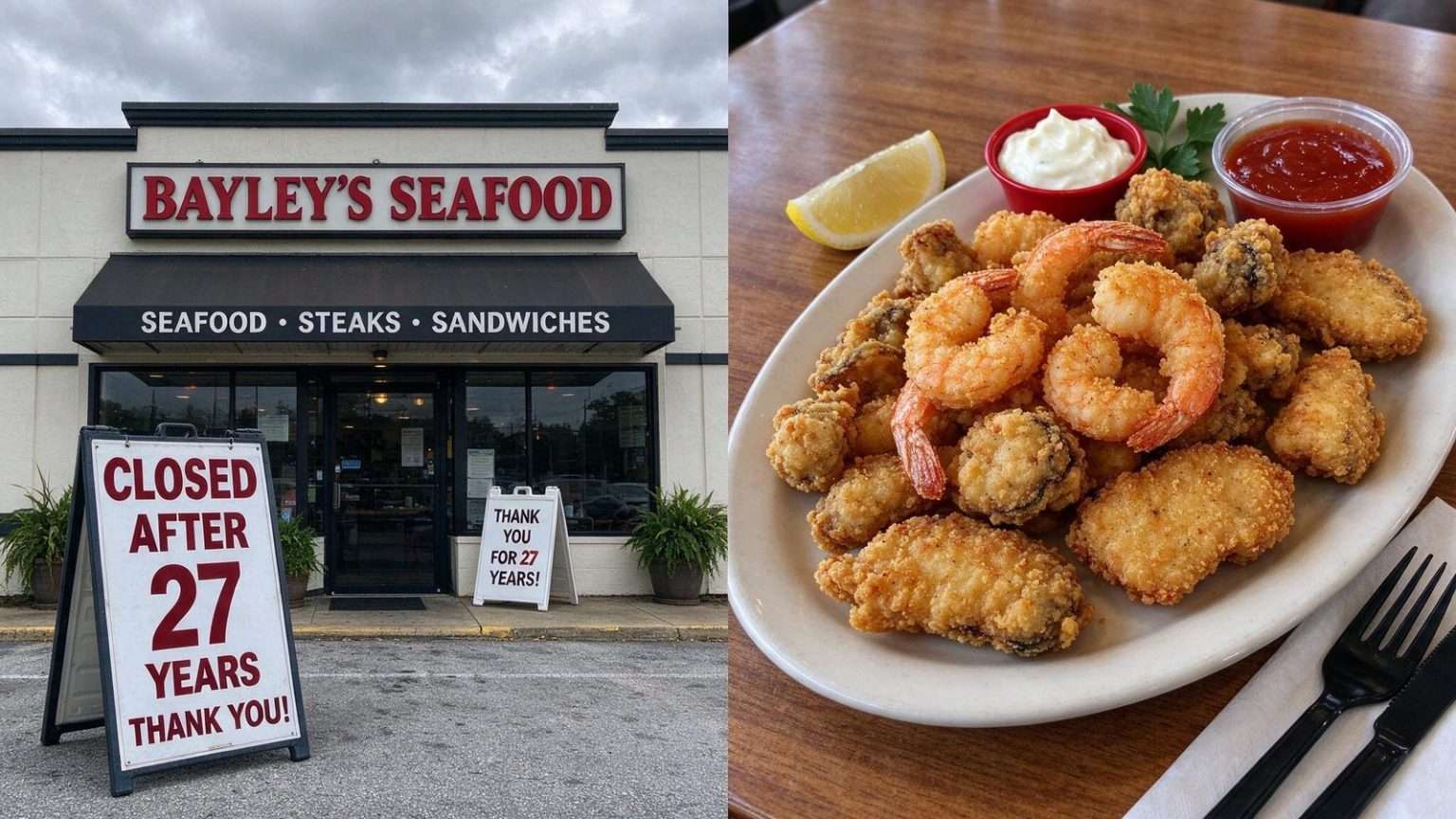
THEODORE, Ala. — Bayley’s Seafood, a family-run fixture of the Theodore dining scene for 27 years, has closed its doors for good. The end came a little sooner than planned: after announcing on June 21 that the restaurant would shut down “next week,” owner William Bayley posted that an outpouring of loyal customers wiped out the kitchen’s fresh seafood by Tuesday afternoon, June 28.
“Due to such overwhelming business from our loyal patrons, we must close as of 4:00 pm today!” the Facebook post read. “Our fresh seafood will be gone by this afternoon so it makes opening tomorrow impossible!”
The original plan had been to serve one last day on Wednesday, June 29, giving regulars a final chance at a table. Instead, the farewell rush arrived faster than anyone expected, emptying the kitchen’s stock and ending the restaurant’s run a day early.
A staffing squeeze too strong to beat
Bayley said the decision to close came down to a familiar problem for restaurants across the Gulf Coast: he simply could not keep enough staff to run the business.
“It’s just getting to where you can’t nobody to work,” he said. “They may [work] for 3 or 4 days and then they’re gone.”
His head cook had been with him for all 27 years, he said, and finding anyone who could replicate that cooking proved impossible — while his two waitresses were putting in 12-hour days to keep the dining room running. A restaurant built around a single kitchen’s way of doing things has no easy substitute, and the loss of that continuity left a gap no hiring wave could fill.
The labor shortage that ended Bayley’s run has been the defining challenge for Gulf Coast restaurants since the pandemic. Establishments across the region have trimmed hours, closed dining rooms and, in a growing number of cases, shut down entirely, unable to find the cooks, servers and dishwashers a full-service kitchen requires.
For a small, family-run operation, the math is starker than it is for a chain. There is no corporate staffing pipeline, no backup kitchen and no substitute for the crew that made the food what it was, which is why Bayley traced the closing to the kitchen itself.
A long run that weathered more than most
The closing capped a long run that weathered more than most. Bayley opened the eatery after years working alongside his father in the restaurant industry, saying he did it because “there wasn’t any decent seafood to eat in Mobile” — fried seafood done the original way.
That mission shaped everything about the place. Bayley’s served the plates Gulf Coast diners measure a seafood house by: fried shrimp, fish and oysters done the original way, the kind of cooking passed from father to son rather than learned from a corporate manual. For 27 years, the restaurant’s kitchen turned out that food daily, and its customers built their routines around it.
Along the way he steered the restaurant through the BP oil spill and the coronavirus pandemic before the labor shortage proved insurmountable. Each crisis tested the business differently. The 2010 oil spill disrupted the supply of Gulf seafood and cast a shadow over the coast’s entire dining economy, and the pandemic forced restaurants everywhere to reinvent their operations almost overnight. Bayley’s survived both, which makes the quiet cause of its final closing — simply running out of workers — all the more telling about the times.
Through those years, the restaurant remained what it was on the day it opened: a family business serving a neighborhood. Theodore’s dining landscape includes plenty of national chains along the highway, but Bayley’s belonged to the older tradition of locally owned seafood houses that once lined the roads of Mobile County, and its closing thins that ranks by one more.
Regulars made the final days count
The last week became a reunion. After the June 21 announcement spread, customers packed the dining room and the takeout line, ordering the plates they had eaten for years and saying goodbye to the staff they had known for decades.
Among them was Robert Berglin, a Fairhope resident who eats at Bayley’s at least once a week and stopped in Tuesday for one last plate.
“This is my favorite seafood place, and I’ve been coming here a long time,” he said.
Berglin’s route from Fairhope, across Mobile Bay to a strip in Theodore, says something about what the restaurant meant. Bayley’s drew customers from well beyond its neighborhood, people who planned their week around a plate of fried seafood and the room that served it, and the farewell week pulled them in from every direction for a last meal.
Bayley said his goodbye in the same spirit.
“I just want to say I appreciate them coming, eating here, being faithful customers, and I’m going to hate it that I won’t be able to take care of them again,” he said.
That exchange, between an owner thanking his customers and customers thanking him back, captured the closing’s mood better than any sign. The restaurant did not fail for lack of business — it closed, in an irony its owner noted, because there was too much of it in the final week, with the farewell crowd consuming everything the kitchen had.
What the closing means for Theodore
The loss of Bayley’s Seafood removes a landmark from Theodore’s dining map and a gathering place from its daily life. For 27 years, the restaurant fed shift workers, families after ballgames, church groups and travelers passing through on Highway 90, and its booths held the kind of regulars every local restaurant depends on and few can replace.
The closing also fits a broader pattern along the Gulf Coast, where independent restaurants have struggled to rebuild staffs since the pandemic upended the industry. Older owners, in particular, have weighed the exhaustion of running short-handed against the option of retirement, and a growing number have chosen to close while the farewell can still be on their own terms.
Bayley’s exit came with the dignity of a packed dining room rather than a quiet shutdown, which regulars say is exactly how the owner would have wanted it. The kitchen ran out of seafood because people came — one last time, and in force — to eat the cooking that a 27-year head cook had perfected and an owner had promised when he opened the doors: fried seafood done the original way.
The era behind him
Bayley’s career in restaurants began long before his own place, in the years he spent working alongside his father in the industry. That apprenticeship taught him both the cooking and the customer relationships that carried the business, and it explains the standard he set: seafood the way his family knew how to make it, served to people he came to know by name.
Restaurants of that kind once defined the Gulf Coast’s dining culture, from the fish camps and seafood houses of Mobile County to the family kitchens of the Eastern Shore. Each closing is felt locally, because these were places where the owner worked the line, the servers knew the orders and the food reflected one kitchen’s way of doing things rather than a corporate recipe.
The economics behind that tradition have grown harder every year. Food costs, insurance and the wages required to attract workers have all risen, while the labor pool that small restaurants depend on has thinned. The pandemic accelerated a shift that was already underway, and the industry along the Gulf Coast is still adjusting to it.
For Theodore, the question now is what fills the space Bayley’s leaves behind. Regulars say no chain can replicate what the room offered, and the hope among longtime customers is that another independent operator takes up the tradition, in that location or another, while the appetite for it remains.
Until then, Bayley’s loyal patrons are left with their memories of the place, the owner’s final thank-you posted on Facebook, and the knowledge that the last week of Bayley’s Seafood was, by every account, its fullest.
The farewell rush itself told the story of the restaurant’s place in the community. Word of the June 21 announcement traveled the way news travels in a place like Theodore, through Facebook comments, church conversations and coworkers telling coworkers, and within a week the customer base had organized itself into a line that emptied the kitchen two days early.
Longtime customers describe the kind of loyalty that outlasts moves, job changes and even a drive across the bay. A weekly plate of fried shrimp may sound like a small ritual, but multiplied across hundreds of families over 27 years, it becomes part of the texture of life in a community, and its loss is felt as more than a business closing.
The industry’s harder math
The conditions that ended Bayley’s run remain in place across the restaurant industry, and owners watching the closing have drawn their own conclusions. A short-handed kitchen means longer waits, exhausted staff and an owner working the line himself, and the model only functions for so long before something gives.
Bayley’s account of his staffing struggle — workers staying three or four days before disappearing — has become a common refrain among Gulf Coast operators. The churn makes it impossible to train a crew to any standard, and for a restaurant whose identity rested on one cook’s 27 years of technique, there was no way to hand the kitchen off.
Industry observers expect more independent closures along the coast as owners reach the same decision point, and communities from Mobile to Biloxi have watched longtime restaurants shut down for the same reason: not a lack of customers, but a lack of hands. In that sense, Bayley’s farewell week, with its packed dining room and empty kitchen, stands as a symbol of the moment for Gulf Coast dining.
The restaurant’s final chapter closed at 4:00 pm on a Tuesday, earlier than planned and fuller than anyone expected, with the people it fed for 27 years crowding the room one last time to say thanks.