Bear Spotted Roaming Spanish Trace Apartments in Saraland
A bear was spotted roaming Spanish Trace Apartments in Saraland on September 12, 2020. Here is what residents should know about bear safety in Mobile.
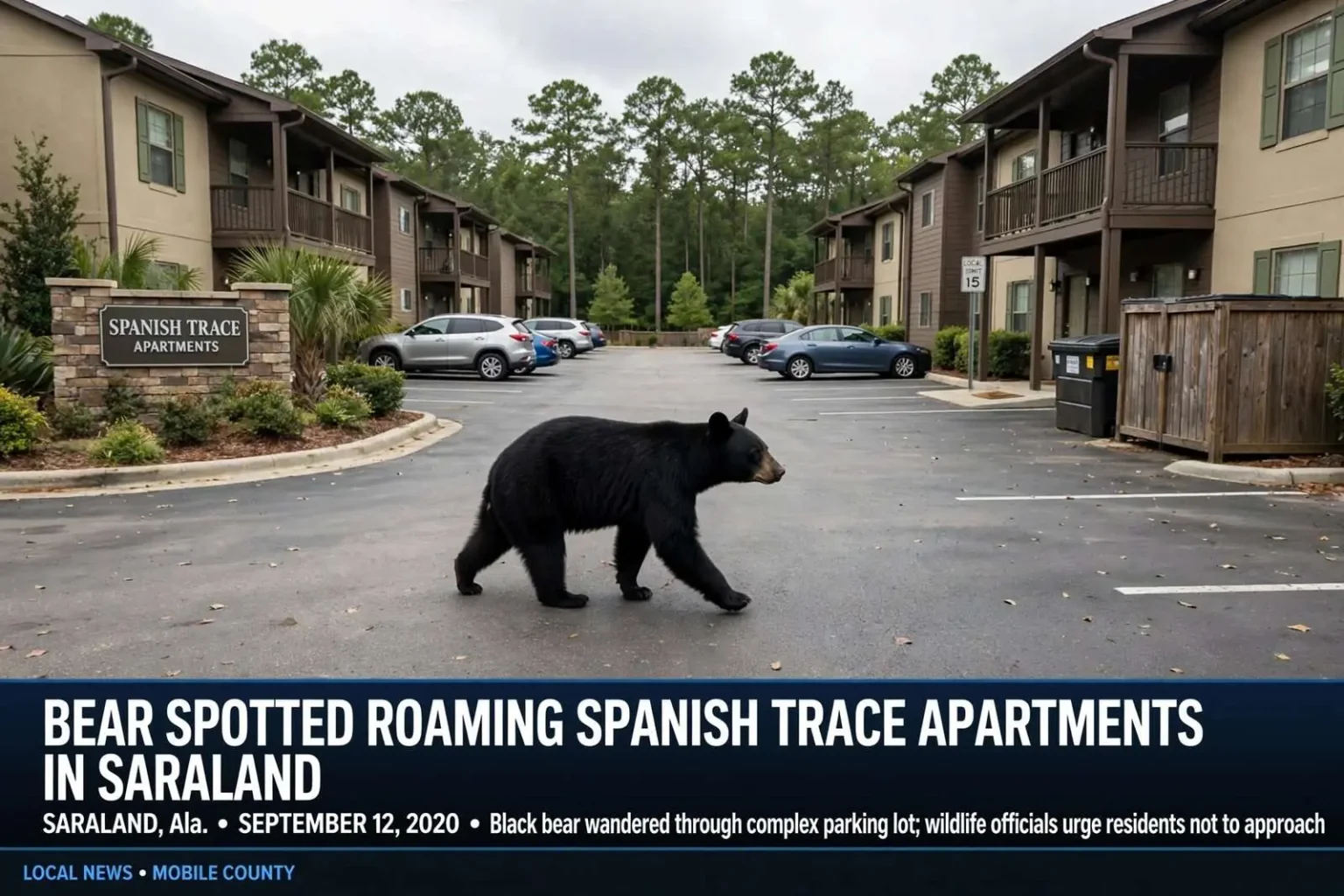
SARALAND, Ala. — A bear was reported wandering through Spanish Trace Apartments in Saraland on September 12, 2020 — a vivid reminder that Mobile County’s expanding residential developments increasingly overlap with black bear habitat in the surrounding rural and suburban landscape.
What happened
A resident of Spanish Trace Apartments captured video of the bear making its way through the apartment complex’s parking areas and nearby streets. The footage quickly circulated on social media, drawing a mix of excitement and concern from both neighbors and wildlife watchers across the Mobile area.
The sighting prompted the familiar round of questions that follows any large-animal appearance in a developed area: where the bear came from, whether it posed a danger, and what residents should do if they saw it. County wildlife authorities’ guidance on those questions is consistent and well-established — advise residents never to approach, corner, or chase a bear. Bears are generally not aggressive, and most encounters end with the animal calmly leaving the area on its own.
The arrival of a bear in a residential part of Saraland — a city at Mobile County’s northern edge where subdivisions give way to forest and farmland — is not unheard of, particularly in late summer and early fall. The city’s geography puts it on the frontier between the Mobile metropolitan area and the wooded stretches of north Mobile County, making it one of the likelier places in the county for a wandering bear to appear.
Bears in South Alabama
South Alabama’s interior supports a population of American black bears that occasionally wanders into populated areas in Mobile and Washington counties. The state’s black bear population is small compared with those of neighboring Southeastern states, which makes each confirmed sighting noteworthy to biologists tracking the animals’ movements and range.
As the Saraland and Satsuma areas have experienced rapid residential expansion into former woodland, bear sightings in neighborhoods have become an intermittent recurring occurrence — and the animals are generally more active in late summer, when natural food sources begin to shift seasonally. Bears that spend spring and early summer in deep woods range more widely in autumn, following food availability, and that seasonal movement is what brings them across the edges of developed land.
Biologists note that the bears of south Alabama are the same species found across the eastern United States — American black bears — and that the subspecies population in this part of the state has been the subject of ongoing research and conservation interest. Sightings in Mobile County residential areas, while uncommon enough to generate social media attention, fit the broader pattern of a modest but persistent bear presence in the region’s remaining forest tracts.
If you encounter a bear
Authorities recommend a short list of practices for residents who see a bear: stay at a safe distance, keep pets leashed and indoors, and secure trash cans and bird feeders — the most common attractants that draw bears into neighborhoods in the first place. A bear that finds no food reward in a residential area typically moves on without incident; a bear that repeatedly finds garbage or pet food returns, which creates the kind of habituated behavior wildlife officials work to prevent.
Residents who see a bear in a residential area are encouraged to report the sighting to the Alabama Department of Conservation and Natural Resources at (334) 242-3469 or local animal control. Reporting serves two purposes: it lets biologists track the animal’s movements across the county, and it ensures that any bear showing unusual behavior — injury, aggression or apparent habituation to people — gets a professional response before a situation escalates.
Sharing space on the suburban frontier
The Spanish Trace sighting is a case study in how the region’s growth patterns produce these encounters. Saraland’s population and housing footprint have grown steadily as Mobile’s metro expansion pushes north along U.S. 43 and Interstate 65, and the city’s newer subdivisions and apartment complexes sit where forest and creek corridors once ran undisturbed. Those green corridors — along waterways and undeveloped tracts — are precisely the routes bears use when moving between habitat blocks.
Wildlife agencies across the Southeast describe the same dynamic: the animals are not moving into neighborhoods so much as neighborhoods are moving into bear country. In Mobile County, the northern tier of the county retains enough contiguous woodland to support roaming bears, and September — a season when natural foods are transitioning — is prime time for the long movements that end in a parking lot or a backyard.
For most residents, the practical takeaway is preparation rather than fear. Black bears are typically shy, avoid people, and pose little threat when given space. The situations that turn a sighting into a problem almost always involve food: an unsecured trash can, a feeder, pet food left outdoors, or a grill with residue. Removing those attractants does more to prevent repeat visits than any response after the fact.
Who handles bears in Alabama
The Alabama Department of Conservation and Natural Resources, through its Wildlife and Freshwater Fisheries Division, is the state agency responsible for managing bear populations and responding to sightings. Local animal control offices handle the initial reports in municipal areas and coordinate with state biologists when a bear needs to be monitored or moved. In practice, most reported sightings result in guidance rather than intervention — officials confirm the animal’s location, advise residents, and let the bear move along on its own schedule.
The September 12 appearance at Spanish Trace Apartments ended the way most such encounters do: the animal moved on, the neighborhood returned to normal, and the video remained as the community’s souvenir of a brief, memorable visit from one of south Alabama’s most elusive residents. For Saraland, the sighting was less an anomaly than a preview of the ordinary frictions that come with living on the edge of bear country — and a reminder that a little preparation keeps those encounters uneventful for both species.
Learning to live with the neighborhood bear
The Spanish Trace video also illustrates how wildlife encounters unfold in the social media era. Within hours of the bear’s stroll through the complex, the footage had been shared widely across local groups and pages, drawing both fascination and a fair amount of second-guessing about what residents should have done. Wildlife officials’ message in the aftermath was straightforward: give the animal room, keep children and pets inside until it moves on, and report the sighting to the professionals who track these appearances.
Saraland sits in one of the likeliest corridors for such visits. The city’s northern reaches border wooded land and creek bottoms that connect to the broader forest mosaic of north Mobile County, where bears live and breed. When young males strike out on their own — a behavior biologists call dispersal — or when seasonal food shifts push animals into new territory, the edges of developed Saraland and nearby Satsuma are natural destinations. September, the month of this sighting, falls squarely in the late-summer window when such movements peak.
What residents can do year-round
Wildlife guidance for bear country applies year-round, not only after a sighting. Securing trash in containers bears cannot open, bringing pet food indoors overnight, taking down bird feeders during active seasons, and cleaning grills after use all remove the incentives that turn a passing bear into a repeat visitor. Residents of Spanish Trace and other complexes near green space can also report attractants in common areas to management, since a single dumpster that bears can access can keep an animal returning to a neighborhood long after its first visit.
None of these measures require fear of the animals themselves. Alabama’s black bears are typically reclusive, and the state’s wildlife biologists emphasize that coexistence — not removal — is the long-term goal for a population that remains one of the Southeast’s smallest. Sightings like the one at Spanish Trace Apartments are valuable records for that effort, helping officials map where bears travel and which corridors connect their habitat. For the residents who watched a bear cross their parking lot on September 12, 2020, the encounter was a rare close look at an animal most Alabamians will never see in the wild — and, handled with the usual common-sense distance, it was over almost as quickly as it began.
Wildlife officials add one more caution for neighborhoods like Spanish Trace: never feed a bear, deliberately or otherwise. Feeding is prohibited under state wildlife regulations because it is the fastest way to turn a wild animal into a dangerous one, and a bear that associates people with food rarely ends its own visits. The September sighting at the apartments ended without incident precisely because the animal found nothing to keep it there — a quiet testament to a neighborhood that, whatever its surprise, handled the visit the right way.