Better Business Bureau: 80 Percent of Online Shoppers Fell Victim to Scams in 2020
More than 80 percent of online shoppers lost money to scams in 2020, according to the Better Business Bureau Serving Central and South Alabama.
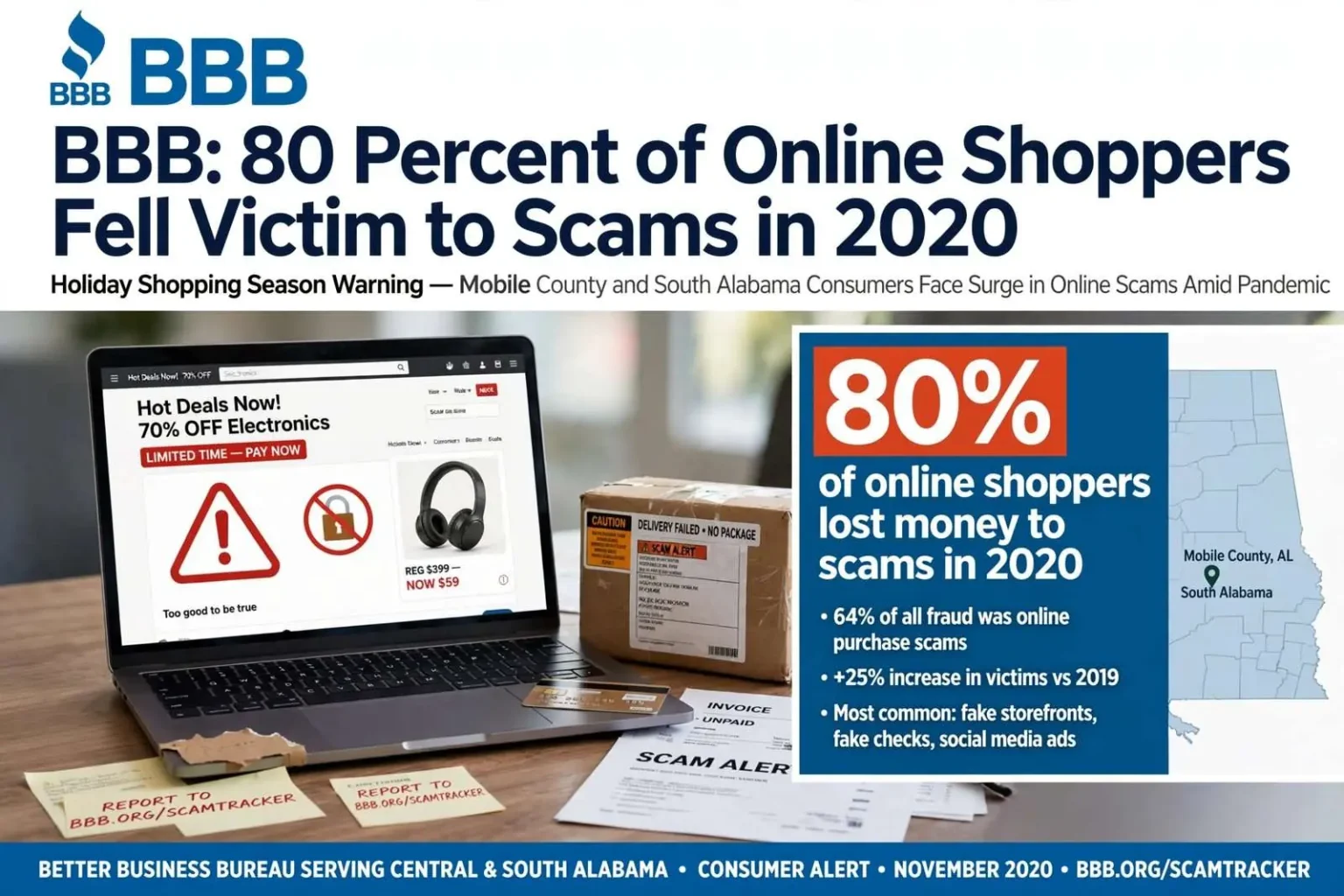
As the holiday shopping season approaches, the Better Business Bureau is highlighting a stark warning for consumers in Mobile County and across South Alabama: more than 80 percent of online shoppers lost money to scams in 2020, a sharp increase that the bureau says demands attention. The figure captures a year in which the pandemic pushed a wave of first-time online shoppers into unfamiliar territory, and scammers followed the money. BBB officials want the warning to land before the season’s spending peaks.
Monde Donaldson, vice president of the BBB Serving Central and South Alabama, discussed the findings this week. The regional bureau, based in Birmingham, covers a territory that stretches from the Tennessee line to the Gulf Coast, including the Mobile metro area. Its staff tracks complaint patterns across the region and translates national fraud data into local consumer guidance.
The Numbers Behind the Warning
The Better Business Bureau traces its consumer protection mission to the early 20th century, when local business associations began policing advertising truthfulness among their own members. Today’s bureau network operates complaint resolution, business accreditation and the Scam Tracker platform as a complement to government regulators like the Federal Trade Commission, which enforces consumer law but does not field the day-to-day complaint volume that bureaus absorb.
According to bureau data, online purchase scams accounted for 64 percent of all reported fraud in 2020, up from just 13 percent five years earlier. Few categories of fraud have grown that fast, and the trajectory tracks the shift of retail spending itself onto phones and laptops. Five years earlier, online purchase scams were a notable slice of fraud reports; by 2020 they had become the dominant one.
The number of victims reporting monetary losses rose nearly 25 percent compared with 2019. That jump matters because most scam victims never file a report at all, which means the reported losses represent a fraction of the true total. Consumer researchers have long estimated that shame and embarrassment keep the majority of victims silent, so the real damage ran well beyond what the bureau’s data shows.
Fraud researchers traced 2020’s spike to the collision of two forces: an enormous migration of spending online and a surge of first-time shoppers with no experience evaluating unfamiliar sellers. Consumers who bought groceries, furniture, electronics and even pets online for the first time encountered the same playbook seasoned shoppers had learned to spot, and the reporting data reflected that inexperience. First-time victims skewed the demographics of fraud reporting younger than in previous years.
The year’s conditions amplified the risk. Pandemic-era shopping moved every kind of purchase online, from groceries to exercise equipment, and shipping delays made long delivery windows seem normal, giving fraudulent sellers extra cover. Shoppers who had learned to distrust a website with a too-good-to-be-true deal found the same warning signs buried under legitimate-looking storefronts.
Facebook, Google, Instagram, direct retailer websites and pop-up ads on social media emerged as the most common platforms where consumers were defrauded. The pattern reflects where the shopping journey begins: a sponsored post, a search result or a pop-up ad leads to a checkout page, and the scam happens between the ad and the package that never arrives. Social platforms, with their targeted advertising and social proof, proved especially fertile ground.
How the Scams Work
In many cases, scammers post attractive deals through polished websites with professional-looking product photos and once a payment is made, no product or service is delivered. The storefronts borrow images from legitimate retailers, run limited-time discounts and use checkout systems that look familiar. By the time the customer realizes nothing is coming, the site has often vanished or stopped responding.
In another common version of the scheme, a scammer poses as a buyer, sends a victim a fake check and asks the victim to refund an alleged overpayment. The fake check scheme targets consumers selling items online through marketplaces and classified listings, and it exploits the time lag in check clearing. The deposit appears to succeed, the refund goes out, and the loss lands on the seller when the bank discovers the fraud.
The fake check scheme deserves particular caution for anyone selling items through online marketplaces, which is where most victims first encounter it. The script is remarkably consistent: a buyer offers the full asking price or more, mentions a mover or an agent who will handle pickup, sends an official-looking check and requests the difference back quickly. Banks must make deposited funds available within days even though check verification takes longer, and that gap is the entire engine of the fraud.
By the time the bank flags the check as fraudulent, the money has already been wired out of the victim’s account. Federal rules generally hold the depositor responsible for funds drawn on counterfeit checks, which is why the scheme is so reliable for thieves and so painful for victims. BBB investigators have warned for years that overpayment refunds rank among the most damaging scams a casual seller can encounter.
The top reason victims gave for falling for these scams was price: the lure of a seemingly extraordinary deal. Bargain hunting is rational behavior, which is what makes it exploitable — a discount that is 70 percent below market on a high-demand item is not a windfall but a signal. The bureau’s researchers note that scammers study the shopping calendar and anchor their offers to whatever consumers are hunting at the moment.
The BBB warns that if a price looks too good to be true, it almost certainly is. The maxim is old, but the data gives it new force: in a year when 80 percent of defrauded online shoppers reported losses, the extraordinary deal was the common thread in the reports. Officials say the instinct to grab a bargain before it disappears is exactly what scammers engineer against.
The Bureau’s Advice for Shoppers
The bureau offered several tips for consumers heading into online shopping season. Do not shop on price alone. Verify that a website is legitimate by checking the URL, watching for spelling and grammar errors and researching the age of the domain. A domain registered weeks before the holiday season is a classic fraud marker, while established retailers’ addresses are consistent and their sites are free of the clumsy phrasing that betrays rushed scam operations.
Package tracking adds another layer of confusion for victims of undelivered-goods scams. Some fraudulent sellers email tracking numbers that show movement for days or weeks before the trail goes cold, which keeps hopeful customers waiting well past any practical dispute window. Consumer advocates recommend disputing charges early rather than waiting for a package that the tracking data suggests is perpetually arriving.
Avoid impulse buys prompted by social media scrolling. The feed is engineered to convert a passing glance into a purchase, and scam advertisers exploit that reflex with limited-quantity offers and countdown timers. BBB investigators suggest pausing before any purchase that begins with an ad rather than a deliberate search, and finding the retailer independently before entering payment details.
Use a credit card or PayPal for added protection; BBB data shows consumers who paid through those channels were less likely to lose money. Credit card issuers and established payment processors offer dispute mechanisms that debit cards, wire transfers, gift cards and payment apps do not match. The bureau’s guidance is unambiguous on one point in particular: anyone asked to pay a suspicious seller by wire transfer or gift card should walk away, because those payments are effectively unrecoverable.
Gift card scams deserve a specific warning because they intersect with the holiday season directly. Requests to pay a seller, a utility or a government agency in gift cards are always fraudulent — no legitimate business or agency collects payment that way — yet the cards remain among the most common payment vehicles scammers request because they are irreversible and widely available at checkout counters everywhere.
Look for the padlock icon and “https” in the browser address bar to confirm a site is secure. The padlock confirms encryption, not honesty, but its absence on a checkout page is a reliable red flag. Scam operations have grown sophisticated enough to imitate secure checkouts, so the bureau presents the padlock as one layer of verification alongside the URL check and domain research rather than a guarantee by itself.
Report suspicious activity to the BBB Scam Tracker at BBB.org/ScamTracker to alert other consumers. The tracker maps reports by location and category, feeding a national database that consumer agencies, journalists and researchers use to spot emerging schemes. A report filed from Mobile or Baldwin County can help flag a fraudulent seller before the next wave of holiday shoppers finds it.
A Local Concern
The warning lands in a region where online shopping has grown quickly but consumer protection infrastructure is comparatively thin. South Alabama shoppers are far from the nearest major retail centers in many counties, which makes online ordering a practical necessity rather than a convenience. That same geography makes residents reliant on delivery promises, and therefore more exposed to sellers who take payment and disappear.
Regional consumer agencies also note that older adults remain disproportionately targeted by phone- and email-based versions of these schemes, while younger shoppers absorb the social-media versions. Households spanning both groups have an advantage: the shopping habits that protect a teenager scrolling Instagram are the same habits, in different form, that protect a grandparent fielding a suspicious call about a package or a prize.
BBB Serving Central and South Alabama fields complaints and offers business profiles that show accreditation status, complaint history and review scores, giving shoppers a free research tool before they buy. The bureau recommends checking a seller’s profile whenever a deal comes from an unfamiliar website, particularly for purchases advertised through social media.
The holiday season concentrates the risk into a few intense weeks. Shipping deadlines compress shoppers’ verification time, gift purchases encourage buying from unfamiliar specialty sites, and scammers stage their most convincing storefronts for the peak days between Thanksgiving and mid-December. Officials urge consumers to build the verification habits now, before the calendar pressure starts.
The 80 percent figure is the headline, but the bureau’s deeper message is that the losses were preventable in most cases. The scams that dominated 2020’s fraud reports relied on recognizable warning signs — extraordinary prices, new domains, ad-driven purchases and pressure to pay in unprotected ways. Shoppers who internalize the checklist, the bureau argues, take themselves out of the pool of victims the next scam depends on.