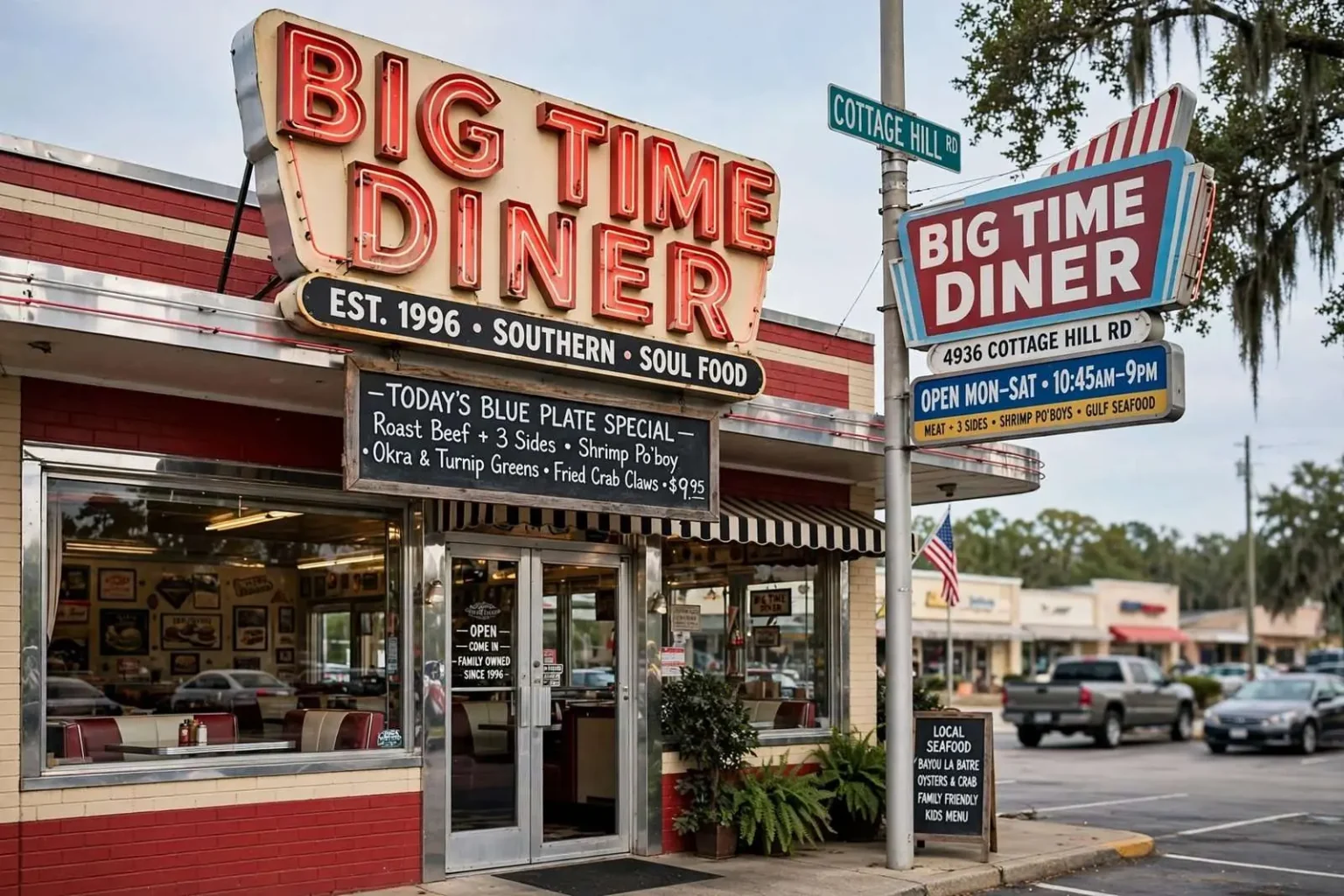
For more than 15 years, Big Time Diner has fed Mobile from its spot on Cottage Hill Road, holding to the same menu that regulars have come to count on since owner Mitch Nyeste opened the doors in 1996. What started as a 1950s-style diner has become a dependable lunch stop built on value, consistency and a family-friendly atmosphere — the kind of restaurant where the servers know the orders before they’re spoken and the menu changes only when the seasons demand it.
Nyeste, a Mobilian for two decades at the time he opened the restaurant, describes the place as a Southern or soul-food diner, and the menu bears that out. The kitchen turns out okra, turnip greens and shrimp po’boys alongside hamburgers, fries and shakes — plates you would not find at a Northern counterpart. The combination reflects both the diner form Nyeste started with and the Gulf Coast pantry that surrounds it, a blend of roadside Americana and lower Alabama cooking in a single dining room.
That room tells its own story. Rock ‘n’ roll memorabilia, gathered at auctions and estate sales before opening, decorates the walls, giving the space the feel of a museum of mid-century pop culture. A children’s menu keeps the room welcoming to all ages, and regulars describe a rhythm to the place — the same families at the same tables week after week, the lunch counter crowded with workers from nearby businesses who have an hour and a fixed idea of what they want.
The Blue Plate Special
Among the most ordered selections is the blue plate special — a choice of meat plus three sides, a format that is about as Southern as restaurant arithmetic gets. Options run from roast beef to seafood, with the vegetable sides rotating through the staples of the Alabama table: the okra and turnip greens, plus the corn, potatoes, casseroles and other fixed accompaniments that a diner of this kind builds its kitchen around.
The blue plate tradition runs deep in Mobile and across the state. The term dates to the divided plates that cafeterias and lunch rooms used a century ago, and the format — one meat, three vegetables, cornbread or rolls — became the default noon meal for generations of Alabama workers. Restaurants that keep the format honest, with sides made in-house and meats cooked the slow way, tend to become institutions; restaurants that cut corners do not last in a market where every customer knows exactly what the dish should taste like.
Nyeste’s pricing has been part of the restaurant’s staying power. Despite rising food costs, he works to keep prices fair while still making a living — a balance that has grown harder as ingredient costs have climbed across the industry. In a neighborhood lunch market, where regulars visit multiple times a week, a menu that drifts upward too quickly loses the very customers it depends on. Holding the line on value is not nostalgia; it is the business model.
Local Roots, Local Sourcing
The diner backs other area vendors, buying oysters, crab claws and gumbo crabmeat from a Bayou La Batre supplier and sourcing much of its other seafood from nearby Mississippi. The choice keeps Gulf products on the plate while keeping money in the regional seafood economy, a chain of suppliers that runs from the processing houses of Bayou La Batre — long one of the busiest seafood ports on the Gulf — straight to the diner’s kitchen on Cottage Hill Road.
Bayou La Batre’s seafood industry has weathered hurricanes, oil spills and import competition over the years, and the buyers who stay loyal through it all are a meaningful part of what keeps dockside operations viable. A restaurant order may look small next to a wholesale contract, but multiplied across the South Alabama restaurants and seafood houses that buy local first, those orders are the difference between a fleet that works and one that sits. Big Time Diner’s kitchen is a small node in that network, but a deliberate one.
Cottage Hill Road and the West Mobile Lunch Trade
The diner’s location says a great deal about how it has survived. Cottage Hill Road runs through one of Mobile’s busiest commercial corridors west of the city center, a stretch lined with strip centers, schools, churches and neighborhoods whose residents grew up on the road. The corridor generates exactly the traffic a lunch-oriented diner needs: office workers, contractors, teachers and shoppers passing within a few hundred feet all day, every weekday, most of them with thirty to forty-five minutes for a meal.
In that environment, speed and consistency are everything. Nyeste credits the staff’s ability to serve hot food and good service at high volume for the restaurant’s staying power — a formulation that sounds simple and is anything but. A kitchen that turns out hot blue plates during a compressed lunch rush, day after day and year after year, is running on trained staff, disciplined prep and a menu engineered to move. Diners that master it become habits; diners that don’t close quietly within a couple of years.
The schedule reflects the same focus. Big Time Diner is at 4936 Cottage Hill Road and open 10:45 a.m. to 9 p.m. Monday through Saturday — a window that catches the early lunch crowd, the after-school families and the early dinner trade, while staying closed on Sundays when much of the family-dining traffic shifts to larger chains and church-day traditions. Six days a week, with Sunday off, is a common rhythm for independent family restaurants, giving staff a guaranteed day with their own families.
An Independent in a Chain-Dominated Market
In a dining landscape dominated by chains, an independent spot that has kept its regulars happy for a generation is a small testament to Mobile’s local business community. The national casual-dining brands that surround the Cottage Hill corridor have corporate marketing budgets, standardized supply chains and deep pockets for remodels. What they cannot replicate is a specific owner’s name on the door, a staff that has worked together for years, and a dining room whose memorabilia was collected one auction at a time because the owner liked it.
Independents also keep their money closer to home. A locally owned restaurant buys from local suppliers — as Big Time Diner does with its Bayou La Batre seafood — pays local taxes and hires from surrounding neighborhoods. Those dollars recirculate through the local economy in ways that franchise royalties do not, which is why city and county economic development officials make a point of supporting homegrown restaurants alongside the national brands they recruit.
The diner’s longevity also tracks with the neighborhood around it. Cottage Hill Road has grown and changed since 1996, with new development filling in gaps along the corridor and the surrounding West Mobile neighborhoods adding population. Through all of it, the restaurant has stayed in place, serving a menu that regulars can recite from memory. That kind of permanence is rarer than it used to be — the restaurant business churns constantly, and the places that last fifteen years and beyond are the exception.
What Keeps Regulars Coming Back
Ask around the dining room and the answers tend to circle the same themes: the food is hot, the plate is full, the price is fair and the room is comfortable for kids and grandparents alike. None of that photographs well, and none of it makes headlines. It is, however, exactly what the Cottage Hill lunch trade wants, and it is the formula Nyeste has run without dramatic revision since the days when the diner first opened as a 1950s-style spot with new memorabilia on the walls.
Two decades on, Big Time Diner stands as an example of the quiet side of Mobile’s restaurant scene — no renovation buzz, no viral moments, just a soul-food diner doing the same things well on the same corner of Cottage Hill Road. The okra and turnip greens still come from Southern recipes, the shrimp po’boys still carry Gulf seafood from nearby waters, and the blue plate special still offers a choice of meat and three sides to a room that knows what it wants before it sits down.
Soul Food and the Mobile Table
Big Time Diner’s menu sits inside a longer Mobile tradition. The city’s cooking draws from the same Gulf Coast well as the rest of south Alabama — seafood from the bay and the Gulf, rice and field peas, greens cooked low with smoked meat, and the deep-fried staples that show up on every plate from a church supper to a roadside cafe. A diner that serves okra and turnip greens next to hamburgers is not straddling two cuisines; it is serving one continuous local table that has always included both.
The shrimp po’boy on the menu carries its own Gulf Coast lineage. The sandwich traveled from New Orleans across the coast decades ago and became standard fare in South Alabama seafood houses and diners, where the only real variable is the shrimp itself. A kitchen that sources from Bayou La Batre starts with an advantage: local shrimp, processed within sight of the boats that landed it, fried and dressed the way regulars expect. It is a simple sandwich that is very easy to do badly, which is why the ones done right become the thing a restaurant is known for.
The same goes for the crab claws and gumbo crabmeat that come off the same supplier’s dock. Crab claws are a Gulf Coast appetizer tradition — fried, marinated or served cold with cocktail sauce — and they appear on menus across the region as a marker of a kitchen’s ties to the seafood trade. Their presence on a Cottage Hill Road diner menu, a dozen miles from the bayou, is the sourcing relationship made visible on a plate.
Rising Costs and the Discipline of Fair Prices
Every independent restaurant in the region has faced the same arithmetic in recent years: food costs up, insurance up, labor up, and a customer base with a fixed idea of what a lunch plate should cost. Chains can absorb some of that with purchasing power and national pricing tests. An owner like Nyeste has to make the call plate by plate — holding prices on the blue plate special, trimming where customers won’t notice, and accepting a thinner margin on the items regulars count on most.
That discipline is one reason family diners so often outlast trendier competitors. A restaurant built on daily regulars prices for volume, knowing that the profit lives in the tenth visit, not the first. The trade-off is a business that can never wander far from what made it work: the menu stays, the value stays, and the memorabilia-covered room keeps filling at 11:30 on a weekday because it always has.
A Fixture at 4936 Cottage Hill Road
For new arrivals to West Mobile, the diner functions as an easy introduction to the neighborhood’s character. The children’s menu and family-friendly room make it a first stop for young families; the counter and quick service make it a daily stop for workers; and the rock ‘n’ roll walls give grandparents something to talk about over fried shrimp. Few restaurants serve all three crowds at once, and fewer still do it for more than fifteen years without changing hands.
Nyeste’s tenure — opening the doors in 1996 and holding the same menu, the same standards and the same local suppliers ever since — is the quiet achievement at the center of the story. The memorabilia gathered at auctions and estate sales before opening has long since become part of the room’s identity, and the staff’s high-volume consistency has become part of the corridor’s routine. Big Time Diner is at 4936 Cottage Hill Road, open 10:45 a.m. to 9 p.m. Monday through Saturday, with Gulf seafood from Bayou La Batre and Mississippi, a blue plate special that runs from roast beef to seafood, and a seat waiting for whoever walks in at 11:45.