Black Bear Turns Up in Saraland Neighborhood Near Celeste Road
A Saraland resident reported a black bear roaming near Celeste Road. Here's what to know about bear sightings in Mobile County and how to respond safely.
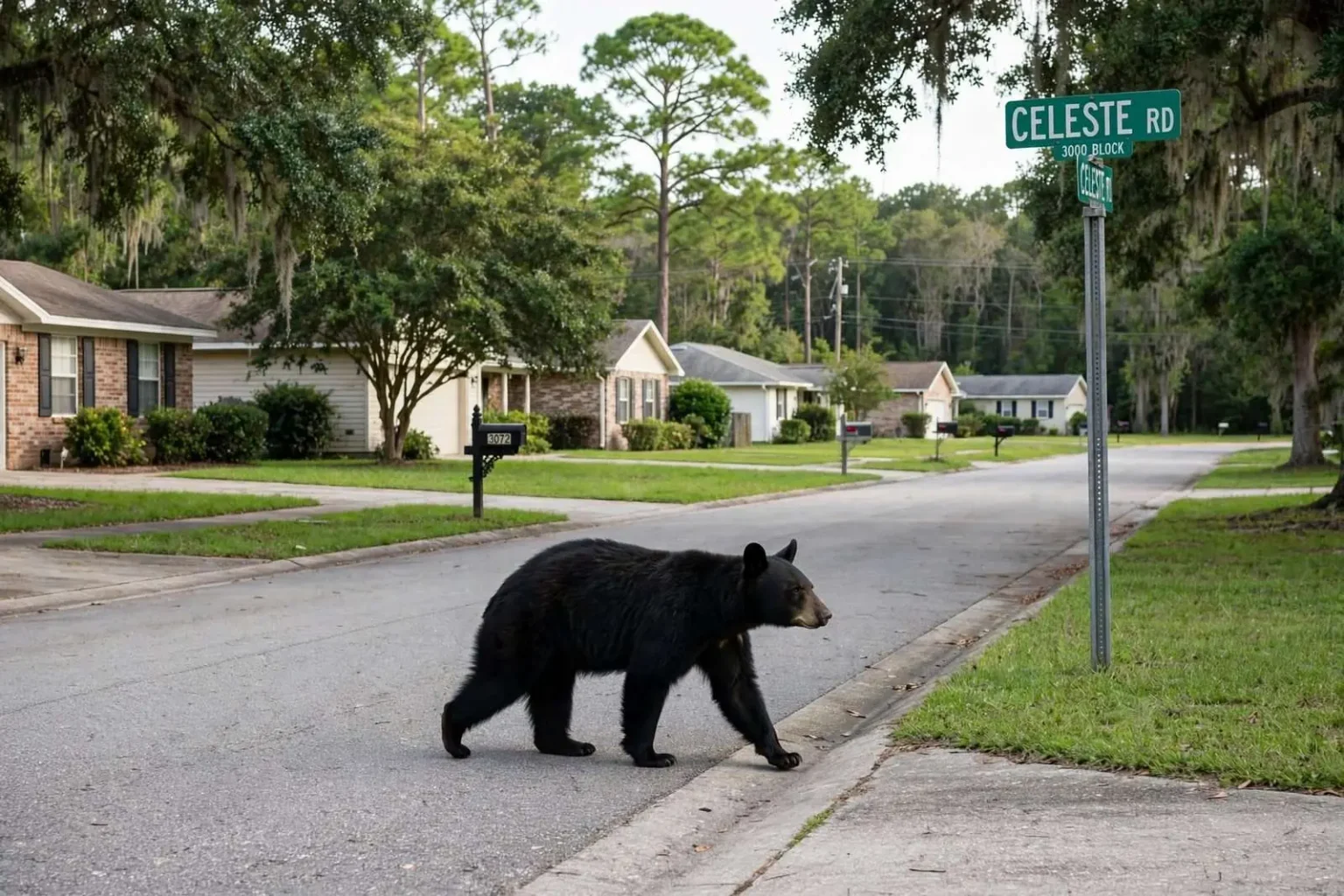
Residents in the Celeste Road area of Saraland got an unexpected visitor in late July when a black bear was spotted passing through the neighborhood.
A local resident shared a photo of the animal after spotting it near the road, which runs through a mostly residential stretch of the city north of Mobile.
The sighting drew the usual round of social media attention and a few nervous phone calls, but nothing about it surprised the biologists who track bear movements across south Alabama. Saraland sits just a few miles from the bottomland forests and swamps that stretch across the northern rim of Mobile Bay, and a young bear traveling through a subdivision is exactly what wildlife officials have come to expect as the state’s small bear population grows and its territory expands.
Bears are no strangers to Mobile County
While sightings like this still draw attention, black bears are native to southwest Alabama, and Mobile County sits squarely in the corridor the animals use as they move between bottomland habitats along the Mobile-Tensaw delta and surrounding woodlands.
Biologists with the Alabama Department of Conservation and Natural Resources have documented a slow but steady increase in bear activity across south Alabama in recent years, particularly during summer months when young bears strike out on their own in search of territory and food.
The bears that appear in Mobile County belong to the Florida black bear subspecies, a population that once ranged across the entire Gulf Coast but was squeezed down to a few strongholds, including the vast swamp and bottomland habitat north of Mobile Bay. The Mobile-Tensaw delta, one of the largest wetland ecosystems in the state, provides that core habitat: miles of unbroken forest, abundant mast crops such as acorns and berries, and waterways that connect one tract to the next. As young bears disperse from the delta’s edge, they follow creek bottoms, green corridors and sometimes highway underpasses into the surrounding suburbs, which is how an animal that belongs to the swamp ends up crossing a lawn in Saraland.
Summer is the peak season for those journeys. Cubs born in the winter spend their first year and a half with their mothers before being pushed out to find territory of their own, and late spring through early fall is when the newly independent animals roam the widest, covering many miles and passing through neighborhoods that look, from a bear’s perspective, like just another stretch of woods with some interesting smells in it.
Young males travel the farthest, which is why so many suburban sightings involve lone animals rather than groups. A dispersing bear may cross dozens of miles of unfamiliar ground in a few weeks, swimming creeks, dodging traffic and living on whatever it can forage along the way. Most of those journeys end quietly, with the animal settling into unoccupied habitat or turning back toward the delta, and only a handful of bears in any year become neighborhood celebrities before they move on.
What officials recommend
State wildlife officials generally advise residents who spot a bear to give it plenty of space and never attempt to feed or follow it.
Most bears passing through a neighborhood are simply moving from one area to another and will leave on their own.
The advice follows from how black bears actually behave. The species is shy by nature and avoids people when it can, and the vast majority of encounters end with the bear slipping away on its own once the excitement dies down. Officials urge residents not to corner a bear, not to let dogs chase it and not to gather in crowds near it, all of which can turn a calm passage into a dangerous standoff. Homeowners who spot a bear from a window should enjoy the moment, keep pets inside and let the animal move on.
Homeowners can reduce unwanted visits by securing garbage cans, bringing in pet food at night, and removing bird feeders when bears are known to be active nearby.
Those steps matter more than any single encounter, because a bear that finds food once will remember the location. Black bears have an extraordinary sense of smell and a powerful drive to eat as much as they can before winter, and a garbage can, a bowl of pet food or a hummingbird feeder can teach a young animal that neighborhoods are worth revisiting. Wildlife managers call the problem “food conditioning,” and it is the single biggest factor in whether a bear’s story ends with a quiet exit or a forced relocation. Grill grates, outdoor refrigerators and unsecured compost piles make the same invitation, so officials recommend cleaning them regularly and keeping attractants locked or indoors overnight.
Reporting a sighting
Sightings can be reported to the Alabama Wildlife and Freshwater Fisheries Division, which tracks bear activity across the state to better understand population movement in the region.
The reporting is not just paperwork. Each verified sighting goes into the state’s bear database, helping biologists map where the animals are moving, which corridors they use and how far the population has spread from its delta stronghold. Over time, that map guides everything from research projects to road planning, and it gives local officials a realistic picture of how often bears are actually in their communities rather than relying on rumor.
Bears are a protected species in Alabama, and it is illegal to hunt, harm or kill one outside the narrow circumstances where a bear poses an immediate threat. That protection is part of why the population has been able to rebuild from near-elimination over the past century, and officials stress that the state’s bears have never been a documented danger to public safety in modern times.
A quiet ending on Celeste Road
No injuries or property damage were reported in connection with the Celeste Road sighting.
That outcome is the norm, and it is the one wildlife officials hope to repeat as sightings become more common. A bear crossing a Saraland yard is not a crisis but a sign of a recovering species using the landscape it always occupied, and the state’s guidance amounts to a simple arrangement: residents secure their trash and give the animal room, and the bear moves along to somewhere more interesting. For a city whose backyard borders one of the wildest landscapes on the Gulf Coast, that arrangement is likely to get more exercise in the years ahead.
Officials note that a sighting does not require an emergency call. Unless a bear is injured, trapped, cornered or behaving aggressively, a report to the Wildlife and Freshwater Fisheries Division is the right channel, and officers will respond if the animal refuses to move or has gotten somewhere it cannot leave. Most of the time, the best response from a neighborhood is patience.
Saraland and the wild edge of the suburbs
Saraland has grown rapidly in recent decades as one of Mobile County’s northern suburbs, its neighborhoods pushing closer to the rural land and timber tracts that separate the city from the delta country. Celeste Road itself runs through that transitional zone, where new subdivisions sit a short drive from creeks, pine plantations and the bottomland that bears favor. Growth of that kind inevitably brings people and wildlife into the same frame, and Saraland is hardly alone: communities across north Mobile County, from Creola to Citronelle, sit inside the same travel corridor.
The delta those communities border deserves its reputation. Fed by the Alabama, Tombigbee and Mobile rivers, it forms a maze of swamps, oxbows and bottomland hardwood forest covering hundreds of thousands of acres north of Mobile Bay, habitat thick with deer, turkey, wild hogs, alligators and the black bears that anchor this story. Conservation groups and state agencies have spent decades expanding protected land around the delta, adding tracts to the wildlife management areas and refuges that give wide-ranging animals room to move.
Living with a recovering species
The increase in bear sightings tracks a broader recovery story across the Southeast. Black bear populations in neighboring Florida, Mississippi, Georgia and Louisiana have all grown under long-standing protections, and the bears at the edges of those populations steadily push into new ground, including southwest Alabama’s delta and the pineywoods of north Alabama, where a separate, smaller bear population has also taken hold in recent decades.
State biologists expect the south Alabama population to keep expanding, and they have urged residents across the region to treat bear awareness as an ordinary part of coastal living rather than a novelty. That means the same habits officials recommend after every sighting: keep garbage secured, feed pets indoors or bring dishes in at night, take down feeders when bears are reported nearby, and report every sighting so the state’s map of bear activity stays accurate.
The Celeste Road bear, photographed and gone by day’s end, followed the script perfectly. The photo made the rounds, the yard emptied of excitement, and the animal continued whatever journey took it past the road in the first place, another young bear in a growing population learning the boundaries of its new world.