

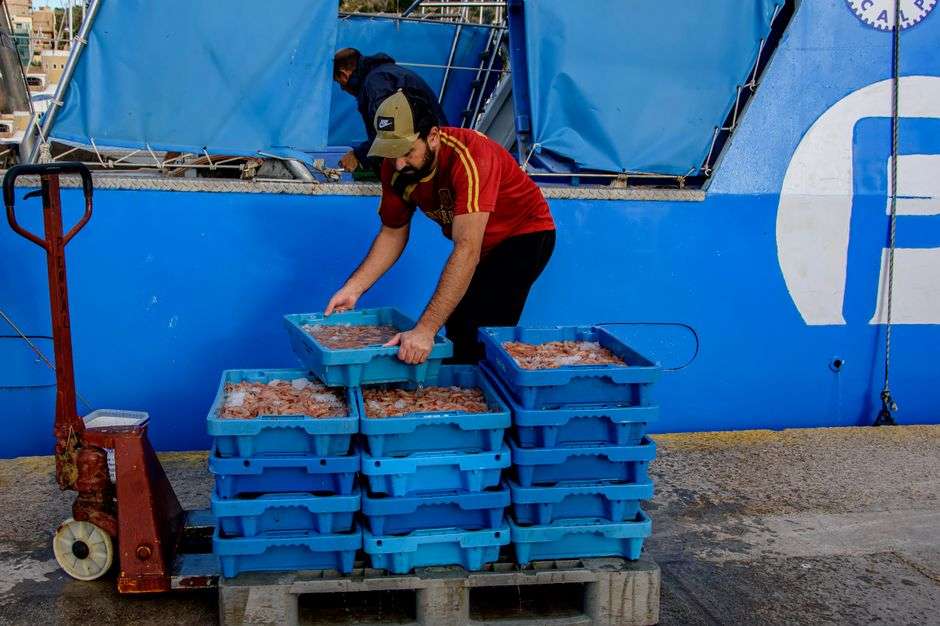
The photos on the wall at Bon Secour Fisheries tell the company’s story in black and white: schooners working as oyster boats, family members sorting and deheading shrimp in big bins, mountains of oysters waiting to be shucked and packed. More than 130 years after the Nelson family entered the seafood business on the Bon Secour River, the operation they built is one of the Gulf’s most respected wholesale houses — and its president, Chris Nelson, has spent a lifetime thinking about where Gulf seafood goes from here.
A fourth-generation house
Bon Secour Fisheries traces to 1892, when the Nelson family’s forebears were producing and selling oysters on the river. Today the company, owned and operated by the fourth generation, is run by Chris Nelson and his older brothers John Andrew and David, who worked alongside their parents, John Ray and Jane Nelson. The company has grown from a small family operation into a major purveyor of seafood from around the world, supplying wholesale and retail customers across the Gulf Coast and the country.
Chris Nelson’s preparation for the job ran through academia. He studied biology at the University of the South in Sewanee — where his brothers earned economics degrees — spent a formative semester at Duke University’s Marine Lab on Pivers Island, North Carolina, and pursued graduate work in marine environmental sciences at Stony Brook on Long Island, with its four classical oceanographies. A Sea Grant fellowship with NOAA took him to Washington, D.C., including an internship with Alaska Senator Ted Stevens, one of the few members of Congress with a direct stake in commercial fisheries policy.
Jimbo, parking spots, and plant-floor diplomacy
Nelson’s summers at the plant came under the management of Jimbo Meador, the Bon Secour Fisheries plant manager who inspired a character in Winston Groom’s Forrest Gump and whom the book was dedicated to. “Jimbo is a hard person not to really like and appreciate,” Nelson says — recalling Meador’s deadpan: “Chris, my friend wrote a book about an idiot who worked at a shrimp plant… and he dedicated it to me. How do you think I should feel about that?” When Nelson returned from college one summer, Meador gave up his own parking spot at the dock. “He is the least entitled person I’ve ever known.”
His first real job was arranging the order boats got unloaded — a rotating queue of captains, none of whom liked being told their turn, complicated by the fact that alcohol was often involved by the time a boat made the dock. Captains who missed their slot went to the end of the line. “It was my lesson in diplomacy,” he says.
The imported-shrimp problem
The industry Nelson inherited was transformed twice. In the late 1950s, the discovery of abundant offshore shrimp in the Gulf turned a summer bay fishery into a year-round, capital-intensive fleet. Then imports — now roughly 90 percent of the U.S. shrimp supply — collapsed prices, and the anti-dumping duties of the late 1990s offered only temporary relief. “There is no easy fix,” Nelson says. “Even here locally, it is difficult to find true Gulf shrimp being served. If you limit yourself to just domestic seafood from the Gulf, you’d have trouble getting enough product.”
The consequences reach the plate: many diners raised on pond-raised imports have never tasted wild Gulf shrimp and might find the real thing — a fresh brown shrimp, say — tastes unfamiliar. He predicts a future in which wild-caught Gulf shrimp and finfish sell at a premium, like Angus beef, because sustainably managed U.S. fisheries are supply-limited by design. Meanwhile, aquaculture keeps improving; he points to high-quality farm-raised shrimp from Ecuador’s mangrove systems and to Alabama’s own farm-raised oysters, now produced on both sides of Mobile Bay where natural reefs have largely vanished.
Management, honestly assessed
Nelson defends the framework even when it pinches. Catch-share programs work, in his view, letting quota holders lease without leaving the dock. Turtle excluder devices and modern reef-fish management have made commercial stocks like grouper and snapper sustainable. Recreational pressure is his larger worry: open-access fisheries with rising participation, he warns, can push stocks off a cliff — and bag limits, for all the grumbling, exist to keep that from happening. Redfish and speckled trout, both reserved for recreational harvest, cannot legally reach a market plate no matter the demand.
His conclusion is unsentimental: wild fisheries have reached peak production, and the only way to feed growing demand is farming. “The only way to provide for growing demand is through aquaculture,” he says. For a 130-year-old family business, that is not a lament — it is the next chapter, written in the same water where it started.