Brewton Teen Gets $350,000 Bond in Shooting Into Occupied Vehicle Case
An Escambia County judge set a $350,000 bond for an 18-year-old Brewton woman charged with attempted murder and shooting into an occupied vehicle, after testimony revealed a dispute over a stolen handgun.
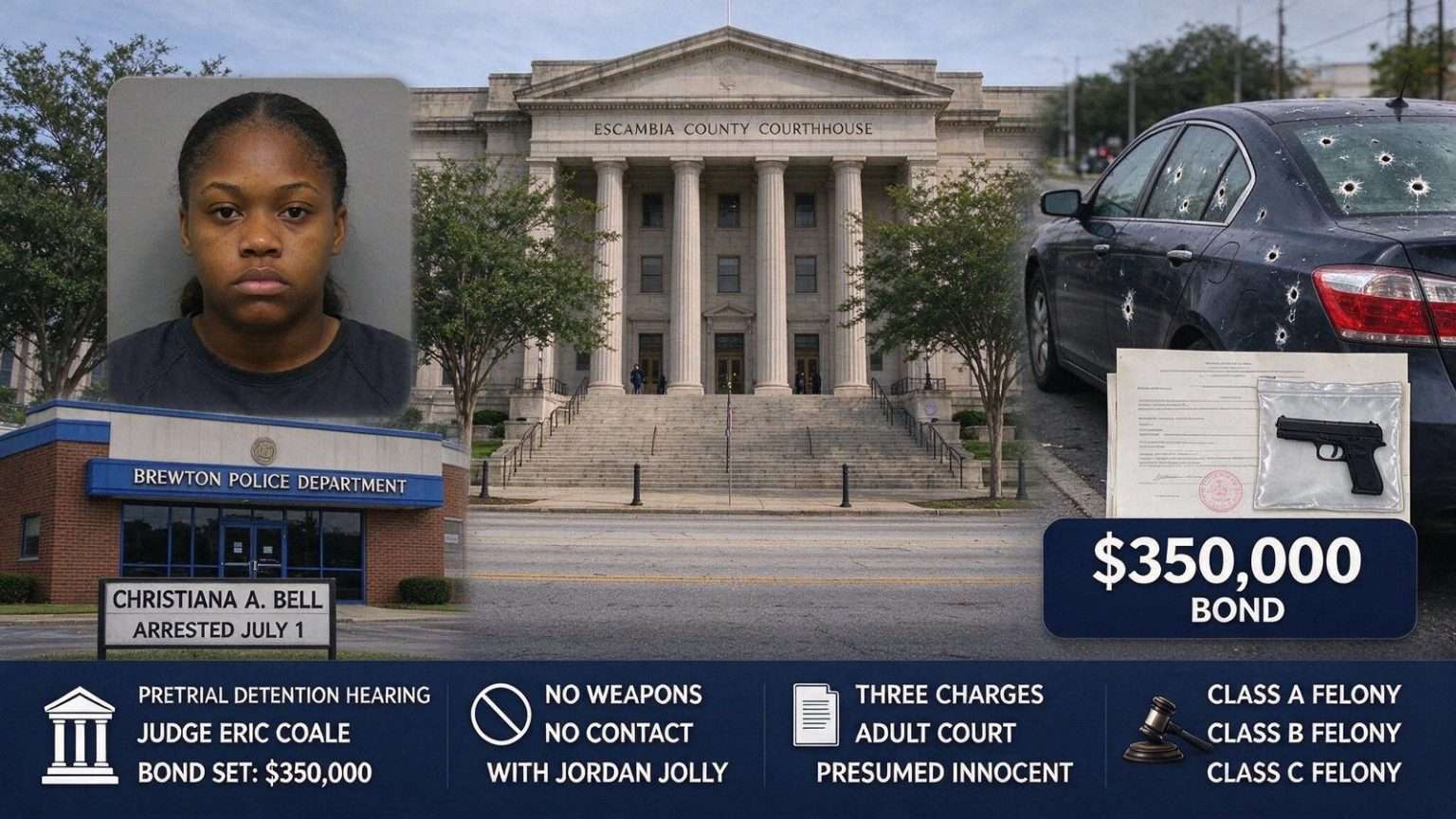
An Escambia County judge has set bond at $350,000 for an 18-year-old Brewton woman charged with attempted murder after a shooting that police say sent multiple rounds into an occupied vehicle, capping a case that also included a brief escape from custody in the middle of downtown Brewton.
Christiana A. Bell, of Lovelace Avenue in Brewton, was arrested July 1 by Brewton police and charged with attempted murder, discharging a firearm into an occupied vehicle, and escape in the third degree. District Judge Eric Coale issued his bond ruling Wednesday morning following a pretrial detention hearing held the day before.
How Police Say It Unfolded
According to Brewton police, the incident came to their attention when the alleged victim, identified in court records as Jordan Jolly, drove his vehicle directly to the police department. The vehicle had been struck by several projectiles.
Officers located Bell on East Jackson Street and detained her. She was taken to the Brewton Police Department for an interview and, following that interview, placed under arrest and transported toward the Escambia County Detention Center.
It was during that transport that the escape charge arose. Police say Bell ran from the transporting officer while handcuffed behind her back. Multiple city police officers and county deputies converged on the area, and she was located near the Escambia County School System’s central office, across from the courthouse.
Testimony About a Missing Handgun
Much of Tuesday’s hearing focused on what led to the shooting. Brewton Police Officer Matthew Brown testified that days before the incident, Jolly told him he had seen Bell and an unidentified man walking and had offered them a ride to get out of the heat. Jolly drove the pair to a store at Midtown and went inside. Bell and the man got out of the vehicle and walked away.
Jolly later noticed that a firearm he kept in the center console of his vehicle was missing. He told police he tried to contact Bell about the gun. He also reported a social media post he believed came from Bell stating that “his shit is taken and is now on the streets.”
Jolly then went to the home of Bell’s grandmother looking for Bell and the missing handgun. According to testimony, the two argued inside the house. Bell said Jolly struck her, and she went into the kitchen to retrieve a knife. Jolly left the house and got into his vehicle. Testimony was that Bell then came around from behind the house with a gun and began firing at the vehicle.
Police said Bell told them she threw the weapon out of a car window near the old Southern Normal School. Officers were never able to recover it.
The Defense Argument
Under cross-examination by defense attorney Karean Reynolds, Officer Brown testified that Bell said she used a .40-caliber pistol to fire at Jolly’s vehicle. Brown also testified that Bell did not wish to press charges against Jolly for allegedly striking her.
Reynolds questioned whether Jolly had ever formally reported the handgun stolen. Brown said he had not done so immediately, though he noted that Bell admitted both to taking the firearm and to shooting at Jolly.
Reynolds argued to Judge Coale that Bell had a right to defend herself and asked the court to dismiss the attempted murder and shooting-into-an-occupied-vehicle charges outright. Judge Coale denied the motion and took the matter under advisement before issuing the bond ruling the following morning.
Conditions of Release
If Bell posts the $350,000 bond, Judge Coale ordered that she may not possess any weapons and may have no contact with Jolly. Violating either condition would ordinarily expose her to immediate revocation of bond and a return to custody.
Under Aniah's Law, a state constitutional amendment Alabama voters approved in November 2022, prosecutors can ask a judge to deny bail entirely for defendants charged with certain violent felonies. The judge decides that request at a hearing, weighing whether any conditions of release could reasonably protect the community and ensure the defendant returns to court. In Bell's case, Judge Coale set a monetary bond with conditions rather than ordering her held without bail.
What the Charges Carry
The three charges Bell faces sit at very different points on Alabama’s felony scale:
- Attempted murder is a Class A felony, punishable by 10 years to life in prison. Prosecutors must prove a specific intent to cause death, not merely reckless conduct.
- Discharging a firearm into an occupied vehicle is a Class B felony carrying two to 20 years. The occupancy of the vehicle at the time of the shooting is the element that distinguishes it from lesser offenses.
- Escape in the third degree is a Class C felony under Alabama law, carrying one year and a day to 10 years.
Because Bell was 18 at the time of the arrest, the case proceeds in adult court rather than the juvenile system.
Bell is presumed innocent unless and until she is proven guilty at trial.