‘I Thought the Cookies Exploded’: Car Drives Into the Front of a Fairhope Subway
An elderly driver pulling into a parking space at 80 Plantation Point struck the front of the Subway restaurant Monday, Fairhope police said. No one was hurt and no charges have been filed. An employee in the back thought an earthquake had hit.
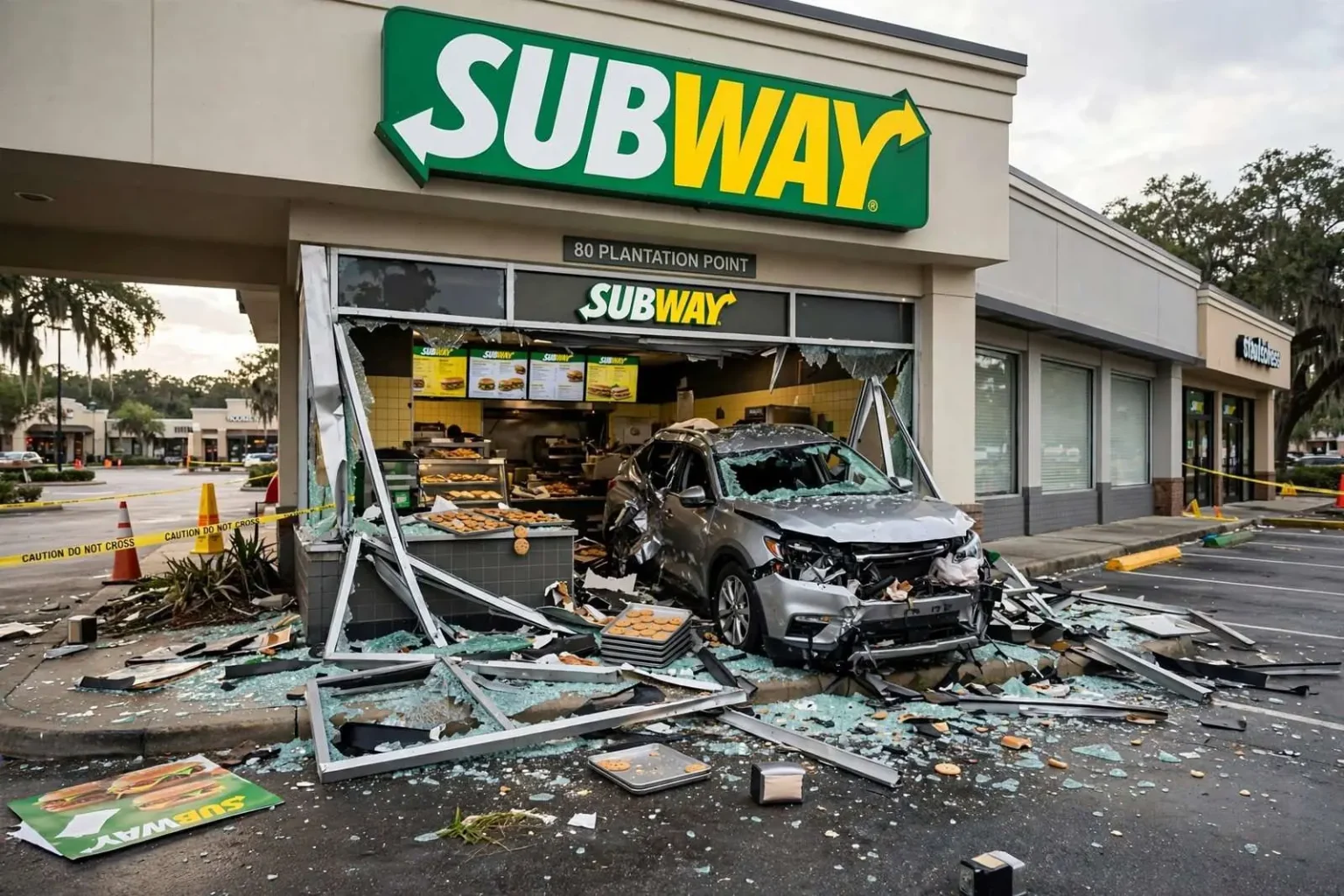
FAIRHOPE, Ala. — Arkeshia Agee was in the back of the Subway on Plantation Point making cookies when the building shook.
“I thought an earthquake happened,” Agee said. “And then I thought the cookies exploded in the oven.”
Neither had happened. A car had come through the front of the restaurant.
“I’m like, a car in the building? What the crap? How this happened?” Agee said.
What Police Say Happened
According to a Fairhope Police Department spokesperson, an elderly woman crashed her vehicle into the front of the Subway restaurant at 80 Plantation Point on Monday, Sept. 7.
Officers said the driver was pulling into a parking space when she accidentally struck the building.
No one was injured. Police said they believe the crash was an accident, and no charges have been filed against the driver.
Agee said she went home for the rest of the day.
“But I’m just glad that everybody was okay and no one was seriously hurt,” she said.
A More Common Crash Than People Realize
A car ending up inside a storefront reads as a freak event. It is not especially rare.
Safety researchers who track what the industry calls “vehicle-into-building” crashes estimate that they happen thousands of times a year in the United States, and the pattern behind them is remarkably consistent. The large majority are low-speed events in parking lots, not high-speed crashes off a roadway. They happen at the moment a driver is parking or leaving a space — the point at which a vehicle is closest to a building and the driver’s foot is moving between pedals.
The single most common mechanism is pedal error: the driver intends the brake and hits the accelerator. It takes a fraction of a second, and in a modern vehicle a fraction of a second at full throttle is enough to cross a sidewalk and reach a wall.
Two other contributors show up repeatedly. One is the geometry of the American strip-center parking lot, where spaces are laid out perpendicular to and directly against the storefront, so a vehicle that surges forward has nothing but a curb and a few feet of concrete between it and the glass. The other is a sudden medical event — a faint, a seizure, a cardiac episode — which produces the same result without any driver error at all.
Why Storefronts Give Way So Easily
The front wall of a fast-food restaurant or a strip-center retail space is usually a curtain of glass in aluminum framing. It is designed to carry its own weight and resist wind, not to stop a vehicle. A curb stops nothing above walking speed; a standard six-inch curb will not arrest a car, it will simply lift the front wheels over it.
The engineered answer is a bollard — a steel pipe set in a concrete footing, usually filled with concrete itself, placed between the parking spaces and the building line. A properly installed bollard is rated to stop a passenger vehicle at parking-lot speeds, and rows of them are the reason many storefronts have survived the same mistake without a hole in the wall.
Building codes in most jurisdictions require them in specific circumstances — in front of fuel dispensers, for instance, or where a drive aisle points directly at a wall — but general storefront protection in retail parking lots is frequently a matter of the property owner’s judgment rather than a code mandate. That inconsistency is why one restaurant in a shopping center will have a line of steel posts across its frontage and the next one over will have nothing.
What Happens to the Building Now
A crash like this creates a short but real to-do list for a property owner before the doors can reopen.
Structural assessment. Even when the damage looks confined to glass and framing, someone qualified has to determine whether the impact affected anything carrying load — a column, a header above the storefront, a portion of the slab. A retail storefront is often non-structural, but “often” is not a substitute for an inspection.
Securing the opening. Boarding up a broken storefront is not just a security step; it is also a weather step, and on the Gulf Coast in September that matters.
Health department clearance. A food-service establishment with broken glass in the dining area and an opening to the outside has a sanitation problem as well as a construction problem. Broken glass, debris and potential pest entry all have to be resolved before a health inspector will sign off on reopening.
Insurance. Two policies usually come into play — the driver’s auto liability coverage for the damage caused, and the property owner’s commercial coverage, which typically pays first and then pursues recovery from the driver’s insurer.
Why No Charges
Police said no charges have been filed and that they believe the crash was an accident. That is the usual outcome in a parking-lot crash of this kind, and it reflects how traffic law is written.
A citation generally requires a violation — reckless driving, driving under the influence, driving without a license or insurance, or a specific rule-of-the-road infraction. Simple driver error in a private parking lot, with no injuries and no aggravating circumstance, frequently does not meet that threshold. Civil liability for the damage is a separate question from criminal or traffic charges, and it is handled between insurers rather than in traffic court.
Practical Advice for Drivers
Because pedal error is the dominant cause, the countermeasures are unglamorous but effective:
- Pull through when you can. Parking so the car faces out of the space, rather than nose-in toward a building, removes the storefront from the equation entirely.
- Come to a full stop before shifting. Most parking-lot surges happen during the transition between drive and reverse.
- Use one foot for both pedals. Two-foot driving in an automatic increases the odds of pressing both at once under stress.
- Take the extra second. Nearly every one of these crashes occurs during a hurried maneuver.
Plantation Point
The Subway at 80 Plantation Point sits in one of Fairhope’s busier retail clusters, on the commercial corridor that serves the city’s eastern side. Fairhope has grown substantially over the past decade, and its shopping centers absorb a steady flow of local and visitor traffic year-round.
The restaurant will need repairs before it fully reopens. As Agee said, the outcome that mattered most was already settled by the time she walked out from behind the ovens.
Older Drivers, and What the Research Actually Shows
Police described the driver in this case as an elderly woman, and it is worth handling that detail carefully, because the public conversation about older drivers tends to run well ahead of the evidence.
What research consistently finds is that crash risk per mile driven follows a U-shaped curve across the lifespan. The highest rates are among the youngest drivers. Rates fall through middle age and remain low for decades. They begin to rise again in the mid-to-late seventies and rise more steeply past eighty.
Several qualifications matter. Older drivers as a group drive substantially fewer miles, and they self-regulate more than any other age group — avoiding night driving, interstates, rush hour and bad weather. Much of the apparent rise in crash rate per mile among the oldest drivers is also a function of frailty rather than error: an older person is more likely to be seriously injured in a crash of equivalent severity, which inflates the injury and fatality statistics without necessarily indicating more crashes.
The crash types associated with aging are specific rather than general. They cluster at intersections, during left turns across traffic, and in situations requiring rapid divided attention or neck rotation. Low-speed parking maneuvers involving pedal confusion also appear, and are associated with reduced proprioception and slower error correction.
The practical response, endorsed by occupational therapists and driver rehabilitation specialists, is not blanket restriction. It is assessment: vision and cognitive screening, a professional driving evaluation where warranted, vehicle modifications, and honest family conversations that start well before a crisis. Alabama, like most states, has a medical review process through which a physician or family member can raise a concern about a driver’s fitness.
What Happened to the Employee
Arkeshia Agee described a sequence that anyone who has worked in a service job can recognize: a loud noise, a wrong first explanation, then the correct one arriving all at once.
“I thought an earthquake happened. And then I thought the cookies exploded in the oven,” she said.
Her second reaction — walking out and finding a car in the building — and her decision to go home for the rest of the day are worth noting because employers do not always account for them. A vehicle entering an occupied building is a near-miss event for everyone inside, and near-miss events produce real stress responses even when no one is hurt. Startle, adrenaline, and delayed anxiety in the hours afterward are ordinary reactions rather than signs of fragility.
Agee, for her part, landed where most people do.
“But I’m just glad that everybody was okay and no one was seriously hurt,” she said.
If It Happens to You
For anyone who finds themselves in a business when a vehicle strikes it:
- Move away from the vehicle and the glass line first. Secondary movement of the vehicle is a genuine hazard, and glass in a damaged frame can fall well after the impact.
- Check the driver. A crash caused by a medical event leaves an incapacitated person in the vehicle, and that is a medical emergency independent of the crash.
- Do not move the vehicle. Beyond preserving the scene, a vehicle wedged into a structure may be holding damaged framing in place.
- Photograph everything before cleanup. Insurance claims on both sides move faster with documentation from before the debris is cleared.
- Get checked even without obvious injury. Adrenaline masks injury for hours.