Mobile Car Seat Check Finds Only 2 of 88 Seats Installed Correctly; 33 Free Seats Given Away
Technicians at a free Nov. 5 car seat check in Mobile found just two of 88 seats installed correctly and gave 33 new seats to eligible families.
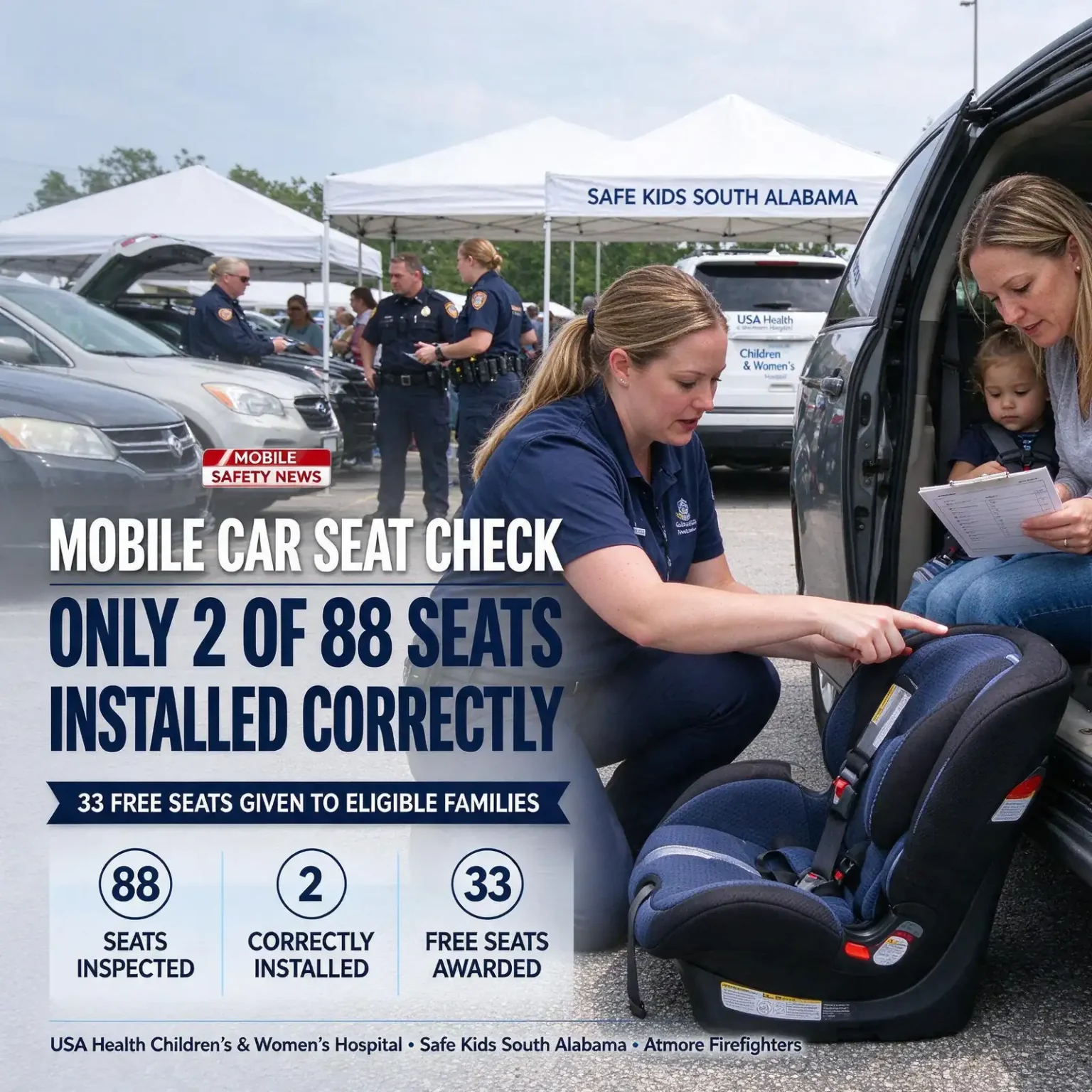
MOBILE, Ala. — When certified technicians looked over 88 child car seats at a free community check in Mobile on Thursday, Nov. 5, they found just two that had been put in correctly. The car seat check results mean that nearly every family who stopped by drove away with a corrected installation, a better-fitting seat or a new seat altogether.
The morning event was a partnership between USA Health Children’s & Women’s Hospital and Safe Kids South Alabama. In addition to the inspections, organizers handed out 33 free car seats to eligible families.
By the Numbers
- 88 car seats inspected
- 2 found to be correctly installed, a rate of about 2%
- 33 new car seats given to eligible families at no cost
- 15 certified child passenger safety technicians from USA Health on hand
- 1 seat per vehicle, with the child required to be present for fitting
The results closely mirror the hospital’s experience a year earlier. At the 2025 version of the event, only three of 113 seats checked were installed properly, a share that was nearly as low.
How the Inspections Worked
The 15 USA Health technicians, each certified in child passenger safety, worked through the line of vehicles one family at a time. They checked how each seat was anchored, whether it was the right type for the child, and how the harness and straps were adjusted. When they found a problem, they showed parents and caregivers how to fix it and explained how to use the seat correctly going forward.
Families who qualified for a free seat had to bring the child along, so technicians could make sure the new seat fit the child’s size and age. The limit was one seat per vehicle.
Atmore Firefighters Joined the Effort
Hospital staff were not the only ones checking seats. Firefighters from Atmore, who have been trained by USA Health staff over the past several months, also inspected seats during the event.
Training first responders extends the reach of the program well beyond Mobile. Fire stations are a natural place for parents to turn for help, and having certified or trained personnel in smaller communities such as Atmore means families there may be able to get a seat checked closer to home rather than waiting for a large event in the city.
Why So Many Seats Are Installed Wrong
Low pass rates at car seat checks are common across the country. National Highway Traffic Safety Administration research has found that close to half of child seats in use have been installed or used the wrong way, and a mistake can make a seat less effective at protecting a child in a crash.
Child passenger safety technicians tend to see the same handful of errors again and again:
- Loose installation. A properly installed seat should not move more than an inch side to side or front to back when tested at the belt path.
- Loose harness straps. Harness straps should be snug enough that no slack can be pinched at the child’s shoulder.
- Wrong harness height. Straps generally should be at or below the shoulders for rear-facing seats and at or above the shoulders for forward-facing seats.
- Misplaced chest clip. The clip belongs at armpit level, not down on the belly.
- Moving up too soon. Children are often turned forward-facing, moved to a booster or moved to a seat belt before they are big enough.
- Expired or damaged seats. Car seats carry expiration dates, and a seat that has been in a crash may need to be replaced.
Many of these errors are easy to miss without training, which is why hands-on checks remain one of the most effective tools safety advocates have.
Protection Doesn’t End With Toddlers
A key message from the hospital’s outreach staff is that car seat safety is not only a concern for parents of infants and toddlers. Officials said each child needs a car seat or booster that matches the child’s age, size and developmental stage, and the seat has to be both installed and used the right way. Many school-age children still need a booster seat so that the vehicle’s seat belt fits them safely.
A seat belt fits an older child correctly when the lap belt lies across the upper thighs rather than the stomach, the shoulder belt crosses the middle of the chest and shoulder rather than the neck, and the child can sit all the way back with knees bending comfortably at the edge of the seat. Many children do not reach that point until they are about 4 feet 9 inches tall, which often comes well after the age when state law stops requiring a booster.
Hospital outreach staff said community checks are valuable because they give parents and caregivers a chance to ask questions, learn the proper way to use a seat and leave confident that their kids are fully protected.
Choosing the Right Seat at Each Stage
Part of the confusion for parents is the sheer variety of seats on the market. In general, they fall into a few broad types:
- Rear-facing-only infant seats are designed for newborns and small babies. Many click into a base that stays in the car and can be carried separately.
- Convertible seats can be used rear-facing for babies and toddlers and later turned around to face forward with a harness.
- All-in-one seats can shift from rear-facing to forward-facing and eventually to a belt-positioning booster.
- Combination seats start as forward-facing seats with a harness and later become boosters.
- Booster seats, either high-back or backless, raise a child so the vehicle’s lap and shoulder belt cross the body in the right places.
Rear-facing is widely considered the safest way for young children to ride, because the back of the seat cradles the head, neck and spine and spreads crash forces across the body. That is why experts urge parents not to rush the switch to forward-facing.
Seats can be secured with either the vehicle’s seat belt or the lower anchors and tethers system, often called LATCH, which is built into most vehicles made in recent decades. Either method can be safe when done correctly, but parents generally should not use both at the same time unless the seat’s manufacturer specifically allows it. Lower anchors also have weight limits, listed in the seat and vehicle manuals. For forward-facing seats with a harness, using the top tether is recommended because it reduces how far a child’s head moves forward in a crash.
What Alabama Law Requires
Alabama’s child restraint law sets minimum standards by age and size:
- Rear-facing in an infant or convertible seat until at least age 1 or 20 pounds
- Forward-facing in a convertible or forward-facing seat until at least age 5 or 40 pounds
- A booster seat until age 6
- A seat belt until age 15
Safety experts emphasize that these rules are a minimum. Federal guidance recommends keeping children rear-facing as long as their seat allows, then using a forward-facing seat with a harness until they outgrow it, then a booster until the adult belt fits. Children younger than 13 should ride in the back seat.
A Grant Behind the Giveaway
The Nov. 5 event was paid for with State Farm Good Neighbor grant money awarded through Safe Kids South Alabama. That support allowed organizers to give away seats and connect families with education and resources on child passenger safety.
Safe Kids South Alabama is the local coalition affiliated with the national Safe Kids Worldwide network, which works to prevent childhood injuries. The hospital’s pediatric outreach team has been holding community safety events for several years, with car seat education as a regular part of that work.
Getting a Car Seat Checked
Families who missed the Mobile event still have options. Parents and caregivers can:
- Watch for future community car seat checks hosted by local hospitals, Safe Kids coalitions, police and fire departments
- Ask their local fire department or police department whether a trained technician is available
- Read both the car seat instruction manual and the vehicle owner’s manual, which explain how the seat should be installed in that specific vehicle
- Register their car seat with the manufacturer so they are notified of any recalls
- Check the seat’s expiration date, usually printed on a label or stamped into the plastic shell
When heading to a check, it helps to bring the child, the car seat, the vehicle in which the seat is normally used, and both manuals. Technicians typically teach parents to install the seat themselves, so they can do it correctly again later.
As the weather turns cooler, there is one more seasonal tip worth keeping in mind. Puffy winter coats and snowsuits can compress during a crash, leaving harness straps far looser than they seemed when the child was buckled in. Safety advocates suggest dressing children in thinner layers, buckling the harness snugly, and then laying a coat or blanket over the top of the straps for warmth.
With only two of 88 seats passing inspection this year, organizers hope more families will take advantage of free checks before a crash puts a seat to the test.