Causeway Classic Wooden Boat Show Returns Oct. 24 to Benefit the Child Advocacy Center of Mobile
The 3rd Annual Causeway Classic Wooden Boat Show is Oct. 24 from 11 a.m. to 5 p.m. at Bluegill Restaurant on Battleship Parkway, benefiting the Child Advocacy Center of Mobile. Admission is $10.
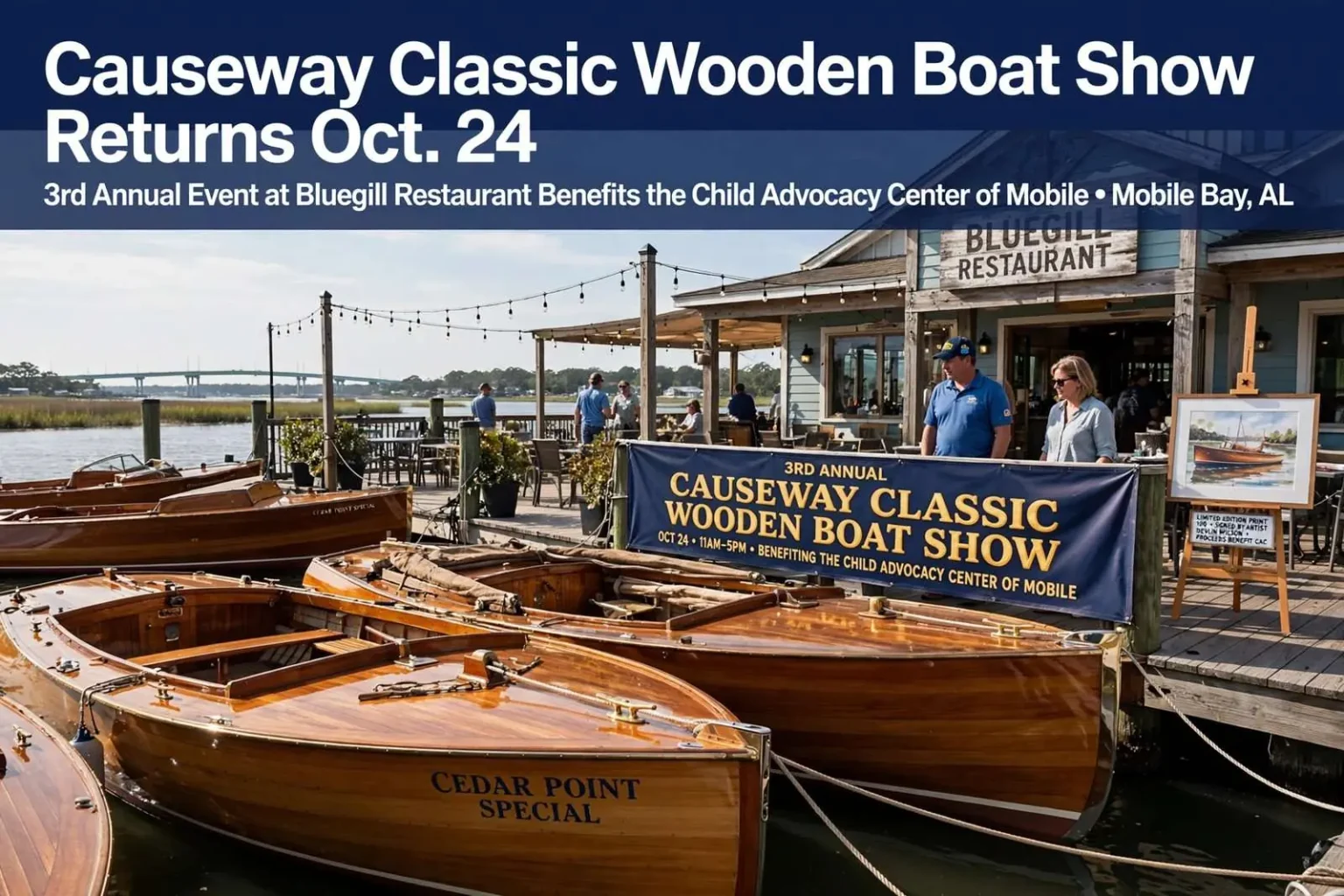
MOBILE, Ala. — The 3rd Annual Causeway Classic Wooden Boat Show returns to Mobile Bay on Oct. 24 from 11 a.m. to 5 p.m.
Benefiting the Child Advocacy Center of Mobile, the show will be held at Bluegill Restaurant on Battleship Parkway and will feature classic wooden boats.
Growing Each Year
Chan Flowers, the event organizer, said the show has expanded steadily.
“It keeps growing exponentially. Last year’s event drew even more boats than the year before, and we raised a little over $16,000 for [CAC],” Flowers said.
“In addition to all the great boats and folks, it’s a fun venue. We’ll be selling short-sleeve, long-sleeve and dry-fit shirts, as well as hats. Artist Devlin Wilson will be signing 100 limited edition numbered prints of his original painting, and, of course, all proceeds will go to [CAC].”
What the Child Advocacy Center Does
Child advocacy centers coordinate the response to child abuse investigations, bringing law enforcement, prosecutors, medical providers, mental health professionals and child welfare workers together in a single child-friendly facility.
The model exists to solve a specific problem. Before child advocacy centers, a child reporting abuse might be interviewed separately by a police officer, a detective, a caseworker, a prosecutor and a physician — repeating the account each time, in institutional settings, to strangers. That process was traumatic for the child and produced inconsistent testimony that weakened cases.
A child advocacy center conducts a single forensic interview, recorded and conducted by a trained specialist, which all participating agencies observe and use. The child tells the account once.
The $16,000 raised last year funds work of that kind in Mobile County.
Why Wooden Boats
Classic wooden boat shows occupy a particular niche in the boating world. Wooden hulls require continuous maintenance that fiberglass does not — caulking, refastening, varnish work, and vigilance about rot — and the people who keep them running generally do the work themselves over years.
A show is where that work becomes visible. Owners bring vessels that represent hundreds of hours of restoration, and the conversations on the dock are the point as much as the boats are.
Mobile Bay and the Causeway are a fitting setting. The area has a long working and recreational boating history, and Battleship Parkway runs directly along the water.
The Limited Edition Prints
Artist Devlin Wilson will sign 100 limited edition numbered prints of an original painting, with proceeds going to the Child Advocacy Center.
Numbered limited runs are a common and effective fundraising device at events of this kind. A print in an edition of 100 carries scarcity that an open-edition reproduction does not, and signing on site turns the purchase into part of attending.
If You Go
- What: 3rd Annual Causeway Classic Wooden Boat Show
- When: Saturday, Oct. 24, 11 a.m. to 5 p.m.
- Where: Bluegill Restaurant, Battleship Parkway
- Admission: $10 at the door
- Benefiting: Child Advocacy Center of Mobile
Wooden boat owners interested in entering the show may contact Flowers at 251-533-3486.
The Boats That Built the Causeway: A Stauter Primer
Most of the wooden hulls on display at the Causeway Classic trace back to one name: Stauter. Lawrence Stauter founded Stauter Boat Works on the Causeway itself, just down the road from the Bluegill, and began building in 1947 while fishing for a living on Mobile Bay. In those days a 12-foot Stauter sold for $97 and a 14-footer for $119 — as Lawrence put it in an interview preserved in the documentary “The Last of the Wooden Boats,” bad weather meant boat-building days: “I got a construction job, but decided I’d rather build boats. So I quit, and opened my boat work business.” His sons still own the rights, though no new boats have been produced since COVID; a Stauter-Built Boats online store sells related merchandise, which will be available at the show.
Among the models collectors prize most is the 16-foot Cedar Point Special, named for the mainland’s last landmark before the Dauphin Island bridge existed — a fishing machine that pulled ski ropes, zip sleds and 16-foot trawl nets for generations of Bay families. Many Stauters in circulation today are family heirlooms kept in lifts from Point Clear to Dog River, and owners still teach their kids to ski behind them.
Keeping those boats connected is the job of the Stauter-Built Society, a Facebook community group of current and former owners — unaffiliated with the old company — where members reminisce, post boats for sale and trade restoration tips. Mobilian Matthew Moore, who grew up around Stauters on Hollinger’s Island, has spent recent years buying and restoring them to mint condition and owns three. “Stauters were so common back in the day. You’d see them all over, in people’s yards, or under an oak tree,” he says. “They are harder to come by now. I have fiberglass boats, too, but there’s nothing like a Stauter.” Show-goers who want to see one up close — or ask a restorer how it’s done — will find plenty of both on the Bluegill’s dock on October 24.
Related coverage from South AL News
- Causeway Classic Wooden Boat Show returns Saturday to benefit Child Advocacy Center
- Six Decades on the Causeway: The Bluegill Keeps Mobile Bay's Seafood Tradition Rolling
- Baldwin County Child Advocacy Gala Set for Nov. 7 in Orange Beach
- Mahogany, Cypress and a Fading Craft: Bayou La Batre's Last Wooden Boat Builders