Century to Get Expanded Health Clinics After $8.7 Million Rural Health Grant
Community Health Northwest Florida is expanding clinics in Century after securing an $8.7 million rural health grant, including a new specialty women's clinic.
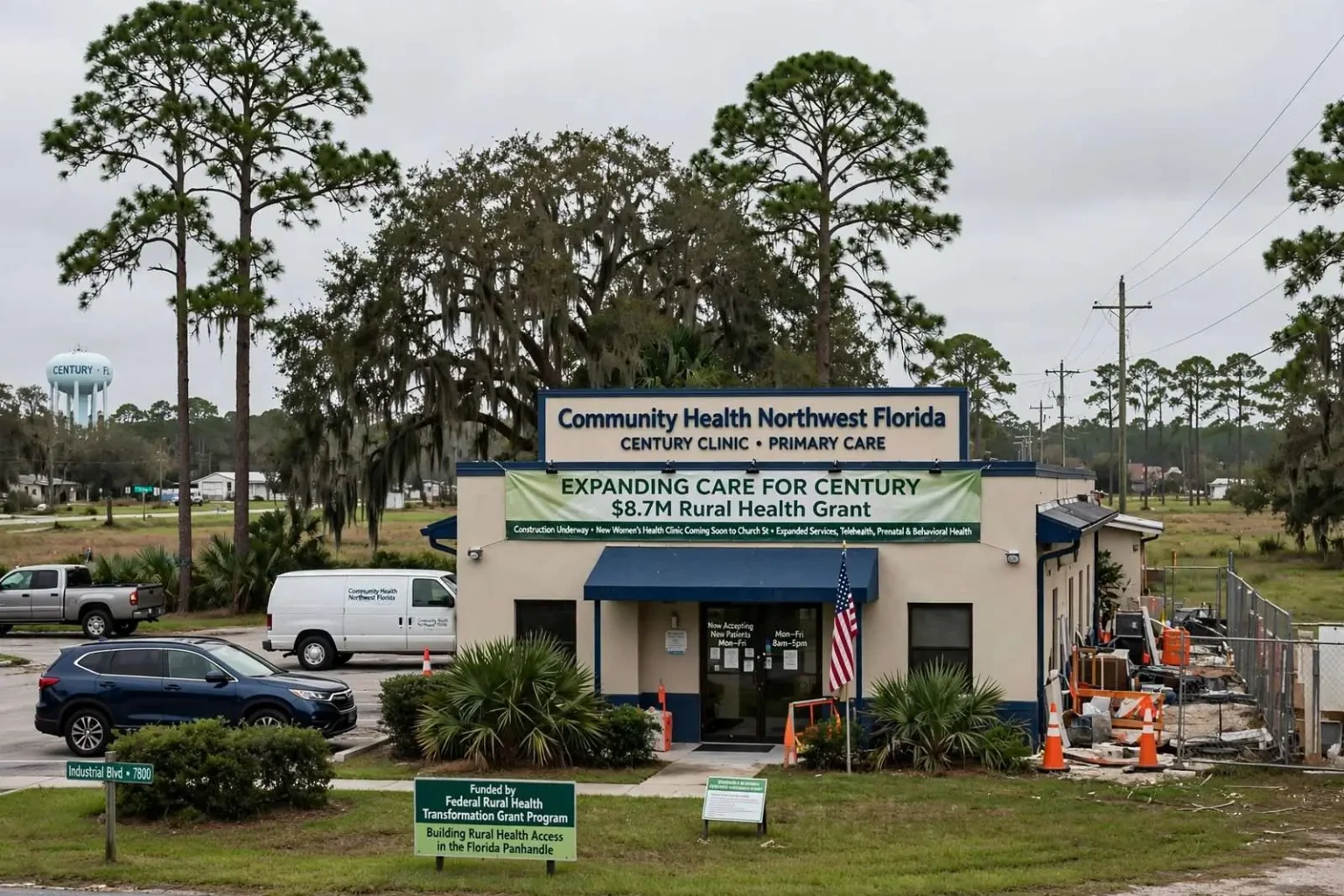
CENTURY, Fla. — Century is set to see expanded health care options in the coming months after Community Health Northwest Florida secured an $8.7 million grant to fill gaps in rural health care in the town, where options have been limited since its hospital closed in 2016. The money is aimed squarely at a community that has spent nearly a decade as a medical desert, where residents drive long distances for routine appointments that residents of Pensacola or Milton can reach in minutes.
The funding comes through the federal Rural Health Transformation Grant Program, with award amounts announced this week. The program represents one of the largest federal investments in rural health infrastructure in recent years, designed to shore up access in communities where hospital closures, provider shortages and long driving distances have compounded each other. Century, tucked into the far northern reaches of Santa Rosa County along the Alabama line, fits that profile precisely: a small town with an aging population, limited public transportation and a health care footprint that shrank dramatically when its hospital closed.
Community Health Northwest Florida helped secure nearly $42 million in federal grant money for the Florida Panhandle and will oversee $41.5 million in regional funding spread across 15 partner organizations over the next five years. The scale of the regional award makes the organization the linchpin of one of the largest rural health investments the Panhandle has received, with the $8.7 million earmarked for Century forming its most concentrated single-community component.
Chandra Smiley, CEO of Community Health Northwest Florida, said the organization is working “in partnership with North Florida Health Council for the four counties, Escambia, Santa Rosa, Okaloosa and Walton,” adding, “Over the next five years we have a little over 41 million coming into the area.” The North Florida Health Council brings regional planning and rural health expertise to the partnership, and the four-county span covers the western Panhandle from the Alabama line to the beaches and communities of Walton County, taking in both dense suburban growth corridors and some of the most isolated corners of the state.
What the money will do in Century
Smiley said the funding will specifically be used to expand access points in Century and the surrounding rural parts of the community. The town and its surrounding service area, which includes communities stretching up the US 29 corridor toward the Alabama state line, have depended on a thin network of clinics since the hospital closure, with residents often traveling 30 minutes or more for primary care and far longer for specialty services.
Community Health Northwest Florida currently shares a primary care office in Century with Lakeview, a partnership that has kept some level of medical service in the town since the hospital era ended. Arrington said the grant will strengthen services at that existing clinic on Industrial Boulevard, giving the town’s main medical facility the capacity, equipment and staffing to operate closer to what patients in more populous parts of the county expect.
“We’re going to be reinforcing the clinic on Industrial Boulevard that’s up in Century right now,” he said, “so really making sure that the capabilities and resources that are up there are truly on par with somebody who may be coming to a clinic down here in the south end of the county.” That parity principle is the heart of the grant’s promise: a patient in Century should not receive a lower tier of care, wait longer for appointments or drive farther for the same services simply because of where they live.
A new women’s clinic on Church Street
About a mile away on Church Street, the organization also plans to open a specialty women’s clinic to address what Arrington described as a lack of women’s care in the northern part of the county. Women in rural communities routinely face the longest drives for obstetric and gynecological services, and the absence of local prenatal care has been linked to worse outcomes for mothers and infants. For expectant mothers in Century and nearby communities, the difference between a clinic five minutes from home and one 40 minutes away can determine whether prenatal visits happen on schedule or not at all.
He said the space could include women’s health and prenatal care, potentially behavioral health and therapy services, case management, and room for community partners to host classes and support events. The blend is deliberate: integrating mental health services, care coordination and community programming under one roof reflects how rural health planners increasingly view a clinic, not as a single-purpose medical office but as a hub that meets several needs at once and reduces the number of separate trips a patient must make.
“It’s kind of a universal space,” he said. That flexibility matters for a town the size of Century, where a dedicated building for each service line is neither practical nor affordable. A universal space can adapt as needs become clearer over the five-year life of the grant, hosting everything from prenatal checkups to health education classes led by partner organizations.
Technology, communication and the regional picture
The grant funding will also go toward improving physician and patient communication and expanding telehealth options, including electronic medical record sharing so providers across different clinics and systems can access a fuller picture of a patient’s care. For rural patients, telehealth has emerged as one of the most consequential tools of the past several years, allowing follow-up visits, specialist consultations and behavioral health sessions to happen without a long drive, provided the clinic infrastructure and connectivity exist to support them.
Record sharing addresses a quieter but equally persistent rural health problem: fragmentation. A patient in a small town may see a primary care provider at one clinic, a specialist in Pensacola and a counselor somewhere else, with none of the three able to see the full chart. Regional record sharing under the grant is intended to close those gaps so that a provider in Century knows what a hospital in Pensacola found and prescribed, reducing duplicated tests and dangerous medication conflicts.
The $8.7 million Century award sits within a much larger regional strategy. With 15 partner organizations across Escambia, Santa Rosa, Okaloosa and Walton counties receiving support over five years, the program aims to lift the whole rural health ecosystem of the western Panhandle — clinics, transportation networks, workforce pipelines and technology — rather than patching one community at a time. The Century investment is simply its most visible early test: if the model of reinforcing an existing clinic and adding a multi-purpose women’s health hub works there, it offers a template for other small towns in the region that lost their hospitals and have been waiting for a way back.
The long shadow of a hospital closure
When Century’s hospital closed in 2016, the town lost more than an emergency room. Hospitals in small towns function as economic anchors and access points all at once: they attract physicians who set up nearby practices, they host visiting specialists, they provide local jobs, and their laboratories and imaging suites catch conditions before they become emergencies. The years since the closure have been typical of what rural health researchers observe nationwide, with residents delaying care, relying on emergency services in distant towns and managing chronic conditions with fewer touchpoints to the medical system.
Community Health Northwest Florida emerged as one of the organizations working to fill that void. The organization operates community clinics across the Pensacola area and Northwest Florida, serving patients regardless of their ability to pay, and its expansion into Century extended that mission into the county’s most underserved corner. The shared primary care office with Lakeview gave the town a foothold of consistent care, and the new grant builds directly on that foundation rather than starting from scratch.
Construction timeline and what residents should watch for
Arrington said he expects construction and rehabilitation work on the buildings to take 90 to 120 days. That relatively short timeline means the physical changes — the reinforced clinic on Industrial Boulevard and the new women’s clinic space on Church Street — could be in service within months rather than years, a pace that stands out in a grant landscape where infrastructure projects often spend years in planning before a shovel moves.
For residents of Century and the surrounding rural stretches of northern Santa Rosa County, the practical changes to watch for are additions of services and staff at the existing Industrial Boulevard clinic, the opening of the Church Street women’s health location, and expanded telehealth options that reduce the need to travel for routine follow-ups. Case management and community classes hosted in the new space will also create new points of contact for families who have not engaged with the health system in years.
The announcement marks a turning point in a story that has hung over Century for nearly a decade. Rural health funding comes in many forms, but investments of this size aimed at a single small town are rare, and the combination of federal money, a regional health organization with local presence, and an existing clinic to build on gives the effort better odds than a ground-up initiative would have. Five years from now, the measure of success will be simple: whether a resident of Century can get primary care, women’s health services and behavioral health support without leaving town, and whether the town’s health infrastructure is once again growing instead of shrinking.