

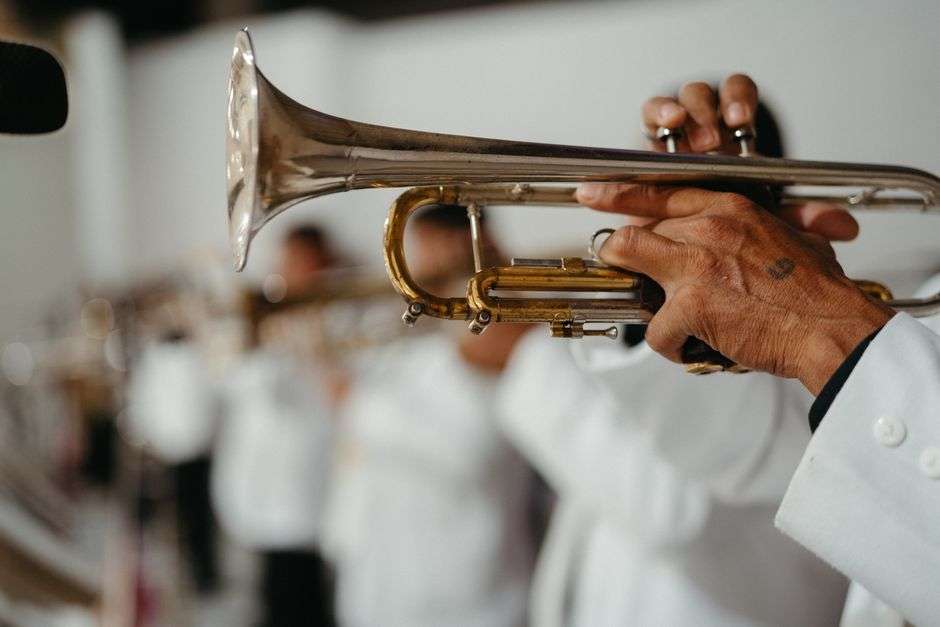
Chip Herrington arrived at a recent interview at the Bluegill restaurant the way he arrives at most places — on his motorcycle, in a coat and tie, straight from an arraignment. An attorney by day and a trumpet player by calling, Herrington leads the Mobile Big Band Society, an 18-piece ensemble that has spent more than fifteen years proving that the Great American Songbook still packs a room on the Gulf Coast.
An orchestra with a mission
The Mobile Big Band Society, founded in 2009 as the vision of attorney and pianist Ralph Holberg, is a 501(c)(3) dedicated to performing and preserving the music of the Big Band era. Herrington joined as a trumpet player and helped build the band to its full big-band complement: five saxophones, four trumpets, four trombones, piano, bass, drums, and two vocalists. The book runs from the 1930s through the 1960s — Glenn Miller, Count Basie, Duke Ellington, Woody Herman, Henry Mancini.
Herrington, who selects every member and manages bookings, applies a simple bar: every musician must be at least as good as he is. “I’m not tooting my own horn,” he says, “but we have the best band assemblage of musicians around.” He also insists the players be paid well — a policy that keeps the region’s best section players coming back.
The Bluegill residency
The band’s anchor venue is the Bluegill on the Mobile Bay Causeway, where early supporter David Cooper of Cooper Restaurants provided seed money for equipment and sheet music and a home stage. The Big Band Society has played the Bluegill on the third Tuesday of every month, March through October, for sixteen years, drawing standing-room crowds to the waterfront deck. Regulars know the drill: arrive three hours early for a table, and expect to dance even if you stand. The band’s web calendar lists the season’s dates, and the series has become a summer fixture of the Mobile arts scene.
Beyond the Causeway, the band plays two or three gigs a month, appearing with music series in Mobile, Daphne, and Fairhope, including concerts at Live at Five’s Halstead Amphitheater. Herrington also fronts the five-piece Chip Herrington Jazz 5, which performs at the People’s Room of Mobile during the city’s Art Walk on second Fridays.
Two music educators’ son
Herrington’s musical pedigree is literal. Born in Columbia, Mississippi, to two music educators — his father a trombonist and high school band director, his mother an opera singer, choral director, and piano teacher — he found a cornet in the attic in second grade and taught himself a C scale from a beginner band book. School band carried him through twelfth grade and into the Pride of Mississippi Marching Band at Southern Miss.
Mobile entered the picture in 1987, when he took a job as assistant band director at Vigor High School. Teaching was not his calling; law was. He entered Ole Miss Law School from 1988 to 1990, but not before Mobile bandleader Bob Schultz hired him to play lead trumpet — a connection that mattered twice, because fellow musician and attorney Bill Steele later helped him land his first job with the Mobile District Attorney’s office in 1991. Back in Mobile and back in the Schultz band, he joined the musicians’ union, AFM Local 407, which opened the door to the era’s biggest stages: national acts passing through town hired union players, and Herrington found himself performing with Lou Rawls, Aretha Franklin, The Temptations, The Four Tops, and The O’Jays.
In 1993 he co-founded the Hurricane Horns horn section with saxophonists Kent and Michelle Karcher, working bands from New Orleans to Atlanta to Memphis — and forging a lasting association with Mobile’s own Wet Willie that continues today.
Why the Songbook endures
The band’s audience spans generations: older fans who remember the original recordings, younger listeners discovering the harmonies and romantic lyrics of Miller and Ellington, and ballroom dancers who show up for the foxtrot tempos. What keeps it working, Herrington says, is simple — the music is great, the band is paid, and the room is full. On the third Tuesday of the month from March through October, the Causeway swings like it’s 1945, and an alligator named Pickle, the band swears, floats over to listen beneath the trumpets.