Citronelle Man Draws 10-Year Prison Term in Washington County Child Solicitation Case
A 27-year-old Citronelle man will serve 10 years in state prison and register as a sex offender after a Washington County jury convicted him of soliciting an undercover officer posing as a 12-year-old child.
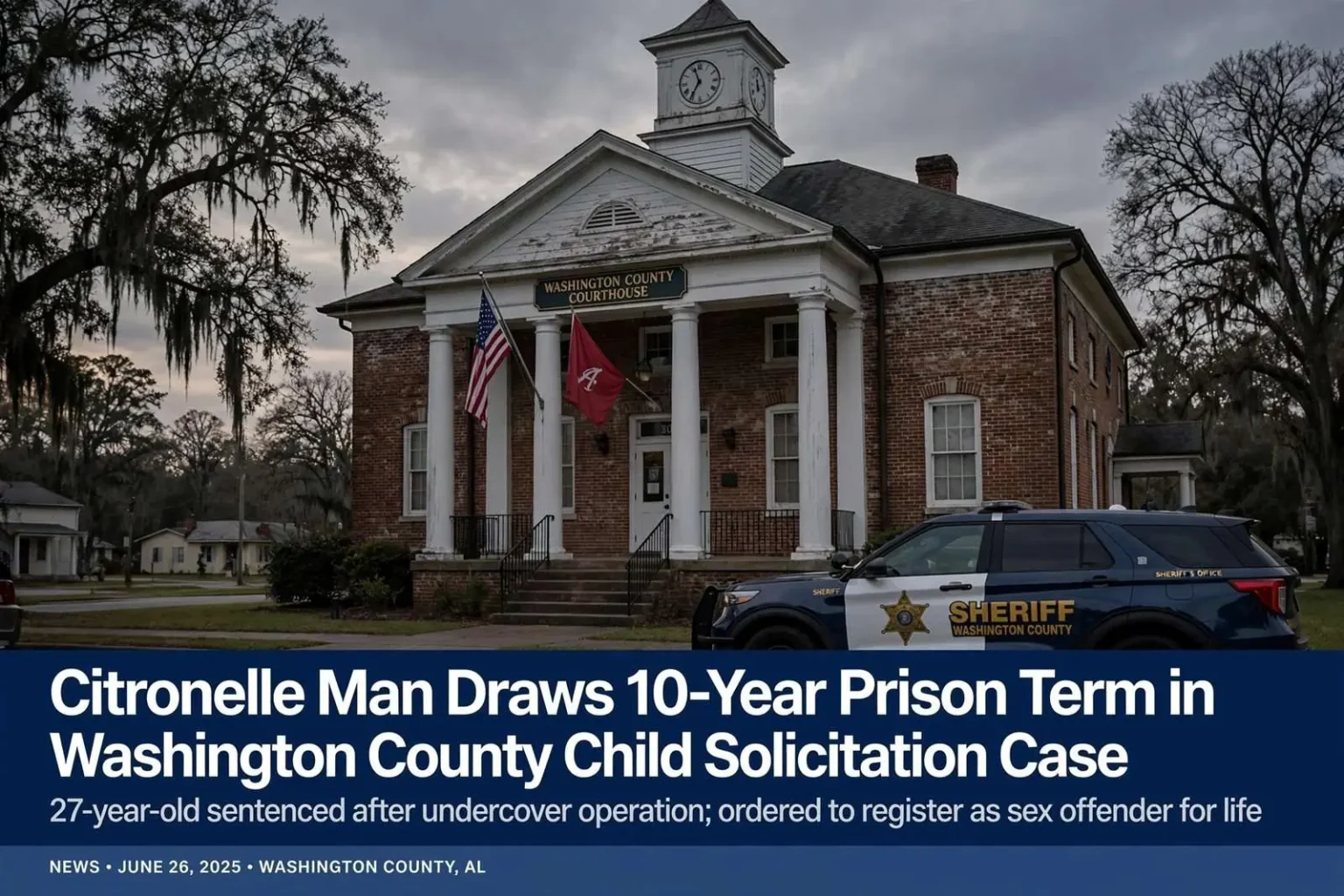
A 27-year-old Citronelle man has been sentenced to a decade in state prison after a Washington County jury found him guilty of soliciting someone he believed to be a 12-year-old child, closing out a case that began with an undercover operation run by one of the smallest police departments in South Alabama.
Charleston Bernard White was convicted in May on two felony counts: traveling to meet a child for an unlawful sex act, and electronic solicitation of a child. On June 26, Washington County Circuit Judge J. Perry Newton handed down two 10-year sentences to be served concurrently, meaning White will serve a single 10-year term rather than 20. He must also register as a sex offender in Alabama, a requirement that will follow him for the rest of his life.
How the Case Began
The convictions grew out of a 2025 investigation by the McIntosh Police Department, the municipal force serving the small Washington County town along U.S. Highway 43. Investigators created an undercover Facebook profile presenting an officer as a 12-year-old child. According to court records, White believed he was communicating with a juvenile throughout the exchange.
Authorities said the conversations stretched from March through July of 2025 and escalated over that period. Prosecutors told the court the messages included requests for illicit sexual images and explicit discussion of meeting in person for sexual activity.
The case moved from online conversation to physical act on July 14, 2025, when investigators said White drove to McIntosh with the intent of meeting the person he believed to be a child. That trip is what elevated the case from solicitation alone to the separate and more serious charge of traveling to meet a child for an unlawful sex act. A Washington County grand jury returned an indictment during its fall 2025 term.
What the Charges Mean Under Alabama Law
Alabama treats these two offenses as distinct crimes with distinct elements, which is why a single course of conduct produced two convictions:
- Electronic solicitation of a child covers the use of a computer, phone or other electronic device to entice, induce or lure a child into sexual conduct. Critically, Alabama law does not require that an actual child be involved. It is enough that the accused believed he was communicating with a minor, which is what makes undercover operations of this kind viable.
- Traveling to meet a child for an unlawful sex act requires the additional step of physically moving toward a meeting. The travel itself is the criminal act, and it is charged as a Class A felony, one of the most serious categories in the state code.
Electronic solicitation of a child is a Class B felony, which carries a range of two to 20 years in prison. A Class A felony such as the traveling charge carries a range of 10 to 99 years or life. Judge Newton's 10-year concurrent sentences fall within both ranges.
What Happens Next
Following his conviction in May, White was held in the custody of the Washington County Sheriff’s Office pending sentencing. He was not granted bond during that interval, meaning he has been continuously incarcerated since the verdict.
Judge Newton granted White’s request to pursue an appeal as an indigent defendant, a finding that he lacks the financial means to hire private counsel. The court appointed attorney Katherine Parten to handle the appeal. An indigent appeal proceeds through the Alabama Court of Criminal Appeals, with the state covering the cost of appointed representation and the trial transcript.
Sex offender registration in Alabama carries substantial and lasting consequences beyond the prison term itself. Registrants face residency and employment restrictions, periodic in-person verification requirements with local law enforcement, and public listing in the state’s searchable database maintained by the Alabama Law Enforcement Agency.
How to Report Suspected Exploitation
Reports of suspected online exploitation can be made to any local police department or sheriff’s office, or through the National Center for Missing and Exploited Children’s CyberTipline. The CyberTipline accepts reports online at report.cybertip.org or by phone at 1-800-843-5678.