Citronelle Mobile Home Destroyed in Early-Morning Fire on Woodland Drive
A mobile home on Woodland Drive in Citronelle was destroyed by an early-morning fire; crews from two departments responded with no injuries.
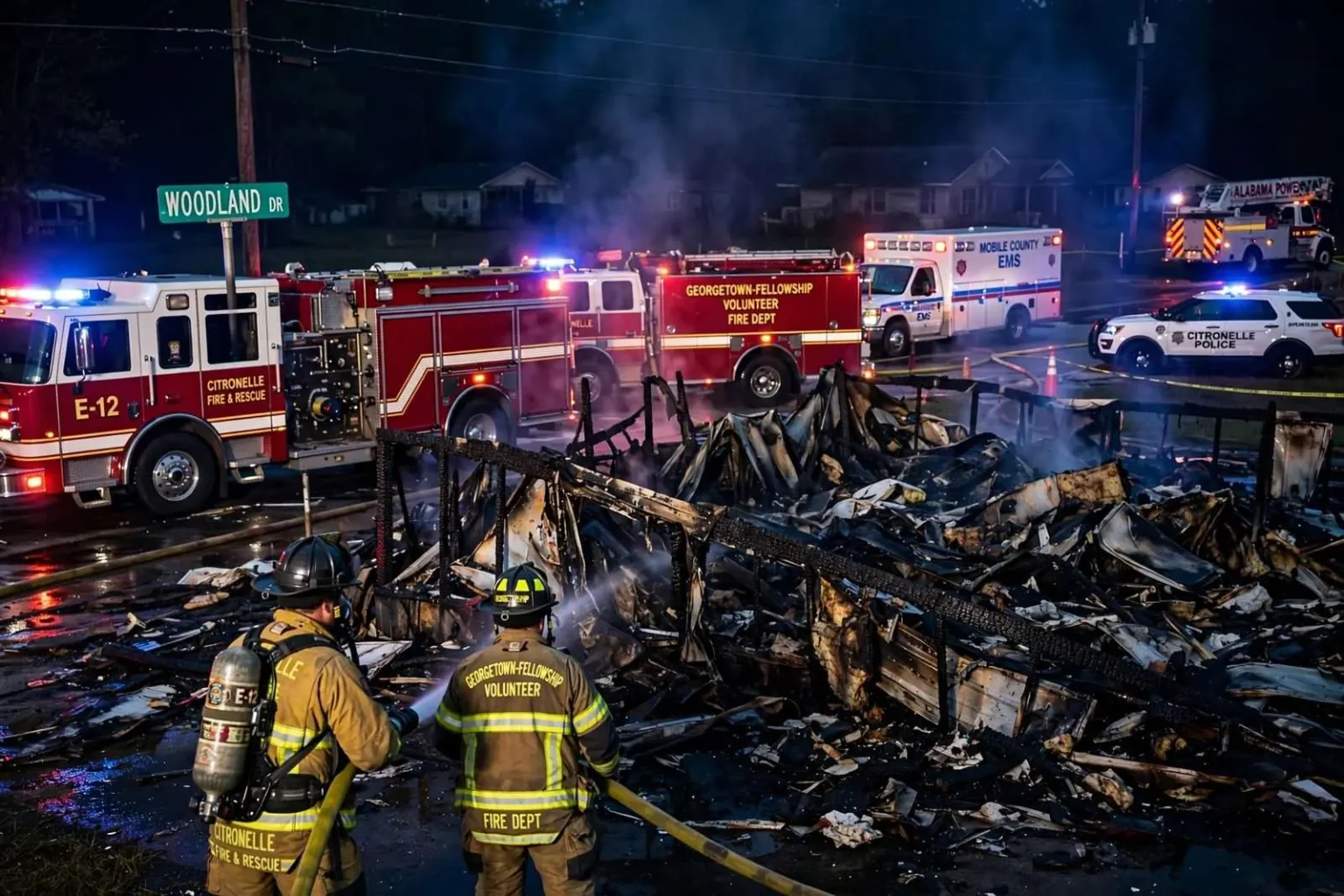
CITRONELLE — A mobile home in Citronelle was destroyed by fire early Thursday morning, though no one was injured in the blaze, according to Citronelle Fire & Rescue.
Crews were dispatched to Woodland Drive at around 2 a.m. and arrived to find the mobile home fully engulfed in flames. The intensity of the fire left no option for an interior attack, so firefighters fought the blaze defensively from outside the structure, protecting nearby exposures while the fire consumed the home.
Fire officials said the home was a total loss. The cause of the fire was not released, and officials reported no injuries to residents or firefighters. It was not immediately clear how many people lived in the home or whether anyone was displaced, but the timing of the blaze — in the hours before dawn — underscores how quickly such fires can turn catastrophic while residents are asleep.
With manpower stretched thin in the middle of the night, Citronelle Fire & Rescue called on the Georgetown-Fellowship Volunteer Fire Department for assistance. Mutual aid among volunteer departments is standard practice across rural Mobile County, where individual departments field limited crews at any given hour and rely on neighboring agencies for extra hands, water supply and apparatus at working fires.
A wide response in the middle of the night
Along with the two fire departments, several other agencies played supporting roles in the response. Mobile County EMS stood by at the scene, as crews do at working structure fires, ready to evaluate and treat anyone affected — residents escaping the home, bystanders, or firefighters suffering from heat and exhaustion. County dispatchers coordinated the response, routing the initial 911 call, alerting the responding agencies and keeping resources moving as conditions changed.
Alabama Power also responded or was notified, as utilities routinely are at structure fires. Crews disconnect electrical service to a burning building to eliminate the danger of energized lines to firefighters and prevent additional ignitions, a step that becomes essential when a fire is being fought defensively around a structure. The Citronelle Police Department assisted as well, helping with scene security, traffic control on Woodland Drive and logistics while firefighters worked.
Defensive firefighting — attacking a blaze from outside rather than entering the structure — is the response of necessity when a fire has already taken the building. Firefighters position engines and lines around the structure, pour water onto the burning mass and keep the flames from spreading to adjacent homes, vehicles and brush. The tactic prioritizes lives over property that is already lost, and it is a common call at mobile home fires, where lightweight construction and the materials in manufactured housing can allow fire to spread through a unit in minutes.
Mobile homes present distinct risks compared with site-built houses. Their construction and layout can accelerate fire spread, and older units may not carry the same built-in fire resistance as newer manufactured homes, which are built to federal standards updated over the decades. Fires at night compound every danger, because occupants may be asleep when smoke begins to fill the home, and smoke alarms are often the only warning they get.
Citronelle sits in the far northern reaches of Mobile County, a small city surrounded by rural communities where volunteer fire departments carry the bulk of the firefighting load. Departments in the region operate with paid-on-call and volunteer members, funded in part by county fire fees and staffed around the clock by members who leave their homes and jobs to respond. A 2 a.m. working fire tests those resources directly, which is why mutual aid agreements tying the county’s departments together are exercised routinely.
Investigating the cause
As is standard after a total-loss fire, the cause had not been released while officials continued their review. Fire origin-and-cause investigations examine where the fire started and what fueled it, looking at electrical systems, heating equipment, cooking appliances and other potential sources. In a structure destroyed by flames, the work of determining a cause can take days or longer, and investigators coordinate with insurance companies, which have a strong interest in the findings.
Investigators also look at whether the home had working smoke alarms, a factor that regularly decides whether residents escape a night fire unharmed. Fire officials across Alabama repeatedly urge residents to test alarms monthly and replace batteries at least once a year, and many rural departments distribute free alarms through community programs. In mobile homes, officials recommend alarms inside each sleeping area and in the hallway outside, plus a planned escape route that every member of the household knows.
The absence of injuries in Thursday’s blaze is the outcome firefighters value most. A total loss of property is a hardship for any family — often the loss of everything from clothing to documents to vehicles parked nearby — but it is one residents can recover from when everyone gets out safely. That is the distinction fire crews in small communities like Citronelle measure their work by.
Woodland Drive is a residential street in Citronelle, in the part of the city where mobile homes and site-built houses sit side by side on quiet blocks. Neighbors woke to the flash of emergency lights and the work of crews through the early morning hours, the kind of scene that reminds small communities how much they depend on their volunteer firefighters.
What comes next for the family
For the home’s residents, the days after a fire are consumed with immediate needs — housing, clothing, food and replacing identification and medications. The American Red Cross of Alabama and the Gulf Coast routinely responds to house fires across the region, providing emergency lodging and assistance to displaced families, and churches and neighbors in communities like Citronelle frequently organize donations when a family loses everything.
Insurance will drive much of what follows, depending on the coverage carried on the home. For renters or owners without coverage, recovery is far harder, a reality that fire officials cite when urging residents to review their policies and keep records of their belongings.
The fire remains under review, and officials have not said when or whether the cause will be made public. Citronelle Fire & Rescue thanked the assisting agencies in the aftermath of the blaze — the Georgetown-Fellowship Volunteer Fire Department, Mobile County EMS, county dispatchers, Alabama Power and the Citronelle Police Department — whose combined work brought a dangerous middle-of-the-night fire to an end with no one hurt.
For now, a family in Citronelle is rebuilding from nothing, and a neighborhood is reminded once again of the value of smoke alarms, escape plans and the volunteer crews who answer the tone at 2 a.m.
Working fires in rural Mobile County also strain water supply, a factor that shapes how they are fought. Outside the reach of municipal hydrants, tanker shuttles move water from fill sites to the fireground, and every additional set of hands matters in keeping the shuttle running. That logistics reality is another reason small departments call for mutual aid early rather than late, and Thursday night’s response followed that pattern.
The call-out also illustrates the hidden network that supports a single fire scene. Dispatchers assign units, track the scene and coordinate radio traffic; EMS stands by for the exhaustion and minor injuries that come with firefighting; police keep onlookers and traffic out of the way; utility crews make the structure safe. When the tone sounds at 2 a.m., all of those pieces move together, drawn from agencies whose day jobs and families are otherwise asleep.
Fire officials use incidents like this one to renew familiar safety messages for the community. Space heaters, extension cords, overloaded outlets and aging wiring are among the leading causes of home fires in winter and during cold snaps along the Gulf Coast, when heating demand spikes in homes built before modern electrical loads were imagined. Cooking left unattended remains the most common fire cause overall nationwide. Officials urge residents to keep a working alarm on every level of the home, to close bedroom doors while sleeping, and to practice a two-way escape plan so that no one is searching for a way out in the dark.
For the Woodland Drive neighborhood, the coming days will bring cleanup: the remains of the mobile home will be cleared, the lot graded and the utility connections capped. But the community’s attention will stay with the family that lived there, who now face the long process of replacing what a few minutes of fire took and starting again in the place they have called home.
The response on Woodland Drive also reflects the reality of firefighting across Alabama’s smaller communities, where the number of available volunteers has declined steadily over the years even as call volumes have risen. Departments recruit continuously, and officials say the need for new members — from firefighters to drivers to support roles — has never been greater. For residents moved by what happened Thursday, volunteering with a local department is the most direct way to make sure the next 2 a.m. call is answered just as quickly.