Citronelle police arrest attempted murder suspect who returned to shooting scene
Citronelle police charged 29-year-old Russell Lamar Robinson with attempted murder after he returned to the Gay Lane home where a man was shot.
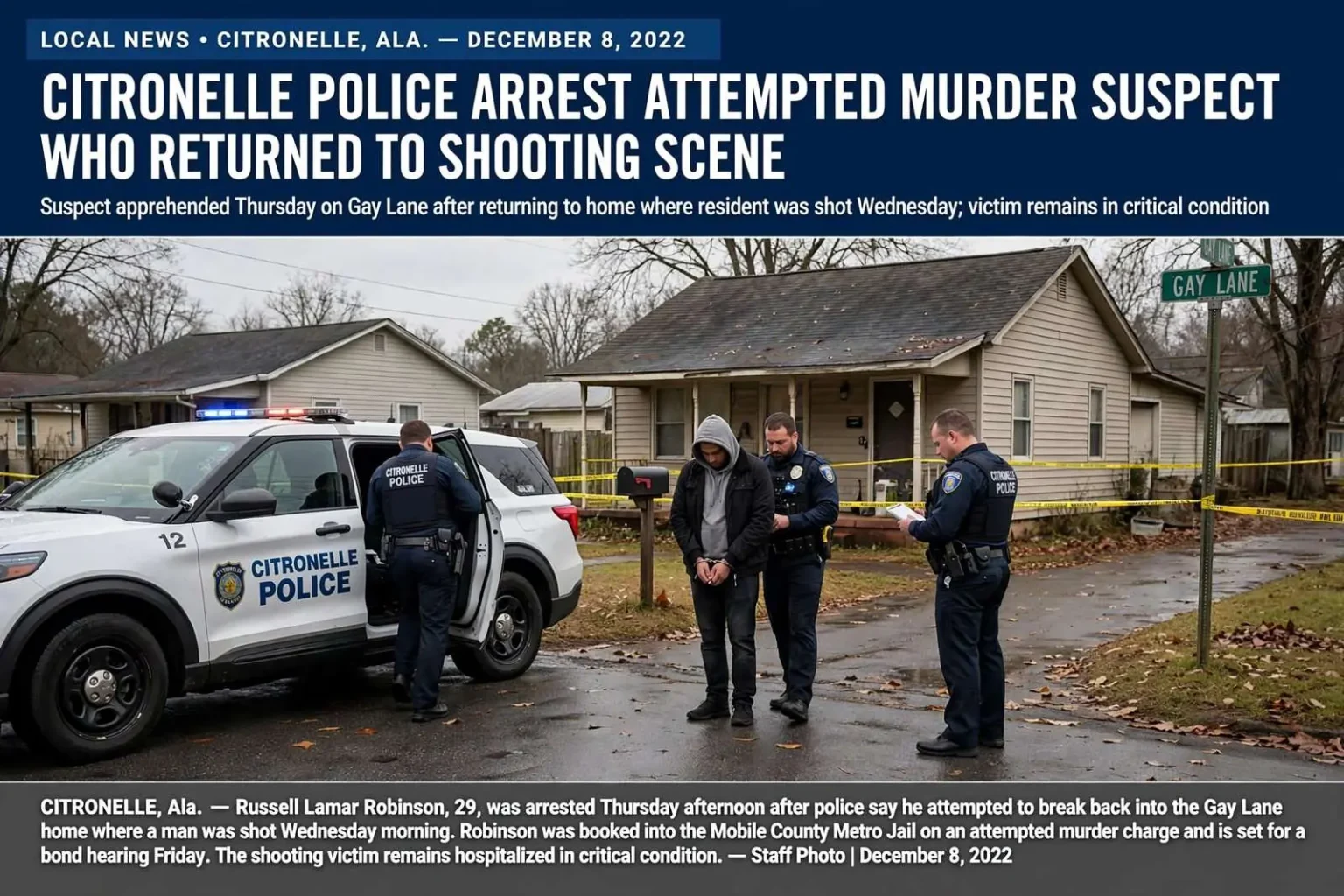
CITRONELLE, Ala. — Citronelle police have arrested a 29-year-old man in connection with a shooting that left one resident in critical condition, and authorities said the suspect was caught trying to force his way back into the home where the shooting happened. The arrest capped roughly 29 frantic hours for the small north Mobile County police department, which had been working the shooting since the previous morning.
According to the Citronelle Police Department, Russell Lamar Robinson was taken into custody Thursday afternoon, December 8, and charged with attempted murder. He was transported to the Mobile County Metro Jail, the region’s central booking facility, where he joined the jail’s population ahead of a court appearance set out on the jail log the following day.
How the case unfolded
Investigators said the trouble began the morning before, when a man was shot once in the chest at a home on Gay Lane at around 10:40 a.m. Wednesday, December 7. The wounded man was flown by helicopter to a local hospital, where he was listed in critical condition — an airlift decision that reflects both the gravity of a chest wound and the distance between Citronelle and the trauma centers along the Mobile Bay coast.
Police said a caller flagged them down at roughly 3:10 p.m. Thursday, reporting that Robinson was attempting to break into the same Gay Lane residence where the shooting had occurred. The report transformed the investigation in an instant: a suspect who had been the object of a day-long search was, according to the caller, standing outside the victim’s home again, trying to force his way in.
When officers arrived, Robinson tried to run but was captured without incident, and no one else was hurt, according to the department. The brief foot chase ended the search quietly, a resolution that officers and neighbors alike considered fortunate given the violence that had started it — a shooting, a critical injury and now an attempted return to the scene.
Trying to get back into the scene of a shooting is the detail investigators find hardest to ignore. It suggests a determination to return to the location regardless of the risk, and it hands prosecutors a vivid piece of the narrative: the man charged with the shooting, allegedly back at the door of the wounded man’s home while the victim fought for his life in a hospital bed.
A booking, a jail log and a bond hearing
After the arrest, Robinson was booked into the Mobile County Metro Jail on the attempted murder charge. A jail log entry indicated he was scheduled to appear in court Friday, December 9, for a bond hearing — a fast turnaround that is typical when the alleged offense is violent, since judges want bond conditions set quickly while the facts are fresh and the risk can be assessed.
At a bond hearing, the questions are narrow but consequential: whether the accused should be released before trial, at what amount, and under what conditions. In an attempted murder case involving a shooting victim still in critical condition, prosecutors typically argue for a substantial bond, and the judge weighs the seriousness of the charge against ties to the community and the risk of another encounter with the victim.
For the family of the wounded man, the hearing marked the first formal milestone in what will be a long process — from the hospital room where he remained listed in critical condition, through the courtrooms where the charge will be litigated, to whatever resolution the case eventually reaches.
Citronelle and its police department
Citronelle sits in the far northern reaches of Mobile County and is one of the county’s largest communities outside the city of Mobile itself. It is a small town by any urban measure — a place with a compact downtown, churches and schools that anchor civic life, and a police department sized for a community where everyone knows the roads and most know each other.
Departments that size handle everything from traffic stops to major felonies with the same handful of officers, and they lean on mutual aid from the Mobile County Sheriff’s Office and neighboring agencies when a case outstrips their resources. A shooting investigation with an airlifted victim and a suspect at large for a day qualifies as exactly that kind of case.
The town’s distance from the city works in both directions. Response times are shaped by geography, and the helicopter flight to the hospital covered in minutes what an ambulance would need much longer to drive. But the same smallness means information travels fast, and a caller flagging down an officer on the second afternoon — rather than waiting for a 911 dispatch cycle — is the sort of detail that reflects how closely residents watch their own streets.
Investigators continued to work the case after the arrest, a process that includes canvasing the Gay Lane neighborhood, collecting evidence from the home and the surrounding property, and assembling the file that will support the attempted murder charge as it moves toward indictment. Detectives would say little publicly beyond the department’s account of the arrest, consistent with the way active cases are handled.
The charge and what it carries
Attempted murder is among the most serious charges in Alabama’s criminal code, reserved for cases in which prosecutors believe a defendant took a substantial step toward killing someone. A conviction can bring decades in prison, and the charge itself shapes every stage of the case that follows — from the bond amount set at the first hearing to the resources prosecutors commit to the file.
The condition of the victim will matter throughout. Authorities said only that he was in critical condition after the flight to the hospital, and updates on his status were expected to come sparingly as medical teams worked. Should his condition change, the legal posture of the case could change with it, which is why prosecutors in shooting cases watch the medical record as closely as the police file.
Robinson, for his part, remains presumed innocent until the state proves otherwise, and the case now moves through the machinery that follows every felony arrest: the bond hearing set for Friday, review by a grand jury down the road, and the pretrial process that follows if the charge is sustained by an indictment.
For the Gay Lane neighborhood, the arrest ended the part of the story that keeps a community up at night — a gunman at large, then a suspect allegedly trying to get back inside. What remains is the slower work of the courts, and the recovery of a neighbor who, as of the arrest, was still fighting to come back from a single gunshot fired on a Wednesday morning in December.
Air-ambulance response is a lifeline for rural northern Mobile County, where the nearest Level 1 trauma care sits across the bay in Mobile. Flight crews can put a critically injured patient at a hospital door in a fraction of the ground-transport time, and in chest-trauma cases, where every minute matters, the decision to fly is often made before an ambulance leaves the scene.
The Mobile County Metro Jail, where Robinson was booked, processes thousands of arrests a year from every jurisdiction in the county, and its daily logs have become the public’s fastest window into who has been charged with what. It was there, in a routine log entry, that the schedule for Friday’s bond hearing first appeared — the kind of detail that once traveled by word of mouth and now sits in a searchable record.
Small-town police work in a case like this moves on old-fashioned tools: knock-and-talk interviews, a fast check with the victim’s family, and attention to who was seen where in the hours after the shooting. The department has not said what led it to Robinson as a suspect, and it is unlikely to elaborate while the case is pending, but the speed of the arrest — inside two days — suggests the pieces came together quickly.
Residents who spoke about the case in the days after the arrest described the usual small-town mix of shock and resolve — surprise that such violence had landed on their street, and relief that an arrest had followed so quickly behind it. Gay Lane itself returned to quiet, with the only reminders being the police tape and the questions that remain about what happened inside the home that Wednesday morning.
As the case advances, the public record will fill in slowly: the bond ruling, any indictment returned by a grand jury, and the pretrial filings that follow. Until then, the account of the case rests where the police department left it — a man shot in the chest, flown out by helicopter; a suspect caught two days later at the door of the house where it happened; and a community waiting to learn why.
The arrest also served as a reminder to residents about the value of quick reporting. The caller who flagged down an officer at 3:10 p.m. Thursday set in motion the capture, and police used the moment to underscore the same point they make after most major cases: when something looks wrong, say something immediately, because minutes matter.
Anyone with additional information about the shooting was encouraged to contact the Citronelle Police Department directly, as investigators continued to build the file ahead of the case’s first court dates.