Citronelle police: Meth found on garbage truck; operator arrested
Citronelle police arrested a garbage truck operator after a search of his truck turned up 6 grams of methamphetamine, authorities said.
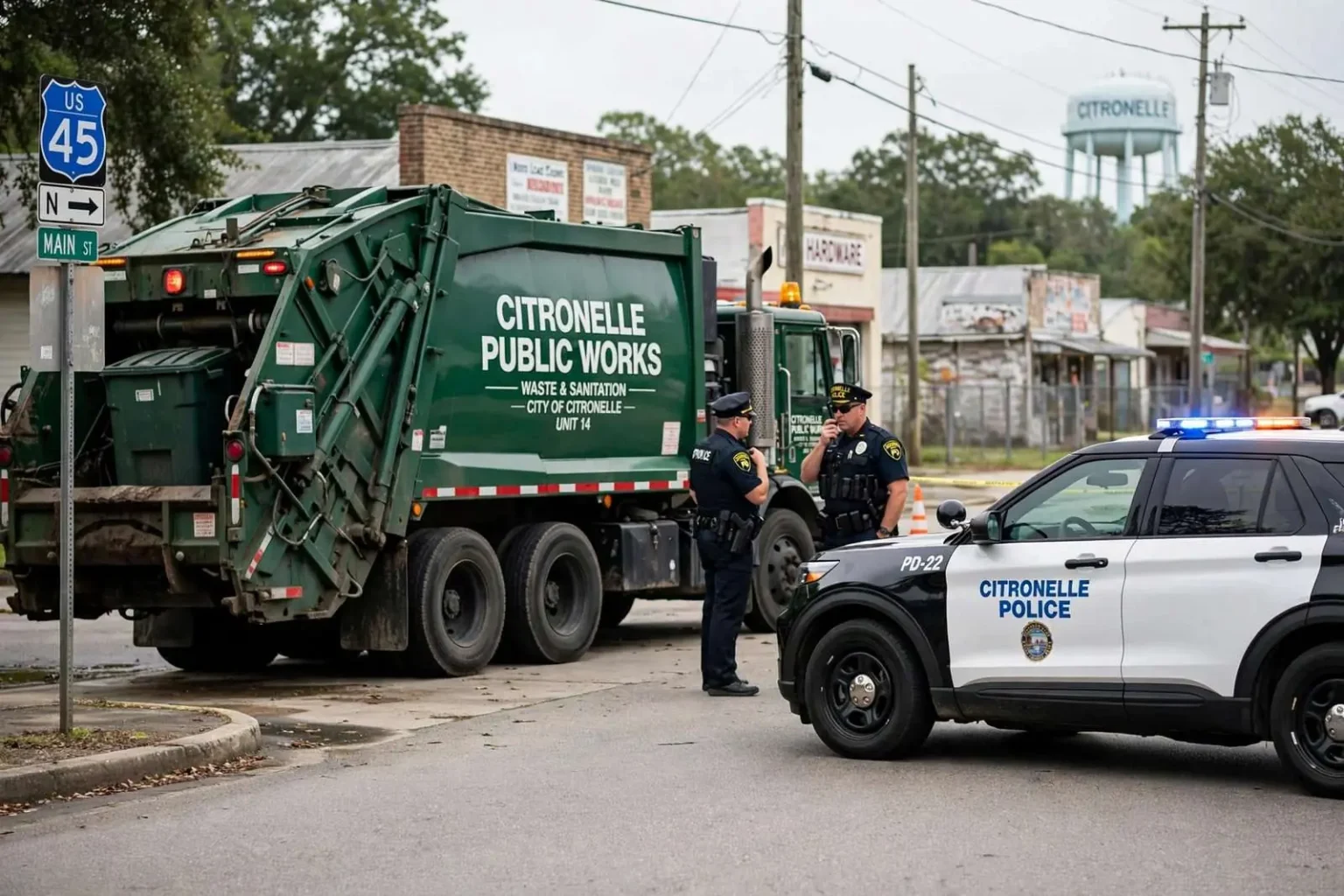
CITRONELLE, Ala. — Citronelle police say they arrested a garbage truck operator after a search of his vehicle turned up methamphetamine, adding a drug charge to what began as a routine traffic stop on the city’s streets. According to the Citronelle Police Department, officers pulled over the truck for not having a license plate, and the subsequent search revealed 6 grams of methamphetamine. The driver, identified as Benjamin Travis Weaver, was taken into custody at the scene.
The arrest unfolded in Citronelle, a city of roughly 4,000 residents in northern Mobile County that serves as a hub for the rural communities that surround it. The city sits along U.S. Highway 45, the corridor that connects the area to Mobile to the southeast and to the Mississippi state line to the northwest. Because Citronelle is the largest population center in that part of the county, its police department handles a steady volume of traffic stops on the highways and city streets that funnel local commuters, school traffic, and commercial vehicles through town.
Police said Weaver was operating a garbage truck at the time of the stop, a detail that has drawn attention given the nature of the vehicle. Commercial collection trucks make regular circuits through neighborhoods each week, and residents on the route depended on that service the morning of the arrest. Officers conducted a search of the truck after the initial stop, and that search is what led to the discovery of the methamphetamine, according to the department.
Following the arrest, Weaver was transported to the Mobile Metro Jail, the main detention facility serving Mobile County and the municipalities within it. He was booked on a charge of probation revocation, according to police, who added that further charges related to the drug find were expected to be upgraded as the case moves forward. Probation revocation means a judge or probation officer has determined, or will determine, that Weaver allegedly violated the terms of a previous sentence, which can result in serving time that had been suspended under an earlier conviction.
The sequence of events — a stop for a missing license plate that ended in a drug arrest — is a familiar pattern in traffic enforcement across Alabama. Under state law, vehicles operated on public roads must display valid registration and license plates, and a missing plate gives officers a clear basis for a stop. Once a stop is underway, any evidence of contraband that comes into plain view or that is discovered during a lawful search can support additional charges, which is what Citronelle police say happened here.
What happens next in the case
With Weaver held at the Mobile Metro Jail on the probation revocation charge, the path forward will run through the Mobile County court system. When officers say further charges are expected to be upgraded, that typically means the district attorney’s office will review the evidence from the stop and search and file formal drug charges to accompany the revocation. Possession of methamphetamine is a felony under Alabama law, and the filing process generally involves warrants or an indictment once investigators complete their paperwork.
The probation revocation charge itself carries real consequences independent of any new drug case. In Alabama, probation is a supervised alternative to incarceration, and a person on probation must comply with conditions such as regular check-ins, remaining law-abiding, and avoiding new offenses. An arrest on new allegations is treated as a potential violation, and a revocation hearing before the sentencing judge can result in the person being ordered to serve the original sentence. In practice, someone arrested while on probation is often held without bond on the revocation matter until that hearing takes place.
For residents of Citronelle and the surrounding communities in northern Mobile County, the arrest raises practical questions about who was behind the wheel of a vehicle that serves their neighborhoods. Waste collection is a service residents interact with weekly, often without giving much thought to the people operating the trucks or the companies that employ them. When an operator is arrested on the route, municipalities typically work with the provider to ensure collections continue, and residents with questions about service can contact city hall for updates on their pickup schedule.
The discovery of methamphetamine in Mobile County reflects a broader pattern that law enforcement agencies across the region have dealt with for years. Meth has been among the most commonly encountered illegal drugs in south Alabama, and sheriffs’ offices and municipal departments in the county routinely report seizures during traffic stops, warrant services, and investigations. The Mobile County Sheriff’s Office and agencies such as the Mobile Police Department have historically partnered with regional drug task forces to interdict trafficking along the corridors that run through the county, including U.S. Highway 45, which passes directly through Citronelle.
Under Alabama’s controlled substances statutes, methamphetamine is classified as a Schedule II drug, recognized as having a high potential for abuse. Simple possession is a felony, and penalties can increase based on prior convictions and the circumstances of the offense. Possession with intent to distribute carries significantly harsher exposure, which is one reason the amount found matters. Six grams is well above the trace amounts associated with personal-use cases in many prosecutions, and prosecutors weighing charges will consider the quantity, packaging, and any other evidence gathered during the stop.
For the Citronelle Police Department, a small municipal force responsible for policing a city that anchors the northern end of Mobile County, the case illustrates how routine enforcement work can surface more serious allegations. Municipal officers in Alabama’s smaller cities handle the full range of calls — traffic, domestic disputes, theft, and drug activity — often with limited staffing. A single stop that produces a felony drug case can represent a meaningful share of an officer’s shift, from the initial traffic contact to the search, the arrest, the evidence inventory, and the paperwork that supports prosecution.
Traffic enforcement and license plate rules in Alabama
The reason for the stop — no license plate — is one of the most common citations issued across the state. Alabama law requires vehicle owners to register their vehicles annually and display the current plate, and failure to do so is a violation that officers can enforce at any time. In practice, plate violations give law enforcement a lawful basis to stop a vehicle and identify the driver, check for outstanding warrants, and observe anything in plain sight. Courts have consistently upheld such stops when the violation is genuine, which is why missing or expired plates are treated seriously by departments across the state.
For commercial vehicles like garbage trucks, registration requirements add another layer. Operators of commercial collection vehicles must keep proper registration and displayed plates on the truck, both for the tractor unit and any associated equipment, and companies that provide municipal collection service are generally responsible for keeping fleet documentation current. A stop for a plate violation on a commercial truck can therefore involve both the driver and questions for the employer about the vehicle’s paperwork.
Residents of Citronelle who witnessed the stop or who have information related to the case can contact the Citronelle Police Department directly. As with any arrest, the allegations against Weaver are accusations at this stage, and the formal charges he ultimately faces will be determined by the Mobile County District Attorney’s Office based on the evidence. The department said the expected upgraded charges reflect its assessment that the drug find supports additional counts beyond the probation matter that landed him in the Mobile Metro Jail.
The case also serves as a reminder for drivers across Mobile County about the consequences that can follow from even minor equipment violations. A missing plate is a fine and a fix for most motorists, but for someone allegedly carrying contraband or living under the restrictions of probation, the same stop can unravel into custody, revocation proceedings, and new felony charges. Officers in small departments like Citronelle’s rely on that leverage of routine enforcement, and the outcome here shows how a morning traffic stop can end with a trip to the county jail.
Methamphetamine enforcement has shaped much of the drug strategy in south Alabama for the better part of two decades. State and local agencies have reported that the drug’s availability in the region has been driven largely by supply brought in from outside the state rather than by local production, following years of restrictions on the sale of pseudoephedrine products that once fed small-scale home labs. That shift has placed more emphasis on interdiction work — highway stops, parcel inspections, and coordinated investigations — as the primary tools for reducing the drug’s flow into communities like Citronelle and the rest of Mobile County.
The Mobile Metro Jail, where Weaver was booked, is the central booking facility for arrests made by municipal police departments, the Mobile County Sheriff’s Office, and state troopers throughout the county. Arrestees are processed there, held pending bond hearings or revocation proceedings, and housed while their cases move through the courts. The facility’s population includes a substantial number of probation and parole holds, reflecting how often new arrests intersect with existing sentences across the county’s dockets.
Probation supervision in Alabama is administered through the state’s court system, with probation officers assigned to oversee individuals sentenced to supervised release in lieu of incarceration. When a person on probation is arrested for a new offense or otherwise violates the conditions of release, the officer can file a delinquency report with the sentencing court. A judge then determines whether to revoke probation, and if revocation is ordered, the individual can be required to serve all or part of the original suspended sentence. Because that process runs parallel to any new criminal charges, someone in Weaver’s position faces two separate tracks: the revocation hearing and the prosecution of the new allegations.
What residents should know
For Citronelle residents, the immediate question is whether garbage collection on the affected route was interrupted. Municipalities in Mobile County contract with private haulers or run their own collection services, and when an operator is arrested mid-route, providers typically send a replacement driver to finish the day’s pickups. Residents who miss a scheduled collection after an incident like this can contact city hall to confirm whether their service will be made up and when the next pickup will occur.
The case also underscores the role that observant residents and routine enforcement play together in small-city policing. A missing license plate is visible to anyone, but it takes a trained officer to turn that observation into a lawful stop and, in this case, a search that allegedly produced 6 grams of methamphetamine. Departments across Mobile County encourage residents to report suspicious activity, and stops like this one show how standard traffic work frequently overlaps with drug interdiction efforts in the region.
As the case proceeds, the formal charges will be announced by the Mobile County District Attorney’s Office, and Weaver’s next court appearances will be set based on when those charges are filed. Until then, he remains in custody at the Mobile Metro Jail on the probation revocation charge. The Citronelle Police Department has not indicated whether the drug evidence suggested distribution or personal possession, and further details about the stop are expected to emerge in court filings as the upgraded charges are presented to a judge.