Citronelle Police Tase Combative Man at McDonald’s, Debunk School Gun Rumor
Citronelle police arrested a combative man at McDonald's with a Taser and say rumors of a student tased at school with a gun are false.
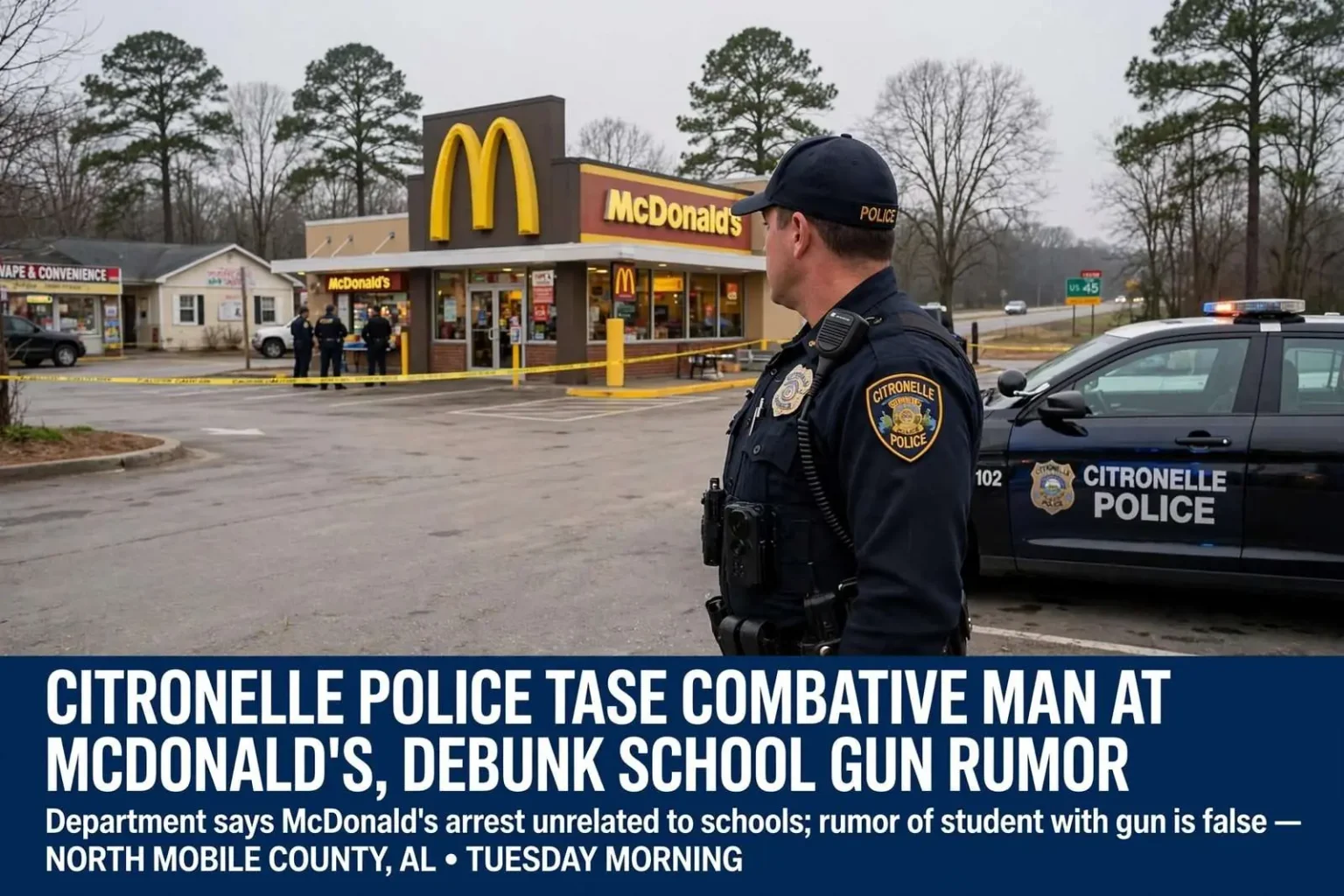
Citronelle police arrested a combative man — believed to be under the influence of drugs — outside a McDonald’s Tuesday morning after officers used a Taser to take him into custody. The department also moved to shut down a rumor circulating in the community that tied the incident to the local schools.
Questions reached police suggesting a student had brought a gun to school and been tased, an account authorities said was false. The department stated that the rumor was untrue and that the McDonald’s incident had nothing to do with the school district, putting out the correction as word of the arrest spread through the north Mobile County community.
No further details about the arrest or any charges were released. The department did not identify the man taken into custody, and it was not immediately clear what prompted the encounter outside the restaurant or whether the man remained hospitalized for a drug-related medical evaluation.
The episode unfolded in Citronelle, a city of about 4,000 people near the Mississippi state line in northern Mobile County. The community sits along U.S. 45, the corridor that connects Mobile to the timber towns of the state’s southwestern corner, and its police department serves as the primary law enforcement agency for the city and its immediate surroundings.
How the Incident Unfolded
According to the department’s account, officers encountered a combative man outside the McDonald’s, a gathering spot along the town’s main commercial strip. Officers believed the man was under the influence of drugs, a circumstance that shapes how such encounters typically develop and end.
Encounters with individuals in an altered state present officers with a difficult set of judgments. A person under the influence may not respond to verbal commands, may misperceive the officers’ intentions, and can exhibit strength and agitation that make routine handcuffing impossible. Departments train officers to de-escalate first, using physical force only when lesser measures fail.
That is the role a Taser typically plays. The conducted-energy device delivers an incapacitating shock that allows officers to take a struggling person into custody while avoiding the higher risk of a prolonged physical struggle or the use of a firearm. In policy terms, a Taser sits in the middle of the use-of-force continuum — more force than verbal commands or holds, less than impact weapons or lethal force.
Once the man was in custody, standard practice calls for medical evaluation, particularly when drugs are suspected. Jail intake screening routinely routes individuals believed to be under the influence to a hospital first, both for their safety and to document their condition. The department did not confirm whether that step occurred, but no details about charges were released, which is consistent with an active medical and investigative process.
Debunking the School Rumor
The department’s unusual second announcement — that no student had brought a gun to school and been tased — reflected the speed at which community rumors travel in a small town. By the time questions reached police, the story had evidently taken on a life of its own, conflating the McDonald’s arrest with the local schools.
School-related rumors carry particular urgency because they touch on parents’ deepest concerns. A report that a student brought a weapon to campus would, if true, trigger emergency protocols, parental notifications, and potentially lockdown procedures through the Mobile County Public School System, which operates the schools serving Citronelle.
Police moved quickly to cut the rumor off, stating plainly that the account was false and that the McDonald’s incident had no connection to the school district. The clarification matters in practical terms: a false weapons rumor can keep parents from sending children to school, flood school offices with calls, and divert law enforcement resources from real work to chasing a story that does not exist.
Departments across the country have adopted the practice of rapid public corrections as social media has accelerated the spread of unverified reports. In communities the size of Citronelle, where residents frequently learn of events through word of mouth and community social media groups before any official word, a quick statement from police carries real weight.
The episode also illustrates the relationship between a small department and its schools. Citronelle’s schools fall within the Mobile County system, and the city’s officers work with school resource arrangements and district communications personnel when incidents touch the campuses. A clear statement separating the McDonald’s arrest from the schools preserved that working relationship and prevented unnecessary alarm.
The Community Context
Citronelle occupies the northern edge of Mobile County, a region of pine forests, timber operations, and small farms that feels far removed from the urban corridors to the south. The city grew up as a railroad town and is known regionally for its oil and gas history — the Citronelle oil field was among Alabama’s most productive — and for community events that draw visitors from across the county line.
Its police department is small, as are most in north Mobile County, and officers handle the full range of calls in a city that serves as the commercial hub for surrounding rural communities. Incidents involving individuals under the influence are among the most common and most unpredictable calls such departments field, particularly at locations like restaurants and convenience stores along the main highway.
The McDonald’s where the arrest occurred sits on that commercial strip, one of the town’s most visible businesses and a natural gathering point. An early-morning disturbance there would have been visible to morning commuters and shift workers passing through on U.S. 45, which likely explains how quickly word of the arrest spread through town.
Drug-related encounters have been a growing share of police work nationwide, and rural departments have felt the shift acutely. Officers in small cities like Citronelle often handle the same individual repeatedly, and departments have increasingly sought crisis intervention training to manage encounters involving substance abuse and mental health crises without unnecessary force.
What Remains Unknown
The department’s statement left open the basic questions that follow any arrest: the man’s identity, the specific charges if any were filed, his medical condition, and whether the encounter prompted any internal review of the use of the Taser. Departments typically confirm such details once charges are formally filed or an investigation concludes.
Use-of-force incidents, including Taser deployments, are generally documented in departmental reports and reviewed by supervisors as a matter of policy. Small departments follow the same review structure as larger ones: the responding officers file reports, a supervisor reviews the deployment, and the records are retained in case questions arise later.
The man believed to be under the influence of drugs, if hospitalized, would face any charges only after his medical situation stabilized. Prosecutors in Mobile County typically review arrest reports once investigators complete their paperwork, and formal charges would appear in court records at that point.
For Citronelle residents, the episode closes with two takeaways from the police department itself: an arrest was made Tuesday morning outside the McDonald’s after a Taser was used on a combative man believed to be on drugs, and no student brought a gun to school or was tased — the rumor connecting the two was false.
Taser Use in Alabama Policing
Conducted-energy devices have been standard equipment in Alabama departments for nearly two decades, adopted as an alternative to batons and physical struggles. Departments that issue Tasers require officers to complete certification training, and policies typically direct that the device be used only on actively resistant or aggressive subjects, not on passive non-compliance.
Policy also governs aftercare. A subject who has been tased is normally evaluated by medical personnel, both because the device’s barbs puncture the skin and because the agitation that led to the deployment may signal a medical emergency such as drug intoxication or excited delirium, which officers are trained to treat as a health crisis rather than a discipline problem.
The devices have drawn scrutiny nationally over the years, with debate centering on deployment against vulnerable individuals and the number of cycles used. Departments respond with tightened policies and reporting requirements, and the general trend in Alabama, as elsewhere, has been toward more documentation and supervisory review of each deployment.
In a small department like Citronelle’s, a Taser use is a notable event simply because of volume — the department fields relatively few use-of-force incidents in a year, and each one represents a call that escalated beyond verbal control. The quick public accounting of Tuesday’s arrest, paired with the rumor correction, reflects a department aware that its community is watching and listening.
Small-Town Policing and Public Communication
The two-part announcement — arrest confirmed, rumor denied — is a textbook example of how small departments manage public information. In a city the size of Citronelle, the police chief’s words carry directly to residents through local media, social media groups, and word of mouth, and an unambiguous statement can settle a community question in a way that silence never does.
Silence, in fact, is what lets rumors grow. When a visible incident occurs and a department says nothing, residents fill the gap with speculation, and speculation in a school-related context can spiral quickly. The department’s decision to address both the arrest and the rumor in one statement headed that off.
The episode is likely to end without further public developments unless charges are filed or additional details are released. For the department, the work continues as it does in any small city: answering the calls, documenting what happened, and keeping the community accurately informed — including, when necessary, telling residents plainly that the story they heard is not true.