Citronelle Woman, 61, Struck and Killed While Walking Along U.S. 45
ALEA says 61-year-old Shirley Smith of Citronelle was hit by a truck while walking on U.S. 45 and died at the scene early Thursday morning.
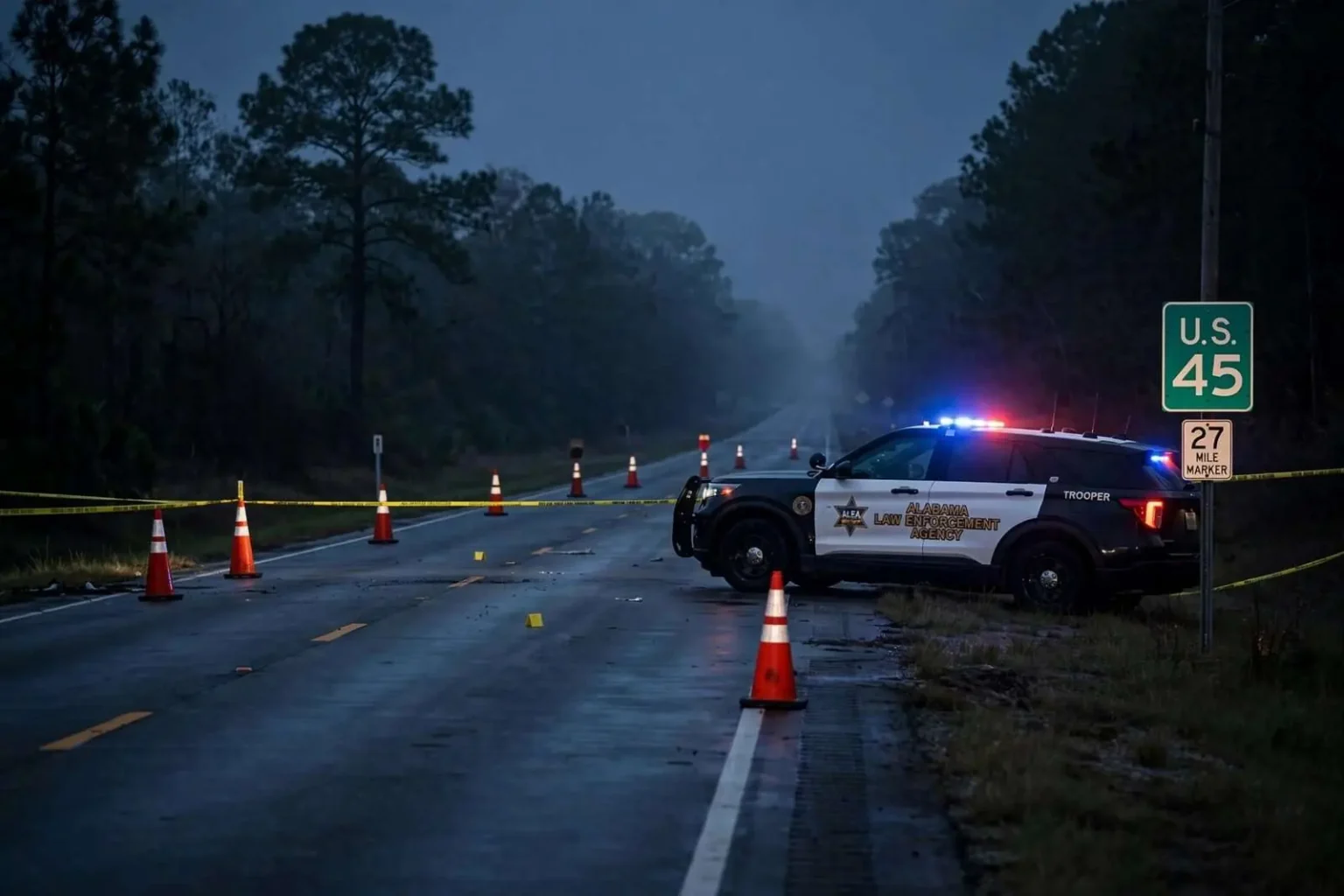
A Citronelle woman died Thursday morning after she was struck by a truck while walking along U.S. 45 in north Mobile County, a crash that claimed her life on one of the region’s most heavily traveled rural highways.
The Alabama Law Enforcement Agency said Shirley Smith, 61, was walking in the roadway near the 27-mile marker — roughly two miles south of Citronelle — when the crash occurred at about 5:14 a.m. on April 21. Smith suffered fatal injuries and was pronounced dead at the scene, according to an ALEA news release.
The crash
The timing placed the crash in pre-dawn darkness, when visibility along rural highways is at its worst. U.S. 45 runs north from Mobile through Mount Vernon and into Citronelle near the Mississippi line, carrying commuter traffic, logging trucks and through freight along a corridor marked by long curves, limited shoulders and stretches of no lighting. A pedestrian in the roadway shortly after 5 a.m. faces the combination of darkness, oncoming headlights and traffic moving at highway speeds.
ALEA troopers responded and closed the roadway for the investigation, a standard procedure that keeps evidence intact and gives investigators room to document the scene. Smith was pronounced dead at the scene rather than transported, indicating the severity of her injuries.
Charges under review
Authorities did not immediately say whether the truck’s driver would face charges. That decision rests on what the investigation shows about the moments before impact: the driver’s speed, attention and sobriety, the pedestrian’s position in the roadway, and whether any attempt to avoid the crash occurred. Alabama law requires drivers to exercise due care toward pedestrians even when the pedestrian is outside a crosswalk, but it also restricts pedestrians from walking in roadways where sidewalks or shoulders are available.
ALEA troopers continued to investigate the circumstances of the crash. Investigations of pedestrian fatalities typically take weeks, involving vehicle inspections, scene reconstruction and, when warranted, toxicology testing. The findings determine whether the case ends as a tragic accident or moves to prosecutors for charges ranging from negligent homicide to driving under the influence.
U.S. 45 and pedestrian risk
The highway where Smith died is the main arterial of north Mobile County, and its character changes along its length. Near Citronelle, it passes through a small-town grid where residents walk along or across the roadway daily, then opens into rural stretches where posted speeds climb and lighting disappears. The 27-mile marker area, two miles south of town, sits in that rural-to-town transition, where the road carries high speeds and few accommodations for anyone on foot.
Pedestrian fatalities on rural highways follow a well-documented pattern nationally. Most occur in darkness, most involve victims walking along the roadway rather than crossing it, and most happen on high-speed roads without sidewalks or lighting. Rural counties across Alabama record these crashes year after year, because walking along the highway remains a practical necessity in areas without other transportation options.
Citronelle and its highway
Citronelle, a city of several thousand residents near the northern edge of Mobile County, anchors the region at the end of the U.S. 45 corridor. The community’s history ties to the railroad and to the oil fields that once made it a regional center, and today it serves as the commercial hub for the surrounding rural stretches of the county. For residents of the outlying areas, U.S. 45 is the road to work, school and town — and its traffic mix includes the heavy trucks that serve the timber and energy industries of north Mobile County.
The loss of a 61-year-old resident on that highway touched a small community where such news travels quickly. Neighbors knew the location, the road and the risks, and the crash renewed the questions that follow every pedestrian fatality on a rural arterial: where lighting might help, where shoulders could be widened, and how drivers and pedestrians alike share a road that was never designed for both.
What the investigation will determine
ALEA’s Highway Patrol Division conducts the investigation, with the findings eventually compiled into a crash report that documents the sequence of events, the factors involved and any enforcement outcome. The truck driver’s cooperation, the vehicle’s condition and any recording from the truck’s systems all feed that record. In crashes of this kind, the determination of charges — or the decision not to charge — follows the evidence, not the outcome alone.
For now, the record stands as the ALEA news release stated it: Shirley Smith, 61, of Citronelle, struck by a truck while walking in the roadway near the 27-mile marker of U.S. 45 at about 5:14 a.m. on April 21, pronounced dead at the scene, with troopers continuing to investigate the circumstances of the crash.
Pedestrian safety on rural Alabama highways has been the subject of repeated state and federal attention, because the numbers consistently show that a pedestrian struck at highway speed has little chance of survival. The risk of death for a pedestrian hit at 20 miles per hour is low; at 40 it rises steeply; at the speeds common on U.S. 45 outside town limits, it approaches certainty. That physics is why the location of a crash matters as much as the circumstances: the same pedestrian misstep on a lit municipal street at 30 miles per hour might end in injury, while on a rural arterial it ends in death.
Alabama’s pedestrian laws attempt to balance the realities. State code requires pedestrians walking along roadways where no sidewalk exists to stay on the shoulder as far from the travel lane as possible, and to walk facing oncoming traffic. But the law acknowledges the lived reality of rural areas: where there is no shoulder to speak of, walking in the roadway is sometimes unavoidable. Drivers, for their part, are obligated to exercise due care to avoid colliding with any pedestrian and to sound the horn when necessary, with extra caution where children or visibly confused pedestrians are present.
The early-morning factor
The 5:14 a.m. crash time falls within the window that national crash data identifies as the deadliest for pedestrians. Fatalities cluster between late evening and early morning, when darkness combines with fatigue, reduced visibility and — on rural routes — the morning movement of workers and freight. In the spring, sunrise in south Alabama arrives after 6 a.m., meaning the crash occurred in full darkness with whatever illumination the truck’s own headlights provided.
Investigators in such cases reconstruct the lighting conditions as carefully as the speeds. Sight distance — how far ahead a driver can see a person in the roadway given the geometry of the road and the reach of headlights — is a decisive variable in whether charges follow. A driver whose headlights revealed a pedestrian at a distance that allowed a stop will be judged differently from one whose sight line offered no realistic chance to react, and crash reconstruction specialists can measure those distances from the scene’s geometry and the vehicle’s capabilities.
Truck traffic on the corridor
The truck involved in the crash is consistent with the traffic U.S. 45 carries through north Mobile County. Logging trucks run the corridor constantly, serving the timberlands that cover much of the county’s northern half, alongside freight haulers and agricultural vehicles. The road’s crash history reflects that mix, and ALEA and county officials have periodically focused enforcement on the corridor for speed, load securement and driver-fatigue violations.
For residents walking along the corridor, the truck traffic compounds the ordinary risks. Heavy vehicles need far longer stopping distances than cars, their headlights sit higher and their drivers’ sight lines over the hood are shorter. When a pedestrian is in the roadway on a curve or a grade, the combination can leave a truck driver with almost no margin — a reality that investigators weigh alongside any evidence of driver inattention or speed.
After the crash
The immediate aftermath of a fatal pedestrian crash on a rural highway follows a set pattern. Troopers close the roadway, usually for several hours, while reconstruction teams photograph and measure the scene, document the vehicle’s final position, mark the point of impact and collect any debris patterns that show the trajectory of the impact. The roadway’s closure on a main arterial like U.S. 45 reroutes local traffic until the scene is cleared, and north Mobile County residents plan around it when they hear the early-morning reports.
The investigation’s conclusion will bring the case to whatever resolution the evidence supports. If it shows the driver was impaired, distracted or speeding, charges can follow under Alabama’s negligent homicide and DUI statutes. If it shows a pedestrian in the roadway in darkness with no realistic opportunity to avoid impact, the case typically closes without charges, and the record stands as another entry in the long list of rural pedestrian fatalities that continue to shape safety discussions along corridors like U.S. 45.
Until ALEA completes its work, the known facts remain those of the news release: a Citronelle woman, 61, walking near the 27-mile marker two miles south of town, struck by a truck in the darkness of an April morning, dead at the scene on the highway that serves her community.