Citronelle Woman Sentenced to 30 Years for Murdering Husband in 2016 Shooting
Ellen Beckham, convicted of murdering her husband in a 2016 Citronelle shooting, received a 30-year prison sentence from a Mobile County judge.
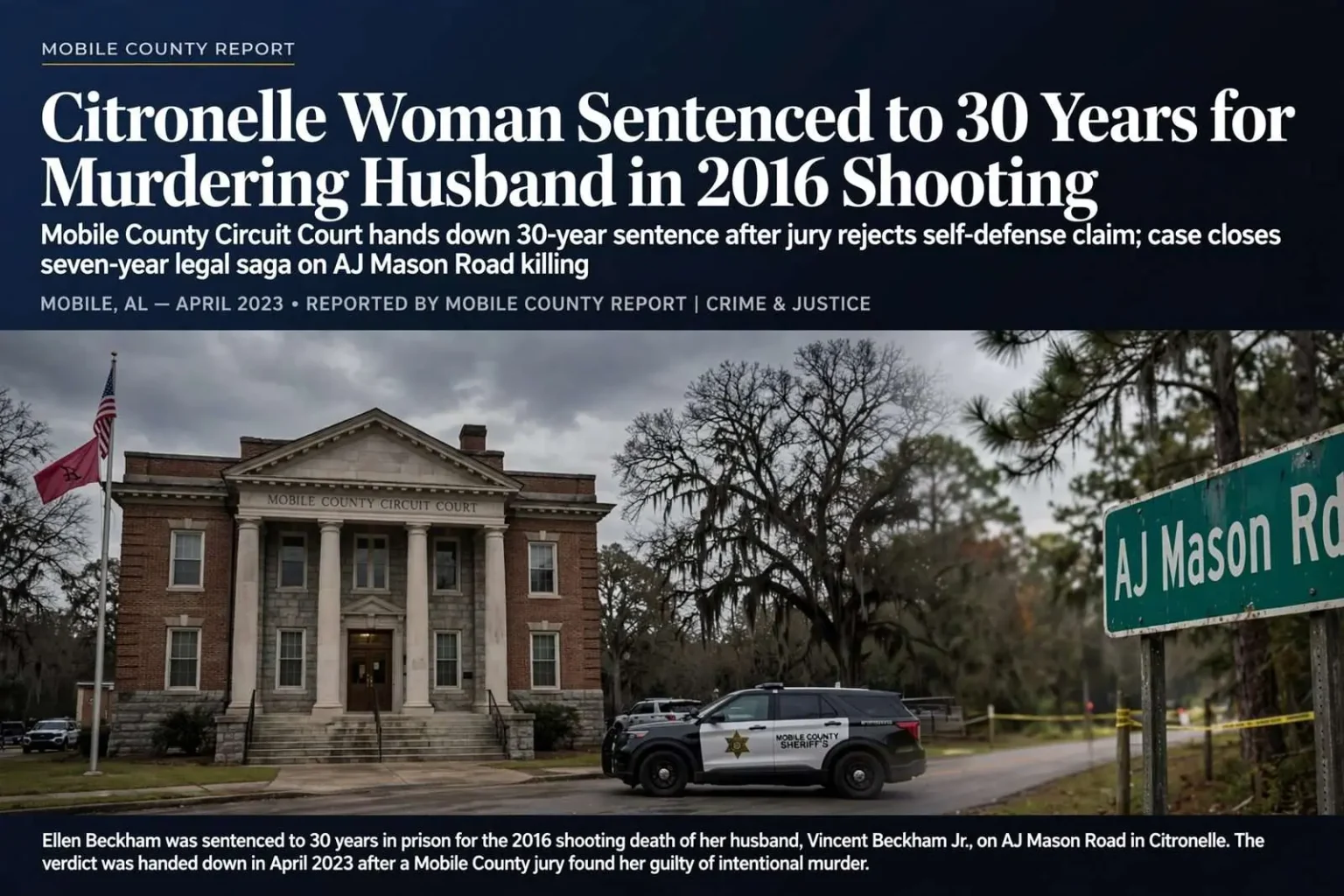
A Citronelle woman convicted of murdering her husband has been ordered to spend three decades behind bars. A Mobile County Circuit Court judge sentenced Ellen Beckham to 30 years in prison, according to court documents, closing a case that stretched across seven years from the shooting to the final sentence. The 30-year term places the case among the more significant domestic homicide sentences handed down in Mobile County in recent years.
The case stems from a shooting on AJ Mason Road in Citronelle in April 2016. Beckham maintained that the shooting of her husband, Vincent Beckham Jr., was an act of self-defense, a claim she carried from her first interviews with investigators through her trial. Prosecutors, however, presented the case as an intentional killing, and a jury ultimately sided with the state.
She was arrested and charged with the killing in 2018 — more than two years after the shooting itself — as investigators continued to develop the case. Court records previously showed she had filed for divorce from Vincent Beckham earlier that same month as the case unfolded, a detail that painted a picture of a marriage coming apart in the period surrounding the shooting.
In April 2023, a jury rejected her self-defense claim and found her guilty of intentional murder. The sentencing followed weeks later, closing out a legal saga that began more than seven years after the fatal shooting. With credit considerations handled through the state prison system, a 30-year sentence means Beckham will spend a substantial portion of her life in the custody of the Alabama Department of Corrections.
The Night That Started It All
AJ Mason Road runs through the rural stretches around Citronelle, a small city in the far northern reaches of Mobile County near the Washington County line. The area, characterized by wooded lots, family properties, and long distances between neighbors, is patrolled by the Mobile County Sheriff’s Office, which responded to the 2016 shooting and led the initial investigation. In communities like Citronelle, major crimes fall to county investigators rather than a municipal detective bureau, and cases can take months or years to move from a scene to an arrest.
The gap between the April 2016 shooting and the 2018 arrest reflects the pace of homicide investigations in a county the size of Mobile. Detectives must reconstruct what happened through physical evidence, witness statements, forensic testing, and medical examiner findings — work that competes with every other case on the office’s docket. By the time Beckham was charged, the case had already been reviewed to the standard prosecutors require before presenting felony charges.
From the moment of her arrest, Beckham’s defense was fixed: she said she shot her husband because she feared for her life. Self-defense claims in Alabama homicide cases turn on whether the defendant reasonably believed deadly force was necessary to prevent death or serious physical injury, and whether that belief was objectively reasonable given the circumstances. Juries weigh those questions against the full record — the physical evidence, the history between the parties, and the defendant’s account of the moments leading up to the shooting.
The Trial and the Verdict
The case reached a Mobile County jury in April 2023, five years after the arrest and seven years after the shooting. Prosecutors argued that the evidence showed an intentional killing rather than a act of protection, walking jurors through the forensic record and the circumstances of the marriage in its final months. The defense leaned on Beckham’s long-held account of fear and self-protection, asking the jury to view the shooting through her eyes that night on AJ Mason Road.
After deliberations, the jury convicted her of intentional murder — the finding that she acted purposely, not in reaction to an immediate threat. The verdict meant that jurors did not accept the self-defense narrative, a determination that also eliminated the possibility of acquittal on grounds of justification. In Alabama, murder is a Class A felony, punishable by 10 to 99 years or life in prison, giving the sentencing judge wide discretion in setting the term.
Inside the Sentencing
The 30-year sentence imposed weeks after the verdict sits in the upper-middle range of what Alabama courts impose for murder convictions. Judges weigh the jury’s finding, the defendant’s background and record, statements from the victim’s family, and the circumstances of the offense when selecting a term within the statutory range. A 30-year sentence signals the court’s view that the killing, while perhaps arising from a troubled marriage, was a grave offense deserving of decades of incarceration.
Under Alabama law, the sentence will be served through the Alabama Department of Corrections, where time-credit rules and parole eligibility shape how much of the term is actually served. The state’s parole board reviews eligible cases, and victims’ families in Mobile County homicides are typically notified and given the chance to speak at those hearings, years after the courtroom proceedings end.
Domestic Violence and the Courts in Mobile County
The Beckham case arrived in court amid growing attention to domestic violence across Mobile County, where prosecutors maintain dedicated units for family violence cases and law enforcement agencies have expanded training on recognizing escalating abuse. Advocates in the region point out that homicides between intimate partners are often the endpoint of long histories that never reached the courts — a pattern that victim-services organizations work to interrupt with crisis lines, shelters, and protective orders.
At the same time, the case illustrates the complicated territory self-defense claims occupy when violence occurs inside a marriage. Alabama law recognizes that a person facing imminent danger may use deadly force, and courts have increasingly examined how abuse history bears on a defendant’s perception of threat. Juries, however, must apply the law to the specific evidence presented at trial, and in this case they concluded the shooting was not justified.
The divorce filing from earlier in the case added a dimension prosecutors and defense attorneys alike considered: it documented that the marriage was ending in the period surrounding the shooting, a period researchers identify as among the most dangerous in an abusive relationship. Separation, studies have repeatedly shown, is when risk of intimate partner violence peaks, a fact that informs how advocates and law enforcement respond to couples in the process of splitting up.
Citronelle and the County’s Rural North
Citronelle, home to a few thousand residents, anchors the northern end of Mobile County along US Highway 45. The city and its surrounding communities are closer to the Mississippi line than to downtown Mobile, and residents there see the county sheriff’s deputies as their primary law enforcement. Cases arising in the county’s rural north travel the same path through the Mobile County court system as those from the city’s suburbs, but they often begin with longer response distances and smaller investigative teams.
The seven-year arc of this case — from a roadside shooting in 2016, through a 2018 arrest, to a 2023 trial and sentencing — mirrors the reality of homicide justice in a large county. Witnesses move, memories fade, and evidence must survive years of testing and legal challenge before a jury ever hears it. The Mobile County District Attorney’s office, which prosecutes all felony cases in the county, carried the case through that entire span to the verdict and sentence.
For the family of Vincent Beckham Jr., the sentencing marks the end of the criminal proceedings, though appeals in Alabama murder convictions are common and can add years to the process. The conviction stands unless a court finds reversible error. Until then, the case stands as one of the more enduring domestic homicide prosecutions in recent Mobile County memory — a reminder that in Alabama courts, self-defense claims in family killings face the full weight of the state’s evidence before a jury decides whose account of a deadly night is true.
What the Sentence Means Practically
A 30-year term in the Alabama prison system is measured by more than the number on the sentencing order. Inmates become eligible for parole consideration under the state’s sentencing laws, and the Alabama Board of Pardons and Paroles weighs institutional record, rehabilitative programming, and — in cases like this one — objections from victims’ family members and prosecutors before releasing anyone. High-profile homicide convictions rarely result in early release on a first parole review, meaning the practical time served in cases of this kind frequently approaches the full sentence.
The weeks between verdict and sentencing are themselves a formal process. A pre-sentence investigation compiles the defendant’s history, and both sides file recommendations: prosecutors arguing for the maximum, defense attorneys presenting mitigating evidence such as the defendant’s age, record, and personal circumstances. Judges in Mobile County announce sentences at a hearing where victims’ relatives are entitled to address the court about the loss they carry — a moment that in domestic homicide cases often becomes the family’s only official account of what the killing took from them.
Self-Defense Law in Alabama
The jury’s rejection of Beckham’s self-defense claim turned on Alabama’s justification statutes, which allow deadly force when a person reasonably believes it necessary to prevent death or serious physical injury to themselves or another. The key word is “reasonable” — the belief must be one that an ordinary person in the same circumstances would hold, judged against the evidence of what actually happened. That standard gives juries room to consider context, including a history of violence in a relationship, but it also requires proof tied to the specific incident.
Defense attorneys in cases like this one typically present the client’s account, any documented history of abuse, and expert testimony on how victims of domestic violence perceive danger. Prosecutors counter with the physical evidence — where shots were fired from, how many, whether the victim was armed — and any inconsistencies in the defendant’s statements over the years. The 2016-to-2023 gap in this case meant both sides were working with evidence gathered years earlier, and the jury had to sort a seven-year-old night on AJ Mason Road into the binary question the law poses: justified killing, or murder.
The verdict also matters for sentencing. Because jurors found intentional murder rather than a lesser form of homicide, the court sentenced under the most serious standard available, short of cases involving additional aggravating factors. Alabama’s sentencing structure gives judges discretion within the Class A felony range precisely so that terms can reflect the specifics of each case — something the 30-year term in this case reflects.
The Long Road Through the System
From the outside, a seven-year path from shooting to sentence can look like delay, but each stage in the Beckham case followed the standard machinery of a felony prosecution. The initial investigation and medical examiner’s work occupied the first stretch; the 2018 arrest opened the formal case; then came grand jury review, arraignment, pretrial motions, and the delays that accumulate in a court system handling thousands of felony filings a year. Trial dates in Mobile County Circuit Court are set and continued as cases ahead of them resolve, and homicide trials — the most complex on the docket — often wait the longest.
Appeals may extend the case further. Every Alabama murder conviction carries a right to appellate review, and the record from the trial — transcripts, evidence rulings, jury instructions — will be examined by the state’s appellate courts for errors that could require a new trial. That process takes years on its own, and it means the final chapter of the Beckham case will not be written when she enters prison, but whenever the appellate courts render their judgment.
What remains certain is the core finding: a Mobile County jury, hearing seven years of accumulated evidence, concluded that the April 2016 shooting of Vincent Beckham Jr. on AJ Mason Road was not self-defense, and the court has now imposed a sentence that will keep his widow in prison into her later years. For a community the size of Citronelle, where the case has lingered in local memory since the first deputies arrived on AJ Mason Road, the sentence finally puts a number on a story that began in the spring of 2016.