

GROVE HILL, Ala. — The Clarke County Board of Education approved its $34 million budget for fiscal year 2027 on Sept. 10.
Superintendent Ashlie Flowers and school system officials discussed the challenges of balancing the budget while maintaining staffing levels and services across the district.
Personnel Is Almost Everything
Personnel accounts for approximately 85% of the budget. The school system currently has four full units, and officials said every school has a principal, assistant principal and counselor.
An 85% personnel share is high even by school district standards and it defines the district’s fiscal reality. With roughly $5 million covering everything that is not salaries and benefits — utilities, transportation, materials, maintenance, insurance and technology — there is very little that can be adjusted without changing staffing.
Maintaining a principal, assistant principal and counselor at every school is a deliberate choice about where that money goes. In rural districts facing budget pressure, assistant principal and counselor positions are frequently the first consolidated across campuses.
Enrollment Is Not Uniform
Enrollment has increased at some schools. Wilson Hall has grown from 119 students to 179, according to information presented to the board.
A jump of that size — roughly 50 percent at one school — creates staffing and space pressure at that campus without necessarily increasing the district’s total state allocation, since funding is driven by system-wide average daily membership from the prior year.
Special Education Funding Has Not Kept Pace
Officials discussed the need for more funding for the growing number of special education students. Despite the increase, the school system is receiving roughly the same number of state-funded units. The district has applied for grants to help offset some of those costs.
Officials said the school system currently serves four deaf students and has additional expenses associated with interpreters, specialized equipment, therapists, nurses and other services.
The cost structure here is not proportional to headcount. A single student requiring a full-time educational interpreter generates an expense comparable to a teaching position, and those services are federally mandated regardless of whether state funding covers them. Four deaf students in a rural district of this size represents a substantial line item.
Cybersecurity and Physical Security
Board members said additional funding has been received for cybersecurity, and the school system has used those resources for firewalls, antivirus and malware protection.
Officials said security work has included replacing locks, improving communications equipment and maintaining cameras and other security systems at schools.
School districts have become frequent ransomware targets nationally, in part because they hold substantial personal data on minors and families while typically operating with limited IT staffing. Dedicated cybersecurity funding is a comparatively recent category in district budgets.
500 Miles of Dirt Road
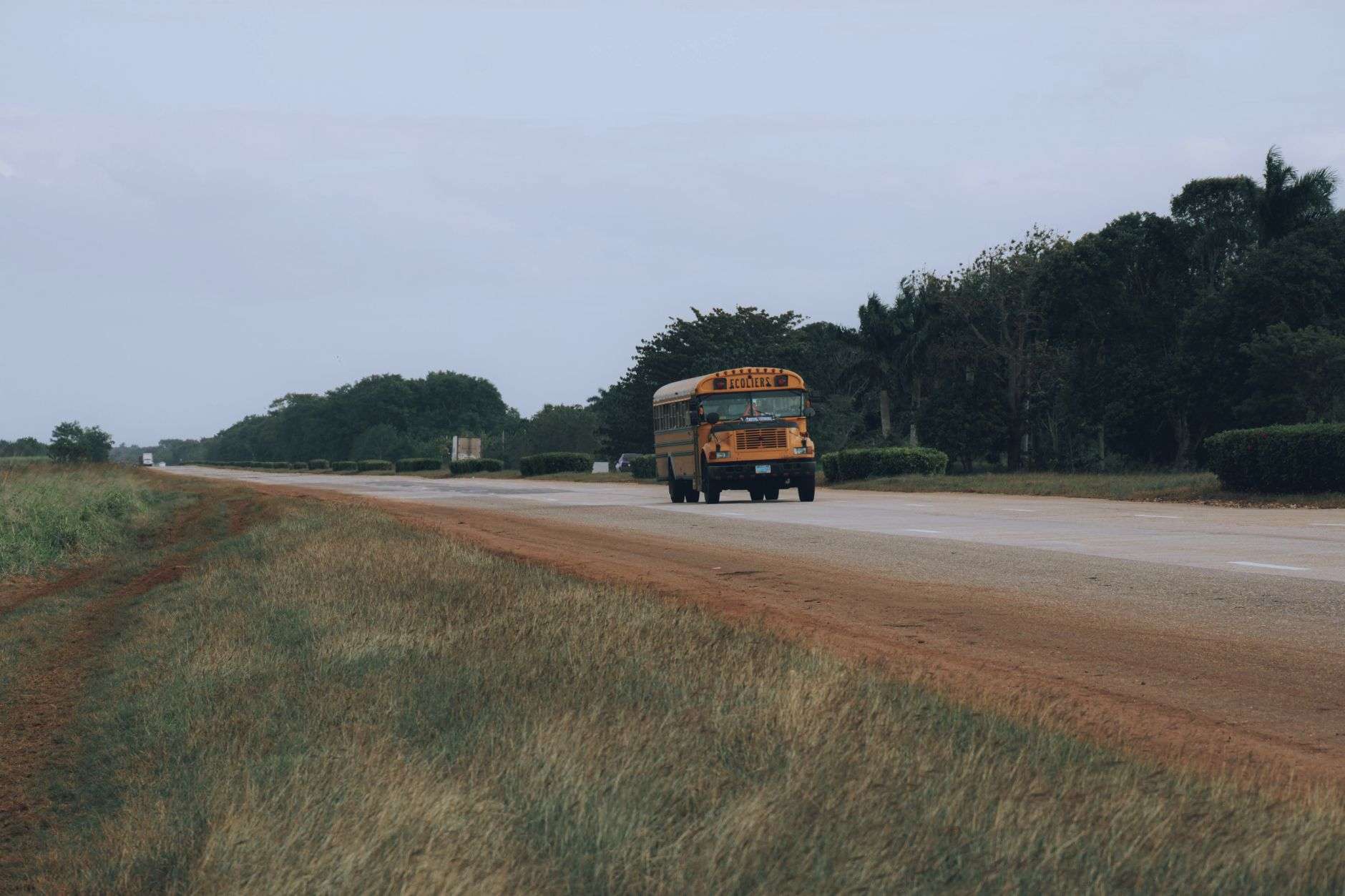
Transportation is one of the district’s significant financial challenges. Clarke County’s 500 miles of dirt roads increase the demands placed on school buses and their maintenance.
Officials said a new school bus costs $175,000, with state funding providing a fraction of that amount.
Unpaved roads are hard on buses in specific and expensive ways: suspension components, brakes, tires, alignment and air filtration all wear faster, and washboarding and soft conditions after rain add mechanical stress and slow routes. A district covering that much unpaved mileage replaces components on a shorter cycle than a district running the same miles on pavement — and does so while the replacement cost of a single bus approaches the annual salary of several employees.
Grove Hill Elementary’s Result
Niquitha Merida of Grove Hill Elementary School presented an overview of the school’s academic progress. Merida said GHES is one of only 19 high-poverty schools in Alabama to score above the state proficiency rate in English language arts (61%) and mathematics (41%).
That is a genuinely notable result. High-poverty designations track student economic need, and outperforming the statewide proficiency rate — not the rate for comparable schools, but the overall state figure — places the school in a small group.
School officials are using targeted interventions to improve achievement, including incorporating art into math instruction, using concepts such as shapes, patterns, symmetry, measurement, fractions and spatial reasoning to help students develop a stronger understanding of mathematics.
The approach has a research basis. Spatial reasoning correlates with later mathematical performance, and students who struggle with abstract numerical representation frequently engage with the same concept presented visually or physically.