Clarke County coroner arrested, charged with assault
Clarke County coroner Mitchell Finney was arrested on two counts of assault stemming from an incident several months earlier, according to a grand jury.
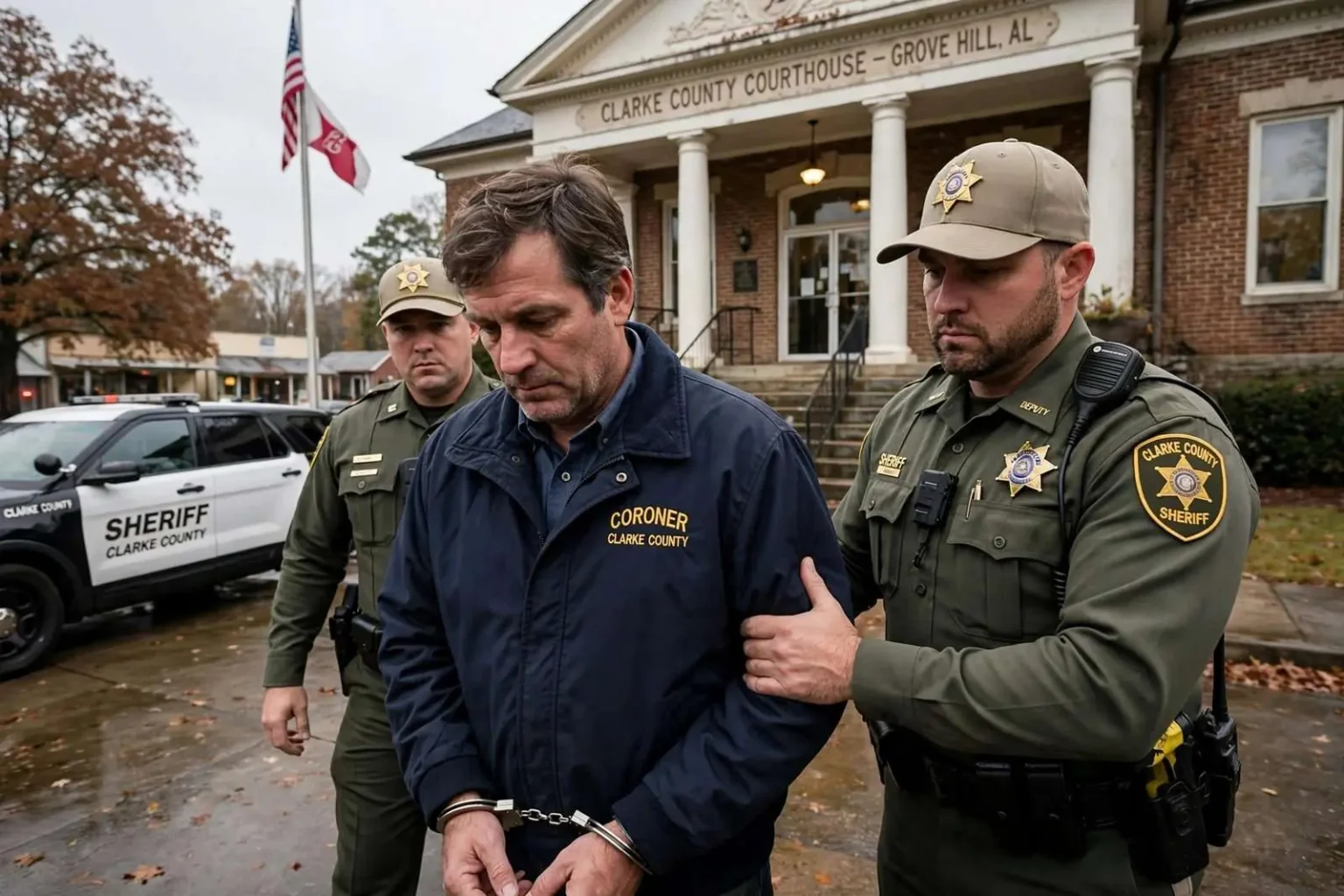
CLARKE COUNTY, Ala. — The coroner in Clarke County was arrested Tuesday by the Clarke County Sheriff’s Office, authorities said, in a case that has drawn attention across the small southwest Alabama county. Mitchell Finney, who serves as the county’s coroner, was arrested on two counts of assault stemming from an incident that occurred several months ago while he was also working for the sheriff’s office.
According to authorities, Finney has since bonded out of custody following his arrest. The charges against him come from a grand jury indictment, the formal document that arises when a panel of citizens reviews evidence presented by prosecutors and determines that enough probable cause exists to bring the case to trial.
One of the two assault counts charges that Finney caused physical injury by punching a person in the face, in violation of the Code of Alabama. Alabama’s assault statute defines degrees of the offense based on the seriousness of the injury and the circumstances involved, with the second-degree charge typically applying when a person intentionally causes physical injury to another. The details of the second count have not been released publicly.
The unusual overlap of roles
The case is unusual because of the positions Finney holds. County coroners in Alabama are elected constitutional officers responsible for responding to unattended and suspicious deaths, overseeing the recovery of remains, and working with law enforcement and the state’s medical examiner system to establish cause and manner of death. At the same time, the indictment stems from an incident that occurred while Finney was also employed by the Clarke County Sheriff’s Office, meaning the same office that made the arrest had been connected to the circumstances out of which the charges grew.
Clarke County, with its seat in Grove Hill, is a rural county of roughly 22,000 residents along the Tombigbee and Alabama river basins north of Mobile. In counties that size, the sheriff’s office, coroner’s office, and district attorney’s staff all operate with small teams, and the people who serve in those offices often work together for years. An indictment that touches two of those offices at once places local officials in unfamiliar territory, and it raises questions about how the case will be handled within the local justice system.
When a public official is charged in a case connected to their own agency, prosecutors sometimes take steps to avoid conflicts of interest, including seeking appointment of a special prosecutor or turning the case over to another district attorney’s circuit. No such announcement has been made in Finney’s case, and the charges will proceed through the court system in the ordinary course unless prosecutors take a different route.
What the charges mean
Assault charges in Alabama are graded by severity. Second-degree assault, a felony, can apply when a person intentionally causes serious physical injury to another, or when a person causes physical injury by means of a deadly weapon or dangerous instrument. Third-degree assault, a misdemeanor, applies to intentionally causing physical injury in less serious circumstances. The specific degree charged in each of the two counts will govern the potential penalties Finney faces if convicted.
A grand jury indictment is not a determination of guilt. It means that a panel of citizens heard the evidence prosecutors presented and found sufficient probable cause to charge. Finney, like any defendant, is entitled to the presumption of innocence, to legal representation, and to a trial where the state must prove the charges beyond a reasonable doubt. His bond release following the arrest is a routine step in that process for defendants charged with offenses of this kind.
Court records in the case will show the next procedural steps, including an arraignment where Finney would formally answer the charges and enter a plea. Cases of this kind often take months to move from indictment to resolution, whether through a trial or a negotiated plea, and the pace in a rural circuit court is typically measured against the calendar of the circuit judge’s docket.
The office of coroner occupies a distinct place in Alabama’s county government structure. In counties without a medical examiner system, the elected coroner is the official who responds when someone dies outside medical care, pronounces deaths under state law, and coordinates the transport of remains. The role requires working closely with sheriff’s deputies, municipal police, and emergency medical services, and coroners frequently appear at scenes alongside the same officers they serve with.
That overlap is what makes Finney’s situation notable in Clarke County. The indictment alleges conduct that occurred while he worked for the sheriff’s office, and the agency that investigated and arrested him is the same one that employed him in that capacity. How the sheriff’s office managed that relationship during the months between the incident and the arrest has not been publicly detailed, and officials have released little beyond confirmation of the arrest and the charges.
Grand jury proceedings in Alabama operate in secret. Prosecutors present evidence to a panel of citizens, defense counsel is not present, and the resulting indictment is the first public glimpse of the case. That is why the account that has emerged — one count alleging that Finney punched a person in the face and caused physical injury — carries few additional details, and why questions about what prompted the incident and who was involved remain unanswered in the public record.
What happens next in the case
From here, the case enters the standard sequence of an Alabama criminal prosecution. Finney will be arraigned on the two counts, a process where the charges are formally read and a plea is entered. Pretrial motions may follow, in which defense counsel challenges the sufficiency of the evidence, the handling of the investigation, or other aspects of the case. If the case proceeds to trial, a jury will hear the evidence and decide guilt or innocence on each count separately.
The timeline for that process in a rural circuit is typically months rather than weeks. Clarke County falls within Alabama’s court circuit structure, and cases move according to the schedule of the circuit and district judges who handle the docket, along with the readiness of the prosecution and the defense. Bond conditions, if any beyond release, would be set by the court and could affect Finney’s activities while the case is pending.
The effect of the charges on Finney’s role as coroner depends on factors that have not yet been made public. Alabama law provides mechanisms for the suspension or removal of certain public officials under specified circumstances, but an indictment alone does not automatically remove an elected official from office, and no announcement has been made about the status of his position. County government in Clarke County has not publicly addressed the question.
Assault law and grand juries in Alabama
Alabama’s assault statutes have long drawn distinctions based on injury and intent, and prosecutors weigh those factors when deciding what degree to charge. An allegation that a person punched someone and caused physical injury can support different degrees of the offense depending on the seriousness of the injury and the circumstances of the act, and the indictment’s two counts will be judged on the specific facts each alleges.
Grand juries sit periodically in Alabama’s counties to review cases presented by the district attorney. Their work typically covers a docket of felony cases, and the decision to indict reflects the panel’s judgment that the evidence supports going forward. The secrecy of the proceedings protects witnesses and the integrity of the case, though it also means the public learns only the outline of the allegations when an indictment is returned.
For Clarke County residents, the case is a reminder of how accountable local offices are to the legal system. The coroner, sheriff, and district attorney are all elected or answerable to the public, and the courts are the forum where allegations against any of them are tested. The case against Mitchell Finney will now run its course there, with the presumption of innocence applying at every stage.
Clarke County’s government structure reflects that of rural Alabama generally. The county commission, sheriff, probate judge, and coroner all operate from offices in Grove Hill, and the county’s judicial functions run through the courthouse there. News of the coroner’s arrest traveled quickly through the community, where the offices involved are small enough that residents often know the officials personally.
The incident underlying the charges occurred several months before the arrest, a gap that typically reflects the pace of investigation and the scheduling of the grand jury that reviewed the case. Grand juries in Alabama counties convene on set calendars rather than continuously, which means a case presented by prosecutors waits for the next panel, and indictments often follow an incident by weeks or months depending on that timing.
Sheriff’s offices handling an arrest connected to one of their own current or former employees commonly turn the investigation over to an outside agency to preserve impartiality. What agency investigated the matter, and whether any outside involvement occurred, has not been publicly detailed. What authorities have confirmed is that the Clarke County Sheriff’s Office made the arrest Tuesday and that Finney was processed and subsequently released on bond.
Coroner duties during a pending case
If Finney remains in the coroner’s role while the case is pending, the county’s death investigation function continues as normal. Coroner calls in Clarke County cover unattended deaths, deaths in custody, and any fatality where a physician cannot certify the cause, and the coroner works alongside state medical examiner personnel to ensure remains are examined where required by law. The position is elected by county voters, which means ultimate accountability for the office rests with the electorate.
Alabama law addresses the temporary incapacity or absence of a coroner through succession provisions, allowing county officials to designate who performs coroner duties when the elected coroner cannot. Whether Clarke County has made any such arrangement pending the outcome of the criminal case has not been announced, and county officials have not commented publicly on the situation beyond confirming the arrest.
The distinction between an official’s personal legal troubles and the functioning of their office is one rural counties confront from time to time, and the mechanisms for managing it are established in state law. What happens in Finney’s case will depend on the outcome of the prosecution, and on any separate action by county or state officials regarding his office.
Community impact and the road ahead
For a county the size of Clarke, an indictment touching the coroner’s office and the sheriff’s office at once is a significant local event. Residents have watched the case develop through the announcements authorities have made, and the details that remain unknown — the identity of the person assaulted, the circumstances of the incident, and the second count’s specifics — are part of the public record’s limits in a grand jury system.
The presumption of innocence applies fully to Finney, as it does to any defendant. The indictment represents the state’s formal accusation, tested in the end by a jury of citizens from the community. Until that process concludes, the facts alleged remain allegations, and the court system is the venue where they will be proven or disproven.
The Clarke County Sheriff’s Office arrested county coroner Mitchell Finney Tuesday on two counts of assault, and he has since bonded out. The case remains pending in the court system, and further details will become public as the prosecution moves forward through arraignment and the pretrial process.