Clarke County deputies search for armed robbery suspect
The Clarke County Sheriff's Office is searching for an armed robbery suspect last seen on Gainestown Road, Sheriff Ray Norris said.
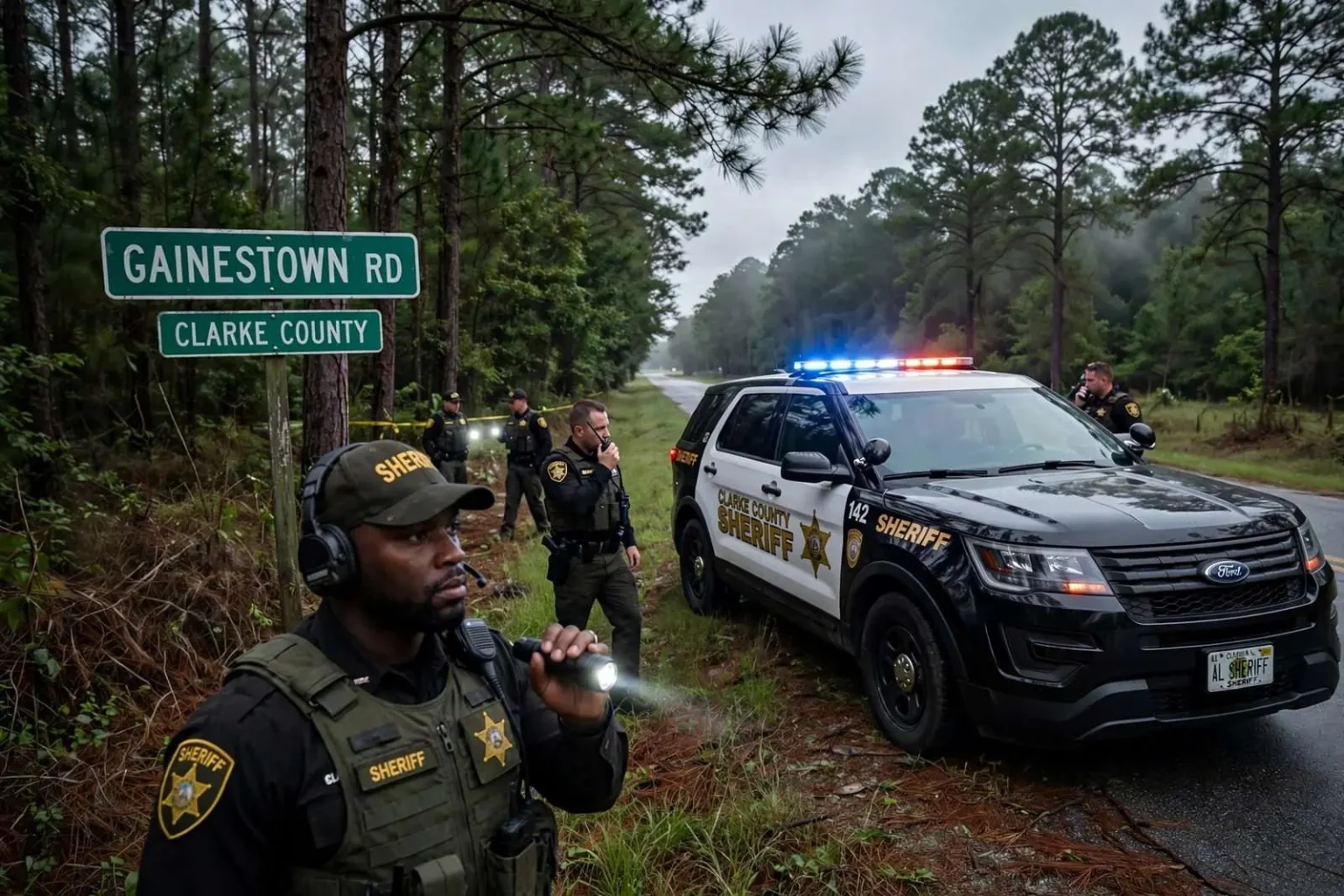
Deputies Launch Search on Gainestown Road
CLARKE COUNTY, Ala. — Clarke County Sheriff Ray Norris is warning the public that the Sheriff’s Office is searching for an armed robbery suspect on Gainestown Road. The suspect is considered armed and dangerous. He is described as a Black male with dreadlocks, wearing dark clothing. Anyone with information about the suspect is asked to contact the Clarke County Sheriff’s Office.
The warning put residents along Gainestown Road and the surrounding rural communities on alert as deputies combed the area for the man they want to question in connection with an armed robbery. In a county where many homes sit well back from the road and neighbors may be separated by acres of pine forest, a search for an armed and dangerous suspect is a serious matter, and the Sheriff’s Office moved quickly to make sure people in the area knew what was happening.
Gainestown Road runs through one of the older parts of Clarke County, tracing a route through timberland and small farms toward the Alabama River. The communities along it are scattered and lightly populated, which cuts both ways in a manhunt: there are few witnesses to a crime, but also few places for a fugitive to go unnoticed. Deputies asked anyone who saw a man matching the description — a Black male with dreadlocks, wearing dark clothing — to stay away from him and call the Sheriff’s Office immediately rather than approaching.
Sheriff Norris’s office has long emphasized that public cooperation is the decisive factor in cases like this one. Rural law enforcement agencies operate with small staffs covering large territories, and tips from residents often determine how quickly a suspect is located. In Clarke County, where the sheriff’s patrol area covers hundreds of square miles of forest, river bottom and farmland, a single phone call can collapse a search area that would otherwise take days to cover on foot.
How an Armed Robbery Investigation Unfolds
When an armed robbery is reported in a rural Alabama county, the first hours matter most. Deputies typically work from the victim’s account to establish a description of the suspect and any direction of travel, then saturate the roads leading away from the scene. Canine units, if available, may be brought in to track from the point of the crime, and aviation or drone support is requested when the terrain makes a ground search slow. Investigators also begin canvassing for security cameras, which in recent years have become a far more common source of evidence even in the countryside, as doorbell cameras and rural surveillance systems spread.
The determination that a suspect is armed and dangerous changes how the search is conducted. Deputies approach with backup, and the public is told explicitly not to make contact with the man. That warning is standard practice, and it exists because robbery suspects who are willing to use a firearm during the original crime pose a continuing risk to anyone who encounters them. In Clarke County, the Sheriff’s Office message made that risk plain while still inviting the public to help from a safe distance.
Once a suspect is located, the legal process moves through the county system. Armed robbery is a serious felony under Alabama law, and charges of that kind are handled in the Clarke County circuit system, with the district attorney’s office deciding on formal prosecution after an arrest. Evidence gathered in the first hours — the victim’s identification, any physical evidence at the scene, and surveillance footage — forms the backbone of the case.
For the residents of Gainestown Road and the surrounding communities, the episode was a reminder of both the vulnerability and the resilience of rural life. A violent crime can occur anywhere, but in a small county it tends to touch people directly. Neighbors talk, information travels, and the sheriff’s phone lines light up. Agencies like the Clarke County Sheriff’s Office depend on that flow of information, and Sheriff Norris’s public appeal was aimed squarely at the people most likely to have seen something useful: those who live and work along the roads where the suspect was believed to be moving.
Clarke County and Its Law Enforcement Landscape
Clarke County sits in southwest Alabama, bordered by the Alabama River on the west and the Tombigbee on the north, with Grove Hill as its county seat and Jackson and Thomasville as its larger towns. It is a county of forests — more than three-quarters of its land is timber — and its law enforcement needs are shaped by that geography. Long distances, few streetlights and scattered residences mean that a search for a suspect on foot or by vehicle is a different proposition than in a city, and the county’s deputies are accustomed to working that terrain.
The Sheriff’s Office works alongside municipal police departments in Jackson, Thomasville and Grove Hill, as well as state authorities, when cases cross jurisdictional lines. In an armed robbery case, that cooperation matters: a suspect fleeing one part of the county may pass through another agency’s territory within minutes. Information shared quickly between departments, and with the public, is what closes the net.
The description released in this case was specific but limited — a Black male with dreadlocks, wearing dark clothing. Authorities asked residents to be alert but not to assume that anyone vaguely matching the description was involved, and to let deputies do the stopping and questioning. Mistaken identifications are a real risk in any search built on a brief physical description, which is another reason the standard advice is to report what you saw, when and where, and leave the confrontation to trained officers.
As the search continued, the Sheriff’s Office reiterated the same request it makes in every case of this kind: if you have information, call. Tips can be given directly to the Clarke County Sheriff’s Office, and in situations like this one, that call may be the thing that brings the search to an end safely — for the deputies conducting it, for the residents of the area, and for the suspect himself, who remains armed and dangerous until he is in custody.
Staying Safe While Helping Deputies
Law enforcement agencies across southwest Alabama repeat a consistent set of guidelines whenever they announce a search for an armed suspect, and the Clarke County warning followed that pattern. Residents were asked to lock homes and vehicles, keep outdoor lighting on after dark, and report immediately anything unusual — a person moving through a yard, a vehicle parked where it should not be, a stranger asking questions at the door. They were also asked to note details that help investigators: the direction a person was traveling, the time of the sighting, and any vehicle involved, including its color and any part of the tag that could be read.
Those details matter because rural searches are fundamentally about narrowing geography. A sighting pinned to a road and a time allows deputies to draw a tight circle and concentrate resources inside it. A vague report does the opposite, scattering units across miles of forest road. Sheriff Norris’s office has always made the point that even incomplete information is worth a phone call; deputies, not callers, decide what is useful.
The armed and dangerous designation also carries practical meaning for the community’s schools and businesses. In situations like this, area residents often keep children close to home until the all-clear comes, and rural churches and gathering places may adjust their schedules. Those decisions rest with local families and institutions, but they are informed directly by the warnings the Sheriff’s Office issues — which is precisely why the office communicates them publicly and quickly rather than working the case silently.
The Role of the Public in Rural Manhunts
Across Alabama’s rural counties, the resolution of armed suspect searches overwhelmingly comes down to citizen tips. Deputies can seal off roads and walk the woods, but the land is vast and the manpower is limited. A suspect moving through private timberland can evade a cordon for days unless someone sees him — a hunter at dawn, a landowner checking a gate, a driver who notices a man walking far from any town. In Clarke County, where hunting clubs and timber companies own much of the ground, those eyes on the land are numerous, and the Sheriff’s Office cultivated them with its public appeal.
Technology has added to those eyes in recent years. Ring cameras and other home surveillance devices, game cameras set out by hunters, and cell phone location records obtained through legal process all shorten the distance between a crime and an arrest. But none of it replaces the basic act of a resident calling in what they saw. The Sheriff’s Office asked anyone with information about the suspect to contact investigators directly.
The episode also illustrated the county’s emergency communication habits. In a rural county without a large media market, word of a manhunt spreads through a combination of local radio, social media posts from the Sheriff’s Office and county emergency management, and simple word of mouth. Each of those channels carries the same core message: the suspect is considered armed and dangerous, do not approach him, and call the Sheriff’s Office with information.
For now, the work of locating the man fell to the deputies of the Clarke County Sheriff’s Office, with the public’s help. The description stands — a Black male with dreadlocks, wearing dark clothing, connected to an armed robbery on Gainestown Road. Anyone who sees him, or who knows anything about the case, is asked to contact the Clarke County Sheriff’s Office. Until an arrest is made, authorities ask the public to remain alert, stay clear of any sighting, and let deputies do their work.