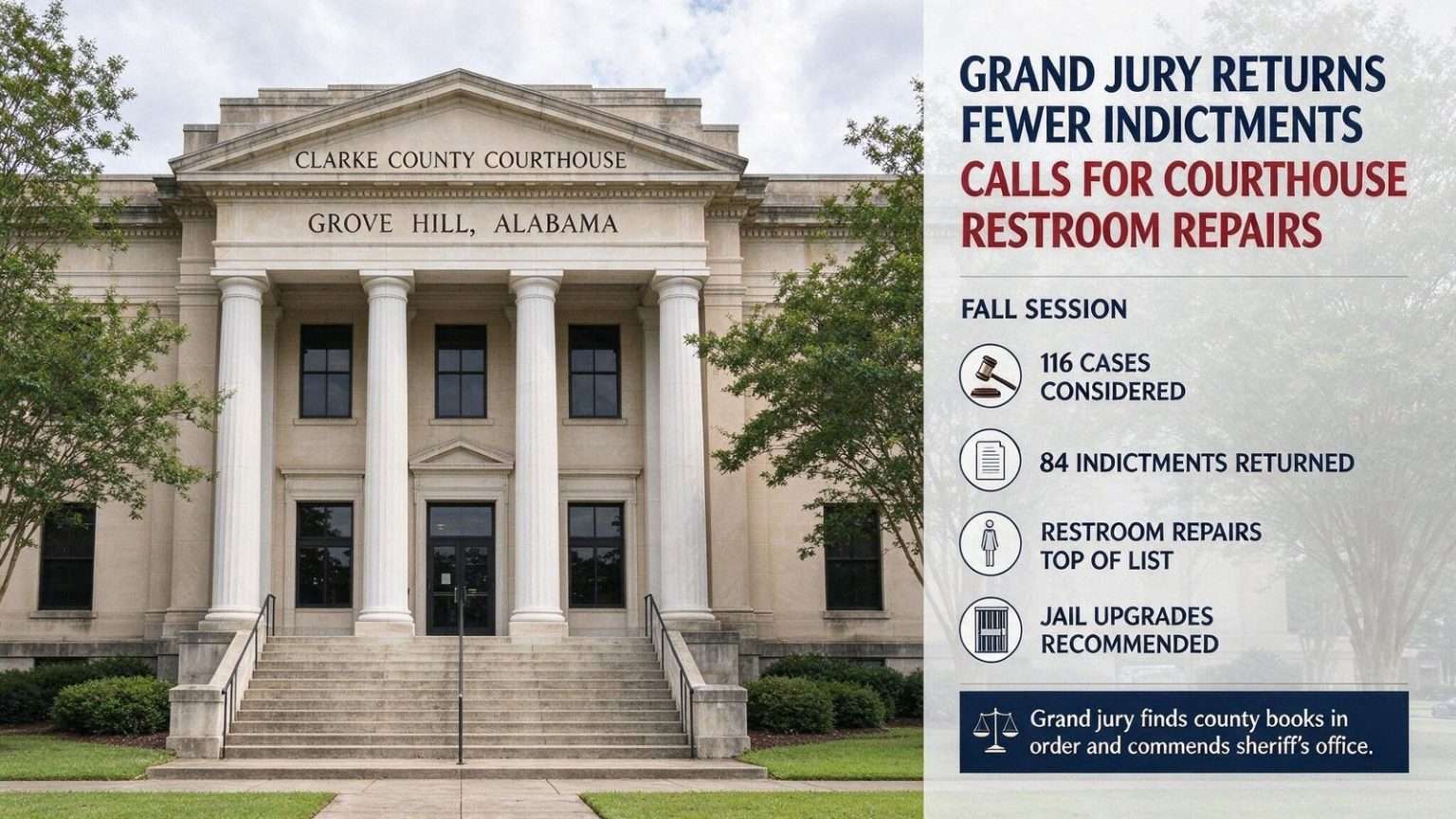
Clarke County Grand Jury Returns Fewer Indictments, Calls for Courthouse Restroom Repairs
The Clarke County Grand Jury handed down 84 true bills during an unusually light fall session, while also recommending repairs to closed courthouse restrooms and jail upgrades, and praising Sheriff DeWayne Smith's programs.
The Clarke County Grand Jury had an unusually low number of cases to consider during its fall session last week, and it returned a correspondingly low number of criminal indictments. The light docket stands in sharp contrast to recent sessions in the rural southwest Alabama county, where grand juries have often faced some of the heaviest caseloads in the region, and the panel used the spare time its short docket allowed to deliver a lengthy list of recommendations for the county’s courthouse and jail.
Grand jurors considered 116 cases and returned 84 true bills, or indictments, made up of 110 felony counts and 57 misdemeanor counts. That is a notably light session by recent standards — true bills returned by Clarke County grand juries usually run well above 100, with a possible high point in 2022, when 503 true bills were issued. A grand jury in Alabama hears the evidence the district attorney presents and returns a true bill when it finds probable cause to charge, so the session’s totals track the volume of cases prosecutors brought forward rather than any change in how the jurors themselves judged the evidence.
The gap between this session and the county’s recent history is striking. A fall session with 84 true bills is barely a fifth of the pace set in 2022, when the county’s grand juries issued 503 true bills across the year, and prosecutors’ reasons for a lighter docket can range from completed investigations waiting on the next session to cases resolved by plea before presentation. Whatever the cause, jurors handled everything placed before them and returned indictments on the majority of the cases they heard.
Courthouse Recommendations
Beyond the indictments, grand jurors issued a lengthy list of recommendations for repairs and improvements to the Clarke County Courthouse and jail in Grove Hill. Among the top recommendations: restoring and reopening the restrooms adjacent to the main courtroom, which are currently closed. Those are the only public restrooms on the second floor of the historic courthouse, and neither one is handicapped accessible or has seen much improvement since the building was constructed in 1955. In the meantime, citizens attending court in the main courtroom must use restrooms in the courthouse annex.
That detour is more than an inconvenience in a working courthouse. Jurors, witnesses, victims and jurors’ families move through the main courtroom on every session day, and a trip to the annex means leaving the building and crossing back — a burden that falls hardest on elderly residents and anyone with limited mobility. The courthouse, built in 1955, is more than seventy years old, and grand juries in Alabama are charged by law with inspecting county facilities, so the panel’s findings carry an official weight that ordinary complaints do not. Recommendations from a grand jury report frequently become the basis for county commission budget decisions in the following year.
Grand jurors also recommended adding a restroom near the revenue commissioner’s office, upgrading the absentee voting room adjacent to the circuit clerk’s office, and creating additional storage space for several county offices and departments. The absentee voting room touches on one of the busier corners of any Alabama courthouse: absentee ballots have grown steadily in use across the state in recent election cycles, and the office that processes them needs space for voters to complete applications and for staff to store and secure ballots through certification. Storage shortages, meanwhile, are a chronic problem in courthouses of this era, where decades of probate, circuit court and revenue records accumulate faster than shelf space.
Jail Upgrades Recommended
On the jail side, the grand jury recommended adding more cells for female inmates, along with additional toilets and showers — complete with partitions between the two — in the jail’s female unit. Jail populations across Alabama have shifted in recent years, and facilities built decades ago were sized and laid out for a mostly male inmate population, leaving smaller counties to retrofit units that were never designed for the numbers they now hold. Additional cells would ease that pressure in Grove Hill, while the privacy partitions jurors called for address a basic dignity and safety issue in the existing showers and toilets.
Jurors also called for a body scanner in the booking area to help prevent contraband from entering the facility. Body scanners, which screen inmates on intake much like the imaging equipment used at airports, have become a standard recommendation in Alabama jail inspections because most of the drugs, phones and weapons that circulate inside a county jail come in on people rather than through fences. A scanner at booking intercepts those items before they enter the general population, reducing overdoses and disciplinary problems, and it reduces the need for invasive manual searches.
The panel recommended raising pay for correctional officers as well, a recommendation that echoes a shortage felt across the state. Alabama county jails have struggled for years to fill corrections positions at the wages rural commissions can offer, and turnover in the jail’s staff affects everything from supervision quality to overtime budgets. Grand jury language urging higher pay gives county leaders one more piece of official documentation to weigh against the constraints of the county’s general fund when budget season arrives.
Books ‘In Order,’ Sheriff Praised
As required by law, grand jurors said they had inspected various courthouse offices and found that “the books kept therein appear to be in order.” They also reviewed reports from the Alabama Department of Examiners of Public Accounts and reported that those, too, “appear to be in order.” The examination of county books is one of the grand jury’s oldest functions in Alabama, a holdover from an era when the jury itself served as the state’s main check on county government between elections, and a clean report means the offices of the circuit clerk, probate judge, sheriff, tax assessor and revenue commissioner passed inspection without flagged discrepancies.
The Department of Examiners of Public Accounts, the state agency that audits Alabama county and municipal governments, issues periodic reports on each county’s finances, and grand juries review the most recent findings as part of their statutory duties. When those reports come back in order, it signals that the county’s bookkeeping, purchasing and payroll practices met state standards for the audit period — a quiet but meaningful assurance for taxpayers in a county with a modest budget.
Jurors commended the overall upkeep of the courthouse and jail. “Further, we would like to commend Sheriff DeWayne Smith and his staff for the quality and effectiveness of mental health and drug programs implemented,” the grand jury wrote in its report. Mental health and substance abuse programs in county jails have drawn increasing attention statewide, as jails have become the default holding facilities for people in crisis while they await trial or transport to state treatment facilities. A sheriff’s office that runs active programming — classes, counseling, and coordination with community providers — is working against the cycle of return bookings that fills county jails, and the jurors’ commendation singled that work out by name.
Clarke County and Grove Hill
Clarke County sits in southwest Alabama, bordered by the Tombigbee and Alabama rivers, with Grove Hill serving as the county seat since the county’s earliest days. The county’s economy has long rested on timber and paper manufacturing, and its population remains one of the smaller in the state, which makes the courthouse in Grove Hill the center of civic life for residents spread across communities such as Jackson, Thomasville and Coffeeville. Sessions of circuit court and the grand jury bring people into town from every corner of the county, which is why the condition of the courthouse’s public facilities matters beyond the building itself.
The grand jury’s role in county government is set out in Alabama law: in addition to hearing criminal cases, each grand jury must inspect the courthouse, the jail, and the books of county officials, and report its findings to the circuit judge. The practice gives every session a second function — a citizens’ audit of county government — and reports like the one filed last week are entered into the public record. County commissions respond to the recommendations as budget and capital planning allow, and repeated recommendations across successive juries often precede actual appropriations.
What happens next depends largely on the Clarke County Commission, which funds courthouse maintenance and jail operations from county revenue. Restroom restoration in a 1955 building, added cells, a booking body scanner and higher correctional pay all carry price tags that must compete with road, bridge and emergency services spending in a small county. The grand jury’s report now becomes part of that deliberation, joining the recommendations of previous panels on the same subjects.
What the Session Numbers Mean
The light session also has practical consequences for the court system’s calendar. Eighty-four indictments means eighty-four cases moving into circuit court for arraignment and trial, a flow that the circuit judge, district attorney and defense bar will process through the coming terms of court. Heavier sessions, like the county saw in 2022, create backlogs that take months to clear; lighter ones give the system room to catch up, settle older cases and prepare the felony files that arrive with the next jury.
For county residents, the report offers a two-sided picture: a justice system processing fewer cases this fall, but one whose grand jury found the county’s books clean, its jail programs effective, and its sheriff’s office worth commending — while delivering a pointed list of physical upgrades the county’s buildings still owe the public. The restrooms by the main courtroom, closed and aging since the Truman administration was in office, sit at the top of that list.