

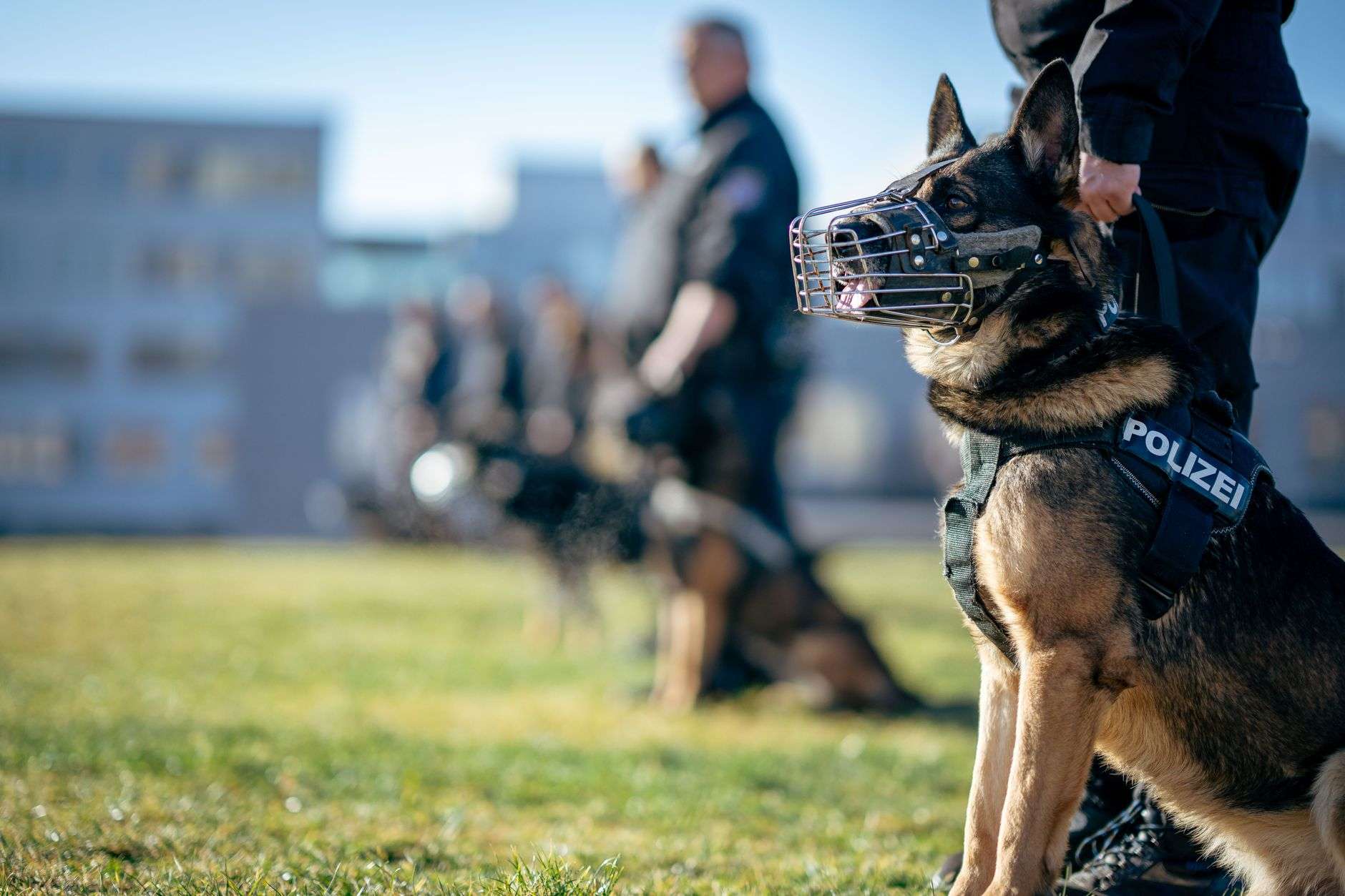
A Clarke County Sheriff’s Office K9 will soon be outfitted with body armor thanks to a donation from a national nonprofit organization, the department announced in a social media post. K9 Joker will receive a bullet- and stab-resistant protective vest through Vested Interest in K9s, Inc., a charity that provides body armor to law enforcement K9s across the country, with the sheriff’s office saying the vest is expected to arrive within the next 10 weeks.
The announcement gives the south Alabama department a piece of equipment that few working dogs carry: armor certified by the National Institute of Justice, the federal standards body whose testing requirements govern protective gear for human officers as well, and custom-fitted for each individual dog. Because working dogs come in a range of sizes and shapes — from compact Belgian Malinois to broad-chested German shepherds — vests must be measured and fitted to the individual animal rather than issued from a shelf.
The nonprofit behind the vest
Since its founding in 2009, Vested Interest in K9s has provided 6,513 protective vests to police and sheriff’s department K9 units nationwide, relying entirely on private and corporate donations to fund the program. The organization operates from Massachusetts but serves departments in every state, and its model is straightforward: donations fund the purchase of NIJ-certified vests, which are then sponsored for specific dogs whose departments apply for the gear.
Update (Aug. 1, 2026): Vested Interest in K9s, Inc. has provided additional detail on the program supplying K9 Joker’s vest. The nonprofit’s donations to date, totaling 6,513 vests nationwide, are valued at roughly $6.9 million. Eligible dogs must be at least 20 months old and actively employed and certified with a law enforcement or related agency; the organization estimates there are about 30,000 law enforcement K9s serving across the United States. Each vest carries a value of $1,800, and the nonprofit says a single donation of $1,050 is enough to sponsor one vest, with tax-deductible contributions of any amount accepted. Those interested in donating or volunteering can call (508) 824-6978 or write to Vested Interest in K9s, Inc., P.O. Box 9, East Taunton, MA 02718.
What the vest does
Police and sheriff’s department K9s are trained to assist officers with tasks ranging from narcotics detection to tracking suspects, and they can face many of the same physical risks their human partners do in the field. A dog sent into a building ahead of officers, deployed to track a fleeing suspect through thick woods, or used to search a vehicle during a traffic stop can encounter the same knives, guns and chaotic scenes that drive officers to wear their own armor.
Protective vests like the one Joker will receive are designed to guard against stabbing and ballistic threats while remaining lightweight enough for the dog to move and work effectively. Weight matters as much as protection in a working-dog vest: a dog encumbered by heavy gear loses the speed and agility that make it useful in a track or apprehension, so manufacturers balance NIJ-tested ballistic panels against a cut and fit that lets the animal run, jump and grip without restriction.
Why departments turn to donations
Departments across Alabama, including several in south Alabama, have turned to Vested Interest in K9s and similar nonprofits in recent years to outfit their K9 units, since body armor for working dogs is not always covered in standard department budgets. A county sheriff’s office like Clarke County’s operates on the modest budget lines typical of rural Alabama law enforcement, where vehicle maintenance, jail operations and payroll consume most of the annual allocation, and specialized equipment often arrives through grants or charity rather than the regular purchasing cycle.
Clarke County sits in Alabama’s timber country north of the Mobile area, a largely rural county where a sheriff’s office K9 does the kind of work that covers wide territory: tracking suspects across acres of forest and plantation land, searching buildings in small towns where backup may be minutes away, and assisting other agencies on calls that cross jurisdictional lines. The office’s K9 program, like those in neighboring counties, depends on the dog’s ability to be deployed quickly — which is precisely what body armor is meant to preserve in a dangerous encounter.
The 10-week delivery window reflects the reality of the donation pipeline: once a department is approved, the vest is manufactured to the individual dog’s measurements, tested against the applicable NIJ standard, and shipped to the agency. Departments typically hold a small ceremony when the vest arrives, and many post photos of the armored dog to social media — the same channel the sheriff’s office used to announce the award.
How K9 programs work in south Alabama
Working dogs across the region handle a workload that has expanded well alongside their human partners. A certified narcotics dog can give officers legal grounds for a search during traffic stops on the corridors that connect Mobile to the rest of the state, and a trained tracking dog can locate missing children, elderly residents who wander from home, and suspects who flee on foot into rural terrain. Those deployments place the dogs at the front of the risk, ahead of officers, in exactly the situations where protective equipment earns its cost.
Handler certification, veterinary care, and ongoing training all add recurring costs to a K9 program beyond the initial purchase of the dog, which is why the donated vest — a one-time, $1,800 item — still represents a meaningful addition. For a department the size of Clarke County’s, an armor donation effectively eliminates a budget line that might otherwise wait years for local funding.
Clarke County is one of several south Alabama counties whose sheriff’s offices maintain K9 programs serving both their own deputies and neighboring agencies. The dogs are typically trained in disciplines such as narcotics detection, article search and suspect tracking, and they certify with their handlers through recognized training standards before deployment. A vest donation like the one Joker will receive travels with the dog through its working career, and departments generally report the gear’s arrival and service publicly because residents often helped fund it through sponsored donations.
A national need, one dog at a time
The nonprofit’s estimate of roughly 30,000 law enforcement K9s serving across the United States puts the scale of the need in perspective: against that national population, 6,513 vests provided since 2009 represents a fraction of working dogs now equipped, which is why the organization processes applications continuously and encourages sponsorships at any contribution level. Vests also have a service life — protective materials age and standards are updated — so departments eventually return for replacements, keeping demand steady even among agencies that have received gear before.
The $1,050 sponsorship figure the nonprofit cites covers the full cost of putting one vest on one dog, with the balance of the vest’s $1,800 value absorbed through the organization’s fundraising. Corporate sponsors, civic clubs and individual donors — often families moved by news of an injured K9 somewhere in the country — keep the pipeline running, and the charity’s all-donation funding model means no department pays for the gear itself.
For the public, the announcement offers a direct way to participate in the program rather than simply applaud it. The contact information released with the update — the (508) 824-6978 phone line and the P.O. Box 9 address in East Taunton, Massachusetts — routes donations and volunteer inquiries straight to the organization, and contributions of any amount are accepted as tax-deductible gifts toward future vests.
What it means for Clarke County
When Joker’s vest arrives within the coming weeks, the sheriff’s office will gain more than a piece of equipment. A protected K9 can be committed to the riskiest deployments without hesitation — the building search at night, the track through a swamp, the apprehension of a suspect who refuses to surrender — because the handler knows the dog carries the same basic ballistic and stab protection the deputy does.
Handlers and their dogs train together, live together and deploy together, a partnership that makes the loss of a K9 a department-wide event and the protection of one a matter of personal concern for the officer on the other end of the leash. That bond is the quieter story behind the donation: an established national charity, funded by strangers’ gifts, fitting custom armor for a dog that patrols the piney woods of south Alabama.
The sheriff’s office said it would share the vest’s arrival with the public once it is delivered. In the meantime, the announcement stands as an example of how south Alabama departments increasingly fill the gaps in their equipment budgets — not with tax increases or grants alone, but through the network of nonprofits that have made K9 protection a national cause.