Clarke County Schools Explain Why Growing Fund Balance Isn’t Free to Spend
Clarke County school leaders say most of an $8 million fund balance is restricted or already committed, as the board reviewed a five-year list of building projects.
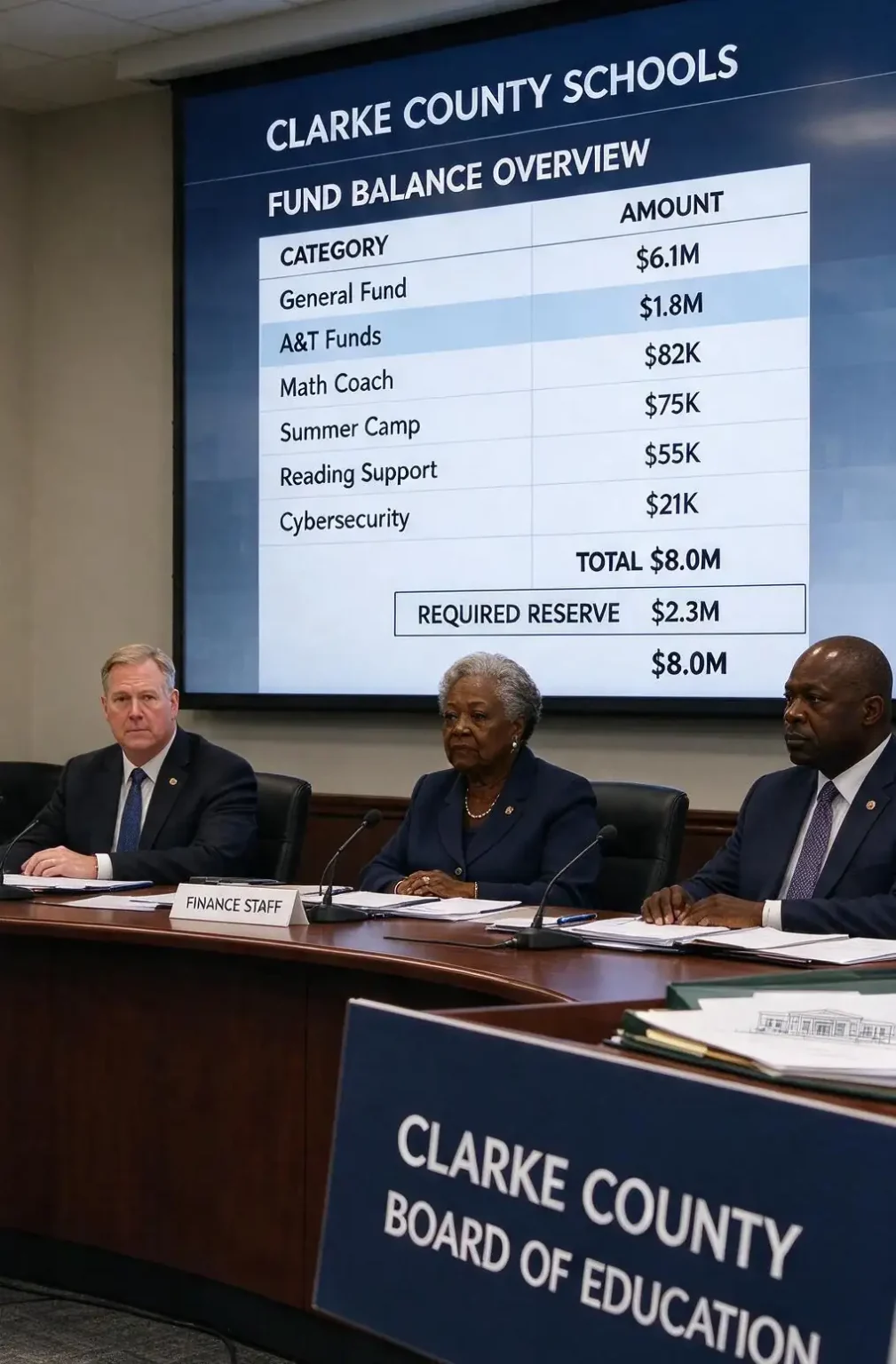
GROVE HILL, Ala. — The Clarke County School District closed the 2025-26 fiscal year with about $8 million in its fund balance, but district finance officials are cautioning residents that the figure does not represent spare cash. Roughly $2 million is already committed, and much of the rest is tied to specific purposes set by the state, they told the Clarke County Board of Education on Thursday, Nov. 19.
The Clarke County Schools surplus has grown substantially from about $2 million two years ago, and officials described the district’s current financial position as perhaps the strongest it has ever been. At the same meeting, the board also reviewed a five-year capital plan listing roughly two dozen building projects at schools across the county, from new roofs and air-conditioning systems to stadium and auditorium upgrades.
Why a Surplus Is Not Spending Money
District financial staff took time during the presentation to address a common misunderstanding. After a similar report two years ago showed a $2 million surplus, the district received calls from community members asking why that money could not be used to hire more teachers. Officials said they had to explain then, and wanted to make clear again now, that much of the money is earmarked and cannot be spent on salaries.
Part of the confusion, officials said, comes from the difference between a reserve and a surplus. A reserve is money a school system is required to keep on hand to protect against emergencies and cash flow gaps. A surplus is simply the amount by which money coming in exceeded money going out during the year, and it may include dollars that are restricted to particular uses or set aside for future obligations.
The One-Month Reserve
Alabama requires local school systems to maintain a reserve equal to at least one month of operating expenses. District officials walked the board through how Clarke County’s requirement is calculated.
General fund expenditures for the year totaled $27.7 million. Dividing that amount by 12 months produces a required ending fund balance of about $2.3 million, which is the minimum the state expects the district to keep in reserve.
Breaking Down the $8 Million
The district’s fund balance is made up of several pieces, many of them tied to specific programs. According to the figures presented to the board, the major components include:
- General fund: $6.1 million
- Advancement and Technology (A&T) funds: $1.8 million
- Math coach funding: $82,432
- Summer camp: $74,974.68
- Alabama Reading Initiative support beyond third grade: $55,078.78
- Cybersecurity funds: $20,581.50
Officials pointed to the math coach money as one example of how the numbers can be misleading. Funding for the math coach and for Advancement and Technology was approved by state lawmakers in June, but the district did not receive the money until the end of August. Although it counts as fiscal 2026 money on the books, the state’s own guidance indicated it was meant to be spent in the following year.
In fact, district officials said, a significant share of the money labeled as fiscal 2026 funding is actually earmarked for fiscal 2027. That timing explains why a sizable balance can appear at year’s end even though the dollars are already spoken for.
What A&T Money Can Pay For
The Advancement and Technology Fund provides supplemental appropriations through the Alabama State Department of Education to support public schools. District officials explained that the money can be used for a variety of needs, including:
- School security
- Facility maintenance
- Classroom instructional support
- Student transportation
- Education technology
- Capital outlay, such as building improvements
Because these funds come with defined allowable uses, they can help with facilities and equipment but are not a source of ongoing money for permanent staff positions.
District leaders told the board that they are working to be careful and strategic about how the money is used.
How Alabama Schools Are Funded
Much of the money Alabama public schools receive comes from the state’s Education Trust Fund, which is supported mainly by state income and sales taxes and appropriated each year by the Legislature. Local school systems also receive local tax revenue, including property taxes, along with federal funds for specific programs. Because lawmakers decide each year how much goes to schools and for what purposes, districts often receive money with strings attached, which is part of why a fund balance can include so many restricted pieces.
The Alabama Reading Initiative, one of the programs reflected in Clarke County’s balance, is the State Department of Education’s long-running effort to improve literacy. Under the Alabama Literacy Act, passed in 2019, the state has placed a strong emphasis on reading skills in kindergarten through third grade, and some funding supports students beyond those early grades as well.
The Five-Year Capital Plan
Alongside the fund balance discussion, the board reviewed the district’s five-year capital plan, which lists building and facility projects with descriptions, estimated costs and priority rankings. Taken together, the 23 items carry estimated costs of roughly $14.5 million.
Highest Priorities
The project at the top of the list is a new roof for the main building at Jackson High School, estimated at $1.5 million. The next items in priority order are new gym flooring at Gillmore Elementary School for $100,000, flooring work at several schools for another $100,000, and fixes to drainage problems at Jackson High School estimated at $300,000.
Security improvements also rank in the upper half of the list. The plan calls for secure vestibules and entrances at Jackson Intermediate School, estimated at $16,500, and at Wilson Hall Middle School, estimated at $20,000. Secure vestibules typically require visitors to pass through a controlled entry area before gaining access to the rest of a school building.
Projects by School
Jackson High School accounts for the largest number of projects. Beyond the roof and drainage work, the list includes gym flooring for $200,000, an entrance and office renovation for $1 million, HVAC work for $1 million, and cafeteria renovations under an energy savings contract for $1.5 million.
Jackson Intermediate School would receive bathroom renovations for $1.2 million, HVAC improvements for $750,000 and Schneider building controls for its gym for $60,000, all under energy savings contracts, in addition to its secure entrance.
Clarke County High School in Grove Hill is slated for Schneider controls for $300,000 and gym HVAC for $150,000 through energy savings contracts, along with an auditorium renovation estimated at $1.5 million.
Grove Hill Elementary School has HVAC work planned for two buildings under energy savings contracts, $1 million for Building B and $750,000 for Building A, plus cafeteria renovations estimated at $1 million.
Gillmore Elementary School would get extended sidewalks and a canopy for $50,000, in addition to its new gym floor.
Wilson Hall Middle School appears on the list for its secure entrance project.
Districtwide and Athletic Projects
Several items span more than one campus. Parking lot resurfacing at multiple schools is estimated at $250,000, and new lighting for baseball and softball fields at both Jackson High and Clarke County High is estimated at $300,000.
Near the bottom of the priority list are two larger projects: upgrades to the stadium and press box at Legion Field in Jackson, estimated at $1.5 million, and the Clarke County High School auditorium renovation, also estimated at $1.5 million.
Understanding Energy Savings Contracts
Eight of the projects on the list, together estimated at about $5.7 million, are labeled as energy savings contracts. Under this approach, which is commonly used by school systems and other public entities, upgrades to heating and cooling systems, controls, lighting and similar equipment are designed to reduce utility costs. The projected savings on energy bills help pay for the improvements over time.
Building automation controls, such as the Schneider systems listed in the plan, allow facilities staff to schedule and monitor heating and cooling more precisely, which can lower energy use when buildings and gyms are not in use.
What It Means for Families
For parents and taxpayers, the presentation offers a clearer view of district finances. While the fund balance has grown, district leaders stressed that most of the money is either required to remain in reserve under state rules or restricted to specific programs, and some is already obligated for next year.
The capital plan, meanwhile, shows where the district hopes to invest in its buildings over the next five years. Projects such as new roofs, HVAC systems and drainage repairs address basic building needs, while the secure entrances reflect the continued emphasis on school safety across Alabama.
A capital plan is a planning document, and the timing of each project can depend on available funding and future board decisions. Residents who want to follow the district’s finances and building plans can attend Clarke County Board of Education meetings, which are open to the public, or contact the district’s central office in Grove Hill with questions.