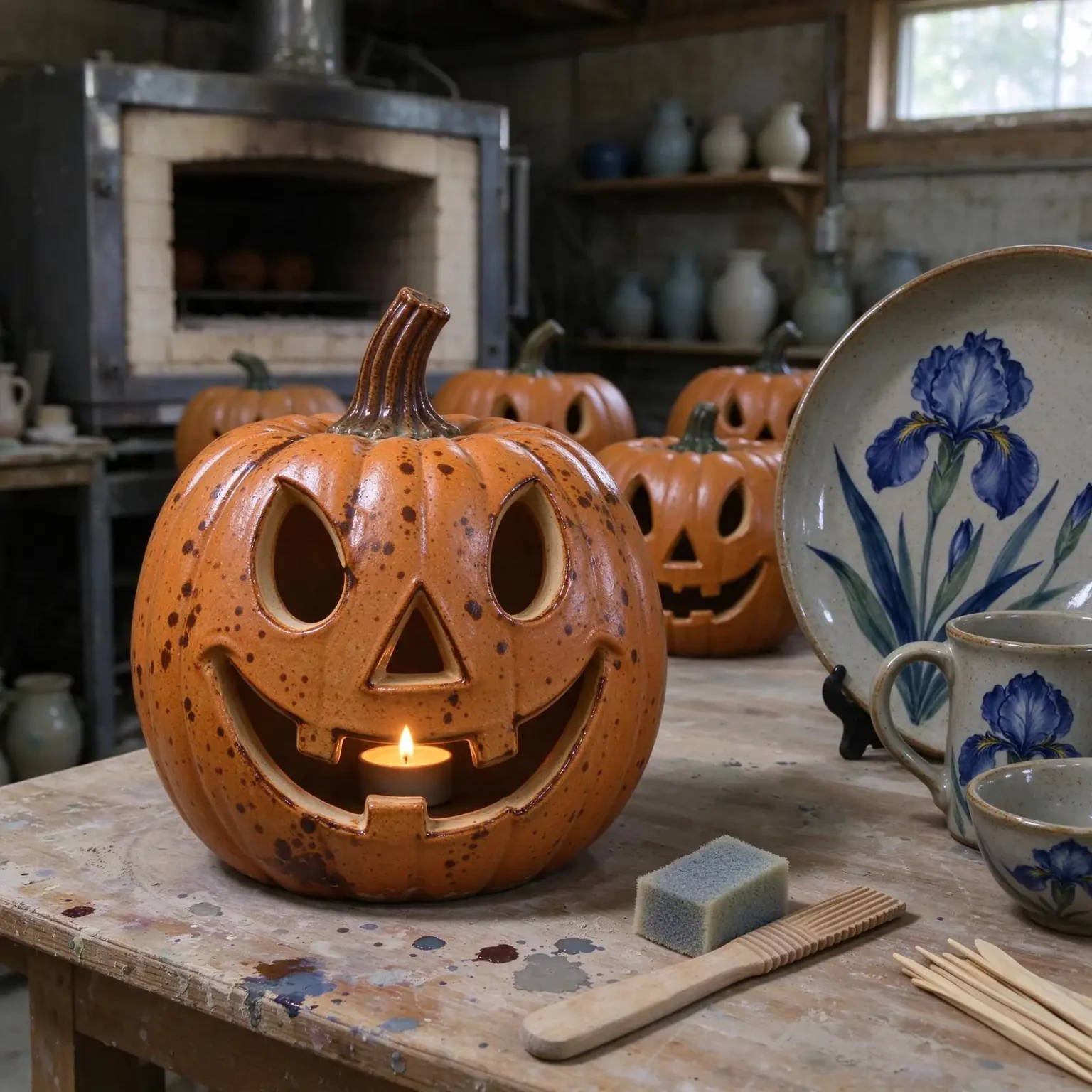
CLAY CITY, Ala. — Tom Jones Pottery, a Baldwin County studio known for hand-thrown functional stoneware decorated with cobalt-blue irises, is marking 50 years in business in 2026. To celebrate the milestone, the shop expects to finish about 1,000 of its ceramic jack-o’-lanterns by December, well above the roughly 700 it usually produces in a year.
The business has worked out of the same building in Clay City since 1980, making it one of the longest-running independent craft studios on the Eastern Shore and in the wider Mobile Bay region.
The business at a glance
- Founded: 1976
- Current location: a 1940s pottery building in Clay City, occupied since 1980
- Specialty: functional pottery such as plates, mugs, pitchers, jars and vases
- Signature decoration: blue irises painted in cobalt glaze
- Seasonal favorite: hand-built jack-o’-lanterns, made from spring through fall
- Studio hours at the wheel: roughly 2 p.m. to 9:30 p.m. on weekdays
- Kiln fuel: natural gas
Jack-o’-lanterns by the hundreds
Although the studio’s main focus is everyday tableware, its ceramic jack-o’-lanterns have become one of its best-loved products. Production usually starts in April or May and runs through October or November, with about 700 pieces in a normal year. Interest tied to the 50th anniversary pushed this year’s total toward 1,000, with the last of them scheduled for completion in December.
Each one is made with deliberately uneven features, such as a lopsided grin or eyes that do not quite line up, so that no two match. The design traces back to a teardrop-shaped incense burner made in 1968 as a gift for the potter’s grandfather. That early piece, finished in a black glaze speckled with gray, has slanted eyes, a triangular nose and a broad mouth, and it is still kept at the shop, signed and dated on its base.
The iris pattern
The blue iris is the decoration most closely linked to the studio. It appears on a wide range of pieces and on postcards sold at the front counter. The motif grew out of a family tradition: irises were grown by the potter’s grandparents in Arkansas and later by his father. An early interest in cobalt blue glazes led to the first attempt at painting the flowers on a pot, and the pattern has been a mainstay ever since.
Roots at the Organic School
The studio’s approach to the craft took shape at the Marietta Johnson School of Organic Education in Fairhope. Founded in 1907 by educator Marietta Johnson, the school became nationally known for a progressive model that emphasized hands-on learning, arts and crafts, and the development of the whole child rather than standardized testing.
Pottery there was taught by Edith Harwell, who ran Pinewood Pottery in Fairhope with her husband and was a leading figure in Eastern Shore ceramics. Her philosophy stressed simple shapes and pieces meant to be used rather than merely displayed. She also insisted that potters sign and date the bottom of every piece, a habit the studio still follows; customers occasionally bring in decades-old items bearing those marks.
Classes were held in the school’s Arts and Crafts Building in downtown Fairhope, on grounds that are now a campus of Coastal Alabama Community College. The future potter first saw Harwell working at a wheel during the Fairhope Arts and Crafts Festival and later, as a ninth grader at the school, watched her throw a pitcher. He graduated in a class of nine students.
College and early career
A scholarship took him to Mississippi College, where he became the first freshman permitted to take pottery. Faculty there recommended a teaching career, cautioning that full-time pottery rarely paid a living wage.
After college, he taught at the Organic School and then worked for Ralph Jennings, a potter in Clay City. Tom Jones Pottery was launched in 1976. For about six months it ran out of a home, then moved to a shop in Daphne. In 1980 the business took over the former Jennings Pottery building in Clay City, where it has remained for 46 years.
Learning the local clay
The early work used wild clay dug a few hundred yards from the shop. Getting that material to behave took time. One recurring problem was shivering, a glaze defect in which a mismatch between how the clay body and the glaze shrink during cooling puts the glaze under too much compression, causing it to flake away from the edges of a fired piece. Solving it took about a year and a half. Local wild-clay digging in Clay City ended decades ago, and the studio now buys its clay from Ohio.
Each kiln firing was a financial gamble in those years, since a failed load meant lost income. The firing process itself produces telltale sounds as pieces cool, and certain pinging noises signaled that glazes were cracking or separating.
Financial ups and downs
Money was the main challenge for most of the studio’s history; the first 30 years were especially uncertain. In the late 1990s, with sales flat, two employees on the payroll and credit card debt building, the business came close to closing. A representative at the studio’s bank stepped in to help work through that crisis.
Other setbacks included a $3,500 monthly gas bill for the natural-gas kiln, which turned out to be a billing error that was corrected. A reliable bookkeeper and accountant helped keep the books on track over the years.
At one point the studio sold wholesale to 16 galleries along the Gulf Coast. A series of hurricanes in the early 2000s ended that arrangement, as storms damaged or closed many of the retail outlets the shop depended on.
How the word spread
The studio has done little paid advertising. Its national following grew largely through seasonal visitors, often called snowbirds, who winter in and around Fairhope, buy pieces, take them home and share them with friends and relatives in other states. Customers sometimes call simply to say they are drinking coffee from one of the shop’s mugs, and some younger buyers have inherited full sets of the studio’s plates.
For the first 25 years, the potter’s mother ran the front of the shop, handling customers so the work in the back studio could continue without interruption. After she stepped away, customer relationships became a bigger part of the daily routine.
A building with its own history
The Clay City shop was constructed in the 1940s as a pottery, using clay tile manufactured nearby. Its builders took an unusual shortcut to support the roof: they topped a stand of pine trees and attached the roof framing to the remaining stumps, which stood about 10 feet tall. The stumps no longer carry the roof’s weight but remain inside the building. Overhead beams are reclaimed lumber from the Port of Mobile, and the floor is poured concrete.
Some of the original pottery machinery is still in place, though the studio now relies on more modern equipment.
Clay City and Baldwin County pottery
Clay City is a small unincorporated community in Baldwin County that takes its name from the clay deposits that once supported brick, tile and pottery production in the area. Baldwin County’s Eastern Shore, including Fairhope, Daphne and Point Clear, has long had an active arts community, and the annual Fairhope Arts and Crafts Festival held each March is among the largest outdoor art shows in the Southeast.
Functional pottery, sometimes called utilitarian ware, has deep roots across the South, where potters historically produced churns, jugs, crocks and tableware for farm households. Studio potters working in that tradition today focus on durable pieces intended for daily use in the kitchen and at the table, often made in large volumes and fired at stoneware temperatures for strength.
How a production pottery operates
Making a single plate or mug at a studio like this involves several stages. Clay is wedged to remove air pockets, then centered and thrown on a spinning wheel. Pieces are left to firm up before handles are attached and bases trimmed, and they must dry slowly and evenly to avoid cracking. Most stoneware goes through two firings: a lower-temperature bisque firing that hardens the clay, followed by glazing and a hotter glaze firing that fuses the glass coating to the body.
Gas-fired kilns, like the one used in Clay City, are common among production potters because they can reach stoneware temperatures well above 2,000 degrees Fahrenheit and give the potter control over the kiln atmosphere, which affects glaze color. Cobalt, the source of the studio’s iris blue, is one of the most stable and widely used ceramic colorants and holds its color reliably at high temperatures.
The Organic School itself still operates in Fairhope, continuing the educational approach its founder introduced more than a century ago.
The work itself
Running a production pottery is physically demanding. The studio is kept humid so pieces dry evenly, and wet clay gives off a strong earthy odor. Throwing at the wheel for more than seven hours each weekday requires stamina, and volume is essential to staying in business. Young people have expressed interest in apprenticing, but production pottery requires turning out far more than a dozen mugs in a day.
Over five decades, the studio has produced tens of thousands of pieces. Many of them, signed and dated on the bottom, remain in daily use in homes across the country, and there are no announced plans to slow down.