CMT’s ‘Sweet Home Alabama’ Reality Series Set to Film in Fairhope
CMT announced its reality dating series Sweet Home Alabama would film in Fairhope, featuring bachelors competing for a University of Alabama student.
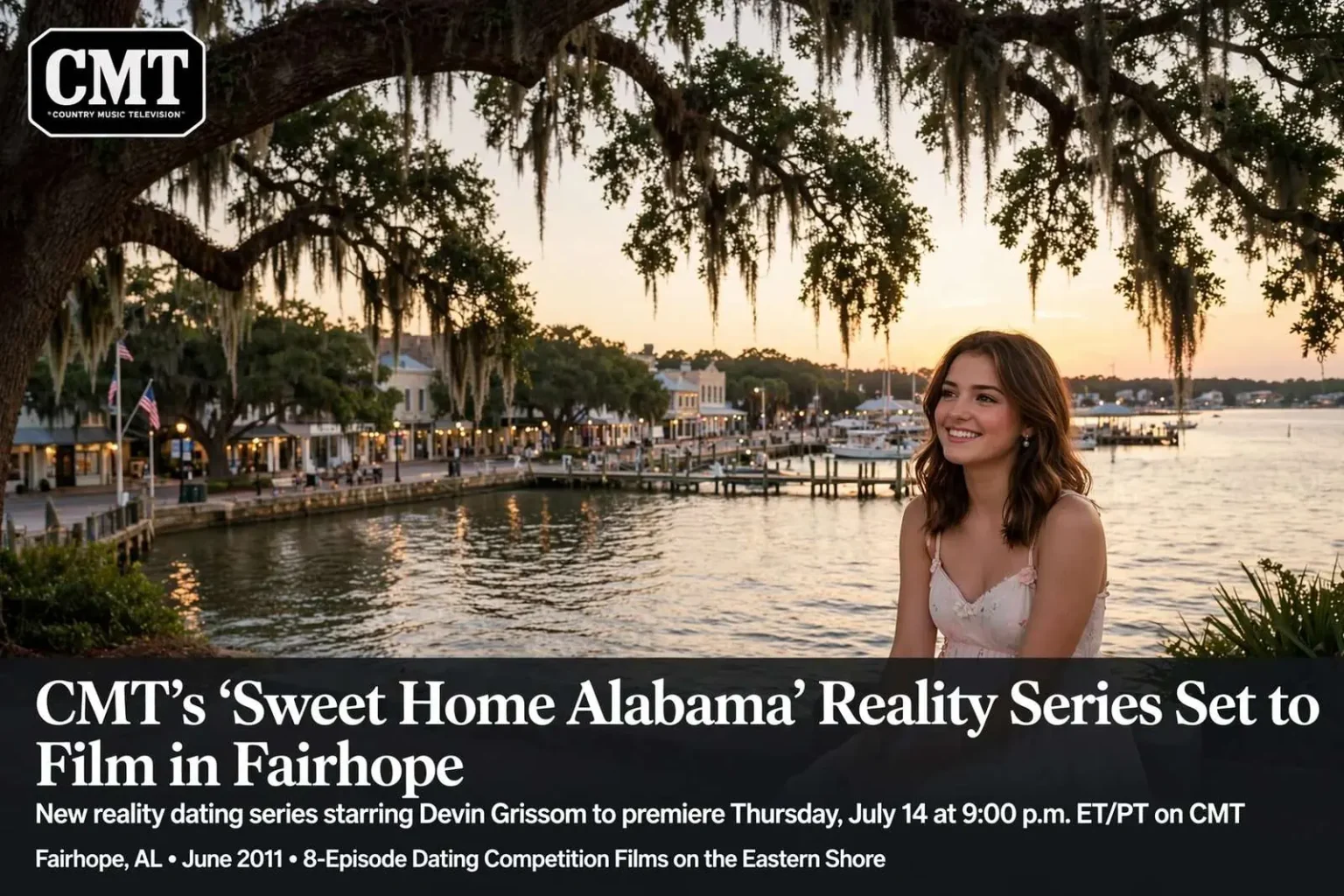
The cable network CMT announced in June 2011 that it would bring a new reality dating series to the small coastal city of Fairhope, Alabama. The show, titled Sweet Home Alabama, was set to premiere on Thursday, July 14, 2011, at 9:00 p.m. ET/PT, putting the Baldwin County community on the national television map. For a bayside town known more for its boutiques, blufftop parks and quiet sidewalks than for cameras and production crews, the announcement represented an unusual moment in the spotlight.
CMT, the Nashville-based country music and lifestyle network, had been steadily expanding its slate of original programming, and reality dating had become one of the most reliable draws in cable television. Network executives bet that a Southern-flavored take on the format, filmed in an authentically Southern town rather than a Hollywood backlot, would resonate with the channel’s core audience across Alabama and the wider Gulf Coast region. The title itself, borrowed from the unofficial anthem of the state, left little doubt about the identity the show intended to project.
A Southern Dating Competition
The eight-episode series centered on Devin Grissom, a University of Alabama student originally from Cordova, Tennessee, who described herself as a devoted southern belle with deep respect for tradition. Each one-hour episode followed the competition as Grissom narrowed a field of twenty bachelors through a series of eliminations, all in pursuit of a lasting relationship rather than a brief summer romance.
Grissom brought a background that producers clearly considered made for the part. An avid Southeastern Conference football fan, she harbored aspirations of a career in sports public relations, a field with deep roots in a state where college football dominates the cultural calendar from August bowl-season speculation to spring practice. She said she was looking for a partner who shared her values and could earn her family’s approval, a requirement that shaped the tone of the competition from its first episode.
The show’s format pitted the twenty competitors against one another in a series of challenges staged around Fairhope, with the city’s charming downtown and waterfront scenery serving as the backdrop. Group dates, head-to-head contests and one-on-one conversations filled the hourlong installments, and the elimination ritual that closed each episode gave the series the episodic tension that viewers of the dating-competition genre had come to expect.
Filming in Fairhope also gave the production a distinct sense of place that no studio set could replicate. Contestants and cameras moved along streets shaded by centuries-old live oaks, past the storefronts of the downtown business district, and out to the waterfront where Mobile Bay stretched toward the horizon. The setting functioned almost as a character of its own, showcasing the unhurried pace and postcard scenery that residents of the Eastern Shore have long taken pride in.
Local Contestants in the Mix
Among the twenty competitors were several men with strong ties to South Alabama and the broader region, giving area viewers familiar hometown faces to follow. Britton McPherson, a vintage home restoration carpenter from Mobile, and Cody Harris, a rodeo professional from Robertsdale in Baldwin County, represented the immediate local area. Their trades said much about the character of the region: historic restoration work in one of Alabama’s oldest port cities, and the rodeo circuit that remains a fixture of rural Baldwin County life.
Multiple contestants also hailed from Birmingham, including U.S. Marine veteran Beau McKinney, landscape company owner Collin Varallo, and bartender Tribble Reese. Their presence gave the state’s largest metropolitan area a substantial stake in the outcome, and the mix of military, small-business and service-industry backgrounds reflected the range of men the casting process had gathered from across the country.
The remaining bachelors traveled from cities across the country, including Los Angeles, New York, Las Vegas, San Diego, and several towns throughout Tennessee and the Southeast. The coast-to-coast roster meant the competition was not simply a Southern affair, and producers made the contrast between big-city contestants and their small-town rivals part of the show’s on-screen dynamic, playing regional identity for both humor and genuine cultural friction.
For Grissom, the geographic spread presented a real sorting problem that went beyond surface impressions. A contestant accustomed to the pace of Los Angeles or Las Vegas would face an adjustment to life on the Eastern Shore, where social life revolves around churches, high school football Fridays and gatherings on the bay, while a South Alabama native would understand those rhythms without explanation. The search, in other words, was as much about finding a man who fit a place as one who fit a person.
Local interest in the series ran high in the weeks before the premiere. Residents scanned the promotional material for recognizable names, business owners anticipated an influx of curious visitors, and fans of the genre across Mobile and Baldwin counties marked the July 14 premiere date on their calendars. Few national productions had ever chosen the city as a full-season filming location, and the novelty alone guaranteed attention.
Production Details
The series was produced by Glassman Media, the production company behind the ABC show Three Wishes. Andrew Glassman, Grant Julian, and Carrie Franklin served as executive producers, with Claire McCabe and Jayson Dinsmore overseeing the project for CMT. The arrangement paired an established independent production house with the network’s own development executives, a structure common in cable reality programming in which the production company handles day-to-day filming while the network retains final say over story and tone.
Bringing a full television crew to a city the size of Fairhope required weeks of advance work before the first episode ever aired. Locations had to be secured along the downtown streets and the waterfront, permits coordinated with city officials, and the practical logistics of moving twenty contestants, hosts, camera operators and equipment around a small Southern town worked out in detail. Residents grew accustomed to seeing production activity around familiar landmarks, and many followed the progress of filming with a mixture of curiosity and civic pride.
The choice of Glassman Media also signaled the show’s ambitions. Three Wishes had demonstrated the company’s ability to produce emotionally driven, family-friendly programming, and Sweet Home Alabama pursued a similar tone: a romance competition that leaned on sincerity and Southern tradition rather than the manufactured conflict that characterized some entries in the genre. The emphasis on family approval, courtship and small-town values was consistent from the concept down to the choice of host city.
Fairhope in the National Spotlight
The selection of Fairhope as the filming location put the Baldwin County city in a national spotlight, showcasing its tree-lined streets, scenic Mobile Bay views, and welcoming small-town atmosphere to a cable television audience. Founded in the late nineteenth century as a utopian single-tax colony, Fairhope had long cultivated a reputation as one of the Gulf Coast’s most distinctive small towns, drawing artists, writers and retirees to its blufftop park and public pier overlooking the bay.
For local leaders and business owners, the exposure carried obvious appeal. Every episode functioned as a long-form tourism advertisement for the Eastern Shore, reaching an audience that might never otherwise encounter the city, and reinforcing the connection between Fairhope and neighboring communities such as Daphne, Spanish Fort and the city of Mobile across the bay. Regional viewers, meanwhile, could point to recognizable scenery and claim a share of the show’s success as their own.
The series also joined a broader pattern in which unscripted television increasingly sought out authentic locations instead of the Los Angeles soundstages that once defined the genre. For Gulf Coast communities working to diversify their economies beyond tourism and shipping, a national production choosing to film an entire season locally was a small but meaningful validation of the region’s appeal.
By the time the premiere arrived, the series had already accomplished what civic promoters along the Eastern Shore could rarely achieve on their own: a sustained national audience for the scenery and spirit of Fairhope. Whether the show ultimately found lasting romance for its bachelorette mattered less to local observers than the simple fact that a Baldwin County city had served as the stage for a network television production from start to finish.
The eight-episode run promised to carry Sweet Home Alabama through the heart of the summer of 2011, with new episodes airing in the Thursday night slot week after week. The schedule gave the show a full season to build an audience, and gave the twenty bachelors ample opportunity to make their case in challenges and one-on-one dates across the city.
For the competitors themselves, the stakes extended beyond romance. Appearance on a nationally broadcast series brought exposure of its own, whether for a Birmingham business owner, a Mobile craftsman or a Baldwin County rodeo professional, and several contestants were expected to leverage their television profiles long after the final elimination. For the twenty bachelors, the competition offered a shot at a relationship with a woman who knew exactly what she wanted; for Fairhope, it offered something rarer still, an extended close-up watched by the entire country.