Coach remembers Evergreen teen Star Simpson
Hillcrest High School cheerleading coach Lashonda Marshall remembers Star Simpson, an Evergreen teen killed in a crash on Highway 84 in Repton.
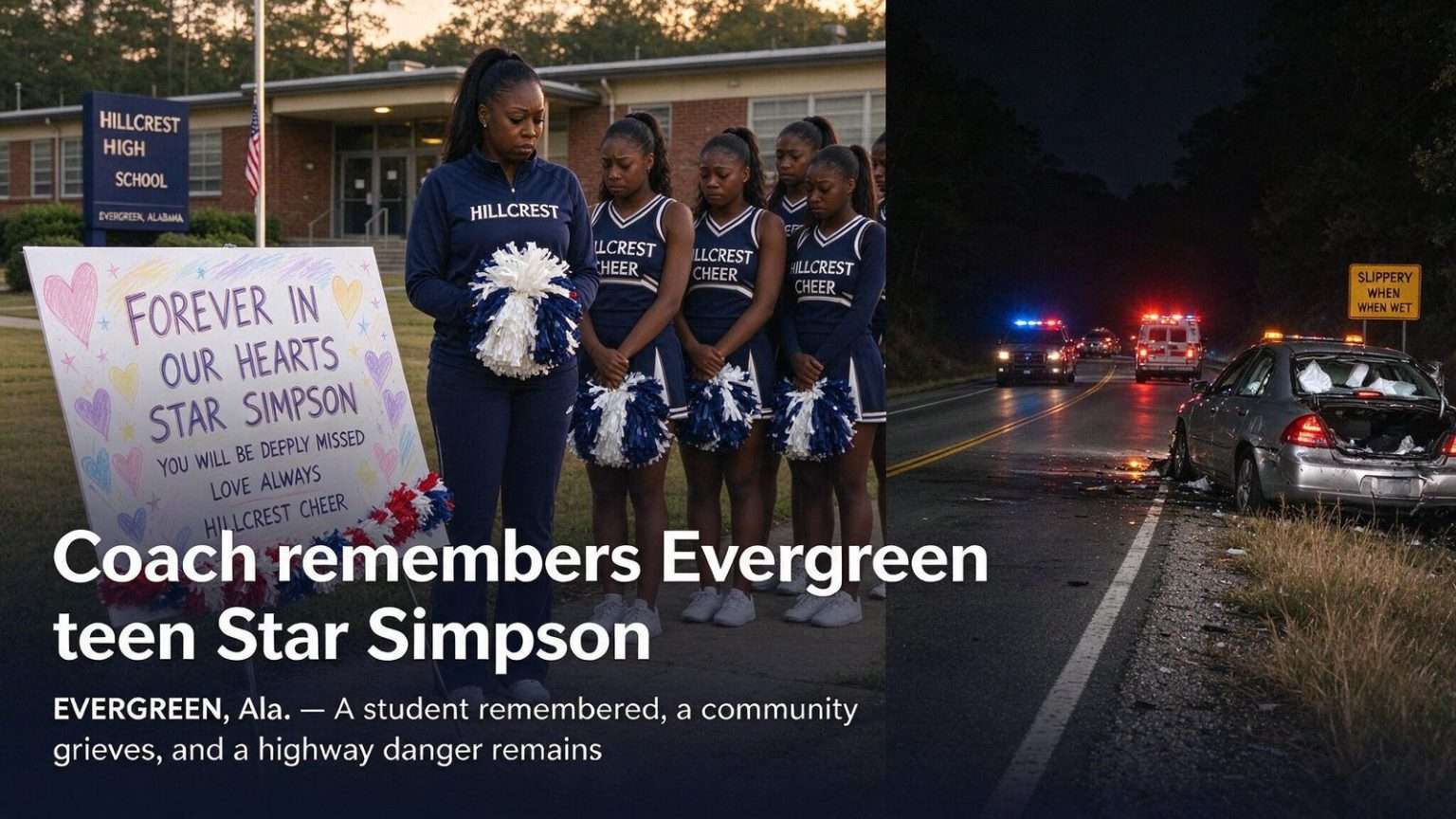
EVERGREEN, Ala. — Star Simpson is a name the faculty at Hillcrest High School in Evergreen won’t soon forget. The teenager’s death on a stretch of Highway 84 near Repton has left the small Conecuh County community grieving, and those who knew her at school are remembering a student who left a mark on the people around her.
“You know when you’re an educator you’re not there to just teach the books, you’re there to teach them life,” said Lashonda Marshall, the school’s cheerleading coach, reflecting on the student she had worked with at Hillcrest. The words capture what teachers and coaches across rural south Alabama often describe as the real work of a small-town school: forming relationships that make a loss like this one hit an entire campus, not just a single classroom.
According to Alabama State Troopers, Simpson was killed Thursday night when her car hit an embankment on Highway 84 in Repton, a small community in neighboring Conecuh County’s west along the U.S. 84 corridor. What happened next, troopers said, made the crash even more heartbreaking. Simpson had gotten out of the wrecked vehicle and tried to flag down help when she was struck and killed.
A dangerous stretch of highway
U.S. Highway 84 is a major east-west federal route that crosses south Alabama, linking communities from the Georgia line all the way to Mississippi, and the segment near Repton carries a steady mix of local traffic and long-haul travelers. Like many rural highways in the region, it passes through stretches of darkness with no overhead lighting, and traffic moves at highway speeds even as the road winds through small communities and past driveways and side roads.
Troopers investigate crashes along this corridor regularly, and the circumstances Simpson’s crash involved — a vehicle leaving the roadway at night, a driver on foot along or near the highway — are among the most dangerous scenarios that occur on rural routes. Public safety officials across Alabama consistently urge drivers who are involved in a wreck to remain in their vehicle with seatbelts fastened when it is safe to do so, to turn on hazard lights, and to call 911 rather than walking along the roadway in traffic, especially after dark.
Those guidelines exist because drivers approaching a crash scene at night often have difficulty seeing a person on or near the roadway until it is too late. Pedestrians on rural highways face some of the highest risk of any roadway users, and safety campaigns across the state continue to emphasize the danger of exiting a vehicle on a high-speed highway, particularly in darkness.
Grief in a small school community
Hillcrest High School serves students from Evergreen and the surrounding parts of Conecuh County, and in a school that size, the loss of one student touches nearly everyone. Teachers, coaches, and classmates share the same hallways, the same athletic events, and often the same churches and neighborhoods, which means a death of this kind reverberates through the community in ways that larger schools rarely experience.
Schools in Alabama typically respond to a student death with counseling support brought in from the county system, giving classmates a place to grieve and talk through the loss with professionals. Coaches and activity sponsors like cheerleading coaches often become a focal point of that response, because the students they work with know them well and the bonds formed through a squad or team run deep.
The scene of a nighttime wreck on a rural highway presents challenges for first responders that urban crashes rarely do. Locations along U.S. 84 near Repton can be several minutes from the nearest fire station or ambulance post, and dispatchers must sort out exactly where a crash occurred on a long, dark corridor before help can be directed to the right spot. The Alabama Law Enforcement Agency’s Highway Patrol posts cover wide territories in rural south Alabama, which means troopers responding to a fatal crash may be coming from another county entirely.
Once a crash involves a fatality, the investigation becomes more extensive. Troopers document the scene in detail, request support from the state’s criminal investigation and reconstruction resources as needed, and work with the county coroner, who is responsible for the decedent under Alabama law. The findings that emerge — why the vehicle left the roadway, and how the pedestrian who left the crash came to be struck — typically take days or weeks to be finalized, and troopers generally do not release preliminary conclusions.
For the Simpson family and the Repton and Evergreen communities, those procedural realities are secondary to the loss itself. What began as a single-vehicle crash ended with a young life lost on the shoulder of a highway, and the sequence of events that troopers described — a driver climbing from a wrecked car to seek help — has resonated with everyone who has heard the account.
Road safety lessons the crash underscores
Safety officials use crashes like this one to reinforce guidance that many drivers have never been taught. If a vehicle becomes disabled, the recommended steps are to pull as far off the roadway as possible, stay buckled inside with hazards on, and call for assistance. If a fire or other immediate danger forces a driver from the vehicle, the advice is to move as far away from the travel lanes as possible, getting behind guardrails or up an embankment rather than standing near the shoulder where a passing vehicle can drift.
For other drivers, the guidance is slower down, move over, and stay alert for people and vehicles on the shoulder, especially at night and in rural areas where deer, disabled vehicles, and pedestrians on the roadside are all common. Alabama’s move over law requires drivers to change lanes away from stopped emergency, recovery, and utility vehicles, and to slow down when they cannot change lanes safely.
None of that guidance changes what happened Thursday night, but the circumstances of Simpson’s death are a reminder of how quickly a crash can become a larger tragedy, and of why the habits drivers build behind the wheel matter for everyone on and near the road.
Remembering Star Simpson
Back at Hillcrest High School, the work of remembering goes on. Educators at small schools often speak of their students as extensions of their own families, and Coach Marshall’s words — about teaching life, not just the books — describe a philosophy that animates teachers and coaches across south Alabama’s rural schools.
The students who knew Simpson at Hillcrest will carry her memory through the rest of their school years, and the faculty who taught her will remember her in the classrooms and events where she was part of daily life. In communities like Evergreen and Repton, that is how loss is carried: together, and close to home.
Evergreen, the county seat of Conecuh County, is a community of roughly 3,600 people along Interstate 65 between Greenville and Atmore, while Repton sits a short drive to the south along the U.S. 84 corridor that connects the county’s smaller communities. The two towns share schools, churches, and family ties, and news of a fatal crash involving a local student spread through both communities quickly, as it always does in a place where nearly everyone knows the family of everyone else.
Thursday night’s crash was investigated by troopers from the Alabama Law Enforcement Agency, whose Highway Patrol handles crash response across the rural counties of south Alabama. In sparsely populated counties like Conecuh and neighboring Monroe, a single trooper post may cover hundreds of square miles of highways, including interstates, federal routes, and farm-to-market roads. Response times to nighttime rural crashes can be long, and the first help on scene often comes from volunteer fire departments and neighbors who live nearby.
Volunteer firefighters along the U.S. 84 corridor respond to wrecks in their response areas day and night, providing traffic control, scene lighting, and first aid until ambulances arrive from the nearest station. Rural counties across Alabama depend on this layered response system, in which volunteers, county ambulances, municipal police, and state troopers each play a defined part in working a serious crash scene.
Why embankment crashes are serious
The crash troopers described involved a car striking an embankment, a common type of single-vehicle wreck on rural highways where shoulder drop-offs, curves, and unpaved margins line the roadway. When a vehicle leaves the pavement at highway speed, hitting a raised embankment or ditch slope can cause the car to overturn or stop abruptly, and the force involved frequently results in serious injury even when the vehicle looks superficially intact afterward.
Highway engineers address these hazards where they can, with guardrails, clear zone grading, and signage at known problem curves, but rural routes like U.S. 84 include long stretches that retain the geometry of older road construction. State transportation officials prioritize rural safety projects based on crash history, and stretches with repeated run-off-road crashes eventually receive attention, though improvements often trail years behind the need.
Drivers on rural highways at night face added risk from factors that daylight driving does not present: reduced visibility, fatigue, wildlife crossing the roadway, and the difficulty of judging curves and intersections in darkness. Crash statistics across Alabama show that a disproportionate share of fatal wrecks occur at night and on rural roads, which is why state safety campaigns focus on those conditions specifically.
Support for the family and the school
In the days following a student’s death, school communities across south Alabama typically organize support that extends beyond counseling sessions. Athletic teams and squads often plan tributes, classmates coordinate memorials, and churches open their doors for gatherings where students and adults can grieve together. Those customs reflect the close-knit character of communities like Evergreen, where school activities sit at the center of civic life.
For coaches and teachers, the loss of a student is a professional and personal blow that many describe as the hardest part of the work. Educators in rural schools often teach the same students for multiple years, watch them grow from middle school to graduation, and follow their lives long afterward, which makes a death like Simpson’s a loss the faculty carries personally.
Alabama State Troopers continue to investigate the crash, and the findings of that investigation will eventually document the sequence of events on Highway 84 that Thursday night. For now, the community’s focus remains where it began that evening: on a student the faculty of Hillcrest High School will not forget.