Community Action Agencies Serving Mobile, Baldwin and Southwest Alabama Win $433,390 in Self-Sufficiency Grants
Two community action agencies covering nine southwest Alabama counties will receive $433,390 of a $2.63 million statewide award for education, job and financial literacy programs.

UPDATE, Nov. 26: Gov. Kay Ivey’s office has released the full statewide breakdown of the Community Services Block Grants, which add up to $2,630,106 across 18 community action agencies. The governor’s office described the awards as support for programs that help families facing financial hardship work toward self-sufficiency, with services that can include emergency help with health care, nutrition and housing as well as youth and family development, depending on local needs. ADECA is administering the money, which originates with the federal health and human services department.
Beyond the two Gulf Coast agencies, south Alabama awards include $139,796 for the Southeast Alabama Community Action Partnership (Barbour, Coffee, Geneva, Henry and Houston counties) and $122,333 for the Organized Community Action Program (Pike, Bullock, Butler, Covington, Crenshaw, Dale and Lowndes counties). In west and central Alabama, Community Service Programs of West Alabama receives $248,948 for a 10-county area that includes Choctaw, Dallas, Sumter and Tuscaloosa counties; the Montgomery Community Action Committee and Community Development Corporation receives $155,971; the Community Action Partnership of Middle Alabama receives $143,982 for Autauga, Chilton, Elmore and Shelby counties; the Alabama Council on Human Relations receives $110,051 for Lee County; the Talladega, Clay, Randolph, Calhoun and Cleburne agency receives $62,369; the Macon Russell Community Action Agency receives $59,607; the Chambers-Tallapoosa-Coosa committee receives $53,214; and the Pickens County agency receives $12,995.
The largest single award, $544,272, goes to the Community Action Agency of Northeast Alabama, whose territory includes Jefferson County along with Blount, Cherokee, DeKalb, Jackson, Marshall and St. Clair. Other north Alabama awards are $183,920 for the Huntsville-based partnership serving Madison and Limestone counties, $162,259 for the Community Action Partnership of North Alabama, $93,158 for the Northwest Alabama agency, $62,369 for Community Action of Etowah County and $41,472 for the Walker County agency. Mobile Community Action’s $250,175 is the second-largest award in the state. The original report follows, with the statewide total corrected.
MOBILE, Ala. — Community action agencies serving Mobile, Baldwin and a string of southwest Alabama counties will share more than $433,000 from a new round of state-administered grants aimed at helping lower-income families reach financial independence. The awards are part of $2.63 million the Alabama Department of Economic and Community Affairs, known as ADECA, is distributing to 18 agencies around the state.
The money supports programs focused on education, employment and financial literacy, three areas that state officials describe as building blocks for households trying to move from hardship toward stability. The grants come from federal dollars provided by the U.S. Department of Health and Human Services, with ADECA handling distribution in Alabama.
The Local Awards at a Glance
- Mobile Community Action Inc.: $250,175, serving Mobile and Washington counties
- Community Action Agency of South Alabama: $183,215, serving Baldwin, Clarke, Conecuh, Escambia, Marengo, Monroe and Wilcox counties
Together, the two agencies will receive $433,390, or roughly 16% of the statewide total. With $2.63 million spread among 18 recipients, the average award across Alabama works out to about $150,000, which places both Gulf Coast agencies above that mark.
Who Is Covered
The combined service area of the two agencies stretches from the Mississippi line to the Florida line and well up into the state’s Black Belt. It takes in some of Alabama’s fastest-growing communities as well as some of its most rural and economically strained ones.
Mobile and Washington counties
Mobile Community Action’s territory pairs the state’s second-most-populous county with one of its smaller rural neighbors. Mobile County includes the city of Mobile, its port and a wide range of urban, suburban and rural neighborhoods, from Prichard and Chickasaw to Grand Bay and Bayou La Batre. Washington County, directly to the north, is a heavily forested, sparsely populated county whose seat is Chatom and whose economy has long leaned on timber and chemical manufacturing along the Tombigbee River.
Seven counties across southwest Alabama
The Community Action Agency of South Alabama covers a much larger footprint:
- Baldwin County, the state’s largest county by land area, with its seat in Bay Minette and growing communities along the Eastern Shore and the coast
- Clarke County, with its seat in Grove Hill
- Conecuh County, with its seat in Evergreen
- Escambia County, Alabama, with its seat in Brewton, not to be confused with Escambia County, Florida, which lies just across the state line around Pensacola
- Marengo County, with its seat in Linden
- Monroe County, with its seat in Monroeville
- Wilcox County, with its seat in Camden
Several of those counties are largely rural, with small towns, long distances between services and limited public transportation. In such places, getting to a job training class, a GED program or a financial counseling session can be a hurdle in itself, which is part of why community-based agencies with local offices play an outsized role.
The timing also matters for part of that region. Escambia, Conecuh, Monroe and Wilcox counties were among the areas struck by Hurricane Isaias in October, and many households there are still dealing with storm cleanup and repairs while the state waits on a federal disaster decision. The self-sufficiency grants are a separate program and are not storm relief, but they will flow into communities where many families are under added financial pressure.
What the Money Is Meant to Do
State officials said people facing financial hardship often find it difficult to recover on their own and can come to feel there is no way out without help. They described the funded programs as using a variety of approaches to steer people toward a better life, and said the state was glad to make the money available.
The emphasis on self-sufficiency sets these grants apart from one-time emergency help. Rather than simply covering a bill, programs of this type generally aim to change a household’s longer-term situation. Within the three focus areas, that can look like:
- Education: help pursuing adult education, high school equivalency credentials or job-related training
- Employment: job readiness, connections to employers and support that helps people keep work once they find it
- Financial literacy: budgeting, managing debt, understanding credit and planning for unexpected expenses
The specific services offered with this round of funding will depend on each agency’s own programs and on the needs it identifies in the counties it serves.
How Community Action Agencies Work
Community action agencies trace their roots to the federal antipoverty efforts of the 1960s, when the Economic Opportunity Act of 1964 created a national network of local organizations to fight poverty at the community level. Today, roughly 1,000 such agencies operate across the United States, covering nearly every county.
Much of their core federal support flows through the Community Services Block Grant, a program of the U.S. Department of Health and Human Services. Under that structure, federal money goes to states, and each state passes most of it through to the local agencies in its network. In Alabama, ADECA is the state agency that performs that role.
A defining feature of the model is local governance. Private nonprofit community action agencies are generally required to have a three-part board made up of elected public officials, representatives of low-income residents of the area and members of the private sector. The idea is that the people who use the services, the governments that serve them and the business community all have a voice in how the money is spent.
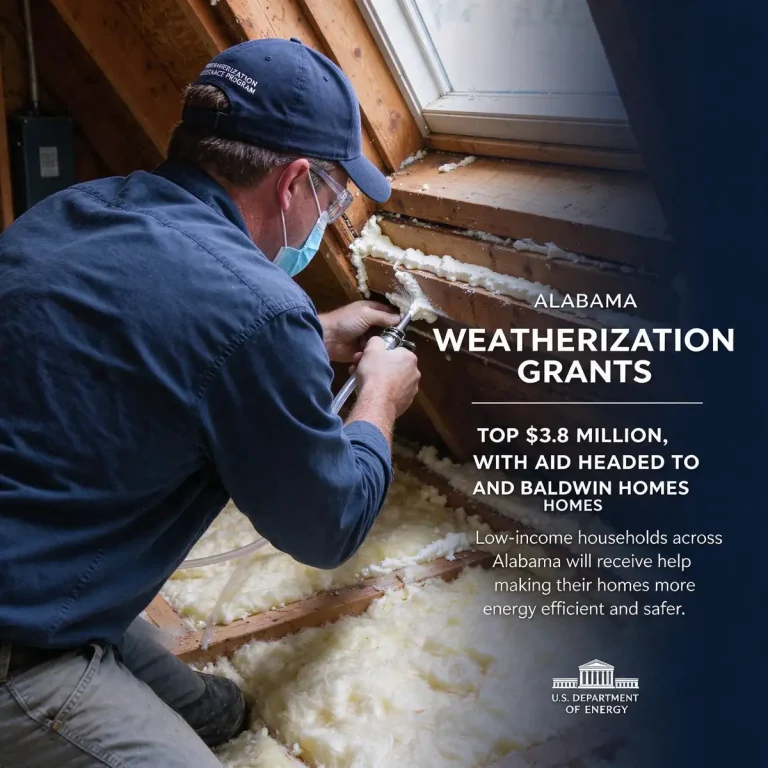
Beyond self-sufficiency programs, community action agencies commonly administer a range of other help for lower-income households, such as energy bill assistance, home weatherization and early childhood programs. Because many residents already know their local agency through those services, it often becomes a single front door for families seeking several kinds of support.
ADECA’s Role in the State
The Alabama Department of Economic and Community Affairs is the state agency that manages a wide portfolio of federal and state grant programs. Its work touches community development, energy, workforce, recreation, law enforcement and victim services, among other areas. For many federal programs, ADECA is the link between Washington and the local governments and nonprofits that actually deliver services.
In this case, the department is administering funds made available by the U.S. Department of Health and Human Services and awarding them to community action agencies around the state, including the two serving the Gulf Coast and southwest Alabama.
Why Self-Sufficiency Programs Matter Locally
Alabama’s poverty rate has long ranked among the higher rates in the nation, and many of the rural counties in the southwest part of the state face persistent economic challenges, including fewer local jobs, long commutes and limited access to training. In growing areas such as Baldwin County, rising housing costs can squeeze lower-income households in a different way, even as job opportunities expand.
Programs that pair education and job preparation with practical money management are designed to address more than one side of that problem at once. A family that gains a credential, lands steadier work and learns to manage a budget is better positioned to absorb an unexpected expense without falling into a crisis.
What Happens Next
With the awards announced, the two agencies will put the money to work through their programs in the counties they serve. Residents of Mobile and Washington counties who want to learn about available services can contact Mobile Community Action. Residents of Baldwin, Clarke, Conecuh, Escambia, Marengo, Monroe and Wilcox counties can reach out to the Community Action Agency of South Alabama.
Eligibility rules for programs of this kind are typically tied to household income, and the agencies can explain which services a family may qualify for and what documentation is needed to apply. People seeking help are generally encouraged to ask about all of the programs an agency offers, since a single visit can open the door to more than one form of assistance.