
Coroner Identifies Woman Found Dead Near Conecuh County Cemetery
The Conecuh County Coroner's Office identified Stephanie Lowery, 37, of Repton, as the woman found dead near Johnson Cemetery on Aug. 3. The cause of death has not been determined.
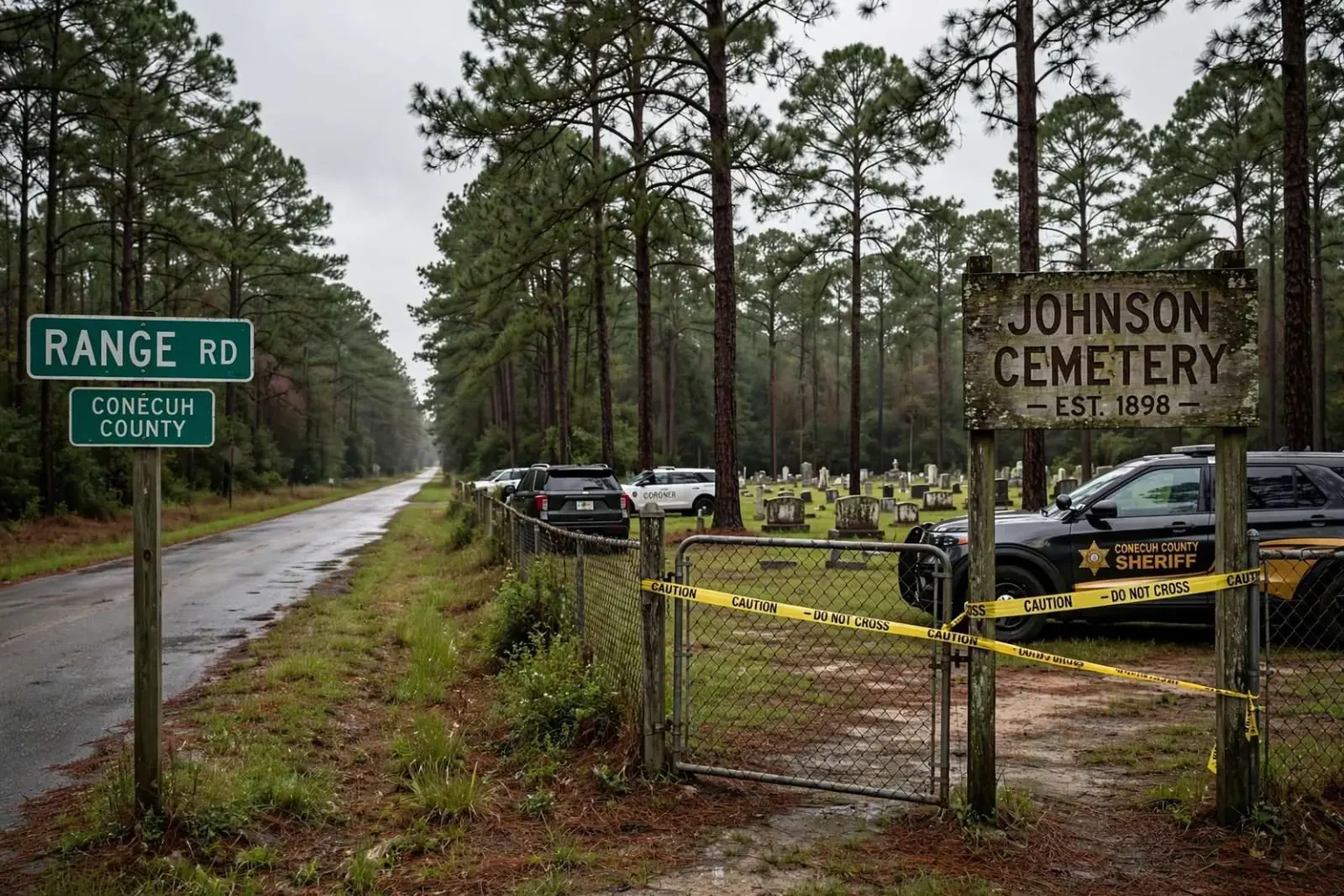
CONECUH COUNTY, Ala. — A death investigation is underway in Conecuh County after a woman’s body was found earlier this month near a cemetery in the rural Range community. The Conecuh County Coroner’s Office has identified the woman as Stephanie Lowery, 37, of Repton. Her body was found off Range Road near Johnson Cemetery around 12:45 p.m. on Aug. 3, and authorities say the circumstances of her death remain under active investigation.
The discovery site sits in one of the county’s quiet rural stretches, where Range Road runs through pine forest and pasture between small communities that dot the landscape south of Evergreen, the county seat. Johnson Cemetery, like the small burial grounds scattered across south Alabama’s rural counties, serves families who have worked the surrounding land for generations. It was in this setting, off the paved road and behind the tree line, that the body was found in the early afternoon of Aug. 3.
Whoever made the initial discovery alerted authorities, and the response that followed brought together the county’s sheriff’s office, the coroner, and state investigators — the standard arrangement in Alabama when a death’s circumstances are not immediately clear.
The identification
The coroner’s office identified the woman this week as Stephanie Lowery, 37, of Repton, a small town in the southwestern part of Conecuh County. Identification is the investigative step that unlocks everything that follows: notification of family, collection of medical and dental records for comparison, and the beginning of the process of establishing where the deceased was in the days before her death. Coroner’s offices in Alabama’s rural counties handle that work with the assistance of state agencies, since the volume of deaths in a small county does not support a large standalone staff.
Lowery’s body was sent to the Alabama Department of Forensic Sciences for examination, officials said. The state agency, which operates facilities serving Alabama’s counties, performs autopsies and forensic testing for coroners and medical examiners across the state. In cases like this one, the forensic examination is central: it is the path to determining both the cause of death — what physiologically ended the person’s life — and the manner of death, the classification that distinguishes natural death from accident, suicide, or homicide.
The cause and manner of her death have not yet been determined, according to the coroner’s office. That uncertainty is itself informative: it tells the public that the case is being treated with the full rigor of an unexplained death, and it explains why authorities are declining to release conclusions before the forensic work is complete.
Who is investigating
The Alabama State Bureau of Investigation, the Conecuh County Sheriff’s Office and the Conecuh County Coroner’s Office are all participating in the investigation. The arrangement is typical for Alabama’s rural counties, where sheriff’s offices handle day-to-day law enforcement with limited personnel and call on the state for investigative depth. The State Bureau of Investigation, part of the Alabama Law Enforcement Agency, supplies seasoned investigators who work homicides and unexplained deaths across the state, moving from county to county as cases require.
The division of labor matters to how cases like this proceed. Sheriff’s deputies secure the scene, canvass the area, and gather local knowledge — who lives along Range Road, who has been in the community recently, who might have seen vehicles in the days around Aug. 3. SBI agents conduct interviews, follow documentary leads, and coordinate the forensic submissions. The coroner’s office manages the legal determinations around the body itself, from identification to death certification once the forensic findings are in.
Authorities said additional information will be released as the investigation allows. That phrasing is the standard assurance investigators give in open death cases, and it reflects the balance they must strike between keeping the public informed and protecting the integrity of an active investigation.
Conecuh County and the Range community
Conecuh County sits in south-central Alabama, an area of pine forests, farmland and small towns where the population is measured in the low five figures across more than 850 square miles. Evergreen, the county seat, anchors the county’s commerce and sits along the Interstate 65 corridor, while communities like Repton, Range, and Castleberry spread across the rural interior. Life there runs on the rhythms of agriculture, timber, and the schools and churches that serve as community centers for widely scattered families.
The Range community, where Lowery’s body was found, is one of those crossroads places — a name on the map marking a cluster of homes, a cemetery, and the roads connecting them to the county’s larger towns. Rural cemeteries like Johnson Cemetery are quiet landmarks, maintained by families and community members, and visited steadily by relatives tending graves. It is the kind of place where anything out of the ordinary — and a death investigation is thoroughly out of the ordinary — registers immediately with the people who live nearby.
Repton, Lowery’s hometown, lies along the county’s southwestern side, its history rooted in the rail line that once carried timber and freight through the region. Small towns across Conecuh County are tightly knit, and news of a resident’s death travels through them quickly — through church networks, family connections, and the conversations that pass across store counters in communities where nearly everyone knows nearly everyone else.
How unexplained deaths proceed in rural Alabama
The machinery that handles a case like this one is built for exactly the constraint Conecuh County presents: a small population, a small sheriff’s office, and a death whose circumstances demand more resources than the county alone can supply. Alabama’s system of county coroners, elected and often part-time, works alongside the Department of Forensic Sciences, which performs the autopsies and laboratory work, and the State Bureau of Investigation, which supplies investigative personnel. Together they approximate the function of a big-city medical examiner’s office and detective bureau, spread across three agencies.
The pace of such investigations does not lend itself to quick answers. Forensic examination, toxicology, records analysis, and the interviewing that investigators conduct in the days and weeks after a discovery all take time, and authorities in rural counties are typically careful about what they release while the work is ongoing. The determination of manner of death — the formal classification — comes only when the evidence supports it, and in cases where the determination is pending, that status can persist for weeks.
What investigators will be doing
In the weeks after a discovery like the one off Range Road, investigators’ work follows a familiar sequence. The scene is processed thoroughly — photographs, measurements, and the collection of any physical evidence before weather and traffic degrade it. A canvass of the area follows, with investigators asking residents along Range Road and the surrounding community what they saw and heard in the days surrounding Aug. 3, and whether anything unusual registered. Records — phone records, financial records, the movements of the deceased in her final days — are assembled to build the timeline that every death investigation requires.
Interviews with family, friends and acquaintances of the deceased serve two purposes at once: they fill in the timeline, and they establish whether anyone had reason to be concerned about her safety. Investigators in cases of unexplained death work from no assumptions, pursuing the possibility of natural causes, accident, and foul play in parallel until the evidence points clearly in one direction.
The involvement of the State Bureau of Investigation signals that the case is receiving that full parallel treatment. SBI agents bring experience from cases across Alabama, and their presence in a rural county’s case is routine for unexplained deaths precisely because the county sheriff’s office, however capable, cannot staff the kind of sustained inquiry these cases demand.
The Department of Forensic Sciences’ role
The Alabama Department of Forensic Sciences occupies a central place in cases like this one. The state agency performs autopsies, toxicology testing, and other forensic examinations for counties across Alabama, and its findings carry the legal weight on which both death certification and any resulting prosecution would rest. Deaths that occur outside medical settings — as deaths in rural areas frequently do — pass through its facilities as a matter of course, making it one of the busiest forensic operations in the state.
The agency’s reports take time, particularly where laboratory testing is involved. Toxicology screens, histology, and the other studies that inform a determination of cause and manner of death are measured in weeks, not days, and coroners across Alabama are accustomed to issuing interim statements while the forensic work proceeds. That is the position the Conecuh County Coroner’s Office has taken in this case: identified, examined, and pending a determination.
What families experience during a pending case
For the family of Stephanie Lowery, the investigation’s slow pace compounds the loss. Families in pending death cases describe a particular kind of waiting — for the forensic report, for answers from investigators, for the ability to hold a funeral without unanswered questions hanging over it. Victim advocates and coroners’ staff in rural counties often serve as the family’s point of contact, relaying what can be shared and explaining what cannot.
Communities like those of Conecuh County rally around such families in familiar ways — food, attendance at services, help with arrangements — even while the official investigation continues quietly. In small towns, that support network activates almost immediately, and it sustains families through the months a complex death investigation can require.
Keeping the investigation moving
As the investigation continues, the agencies involved will rely partly on the public. Investigators in rural death cases consistently emphasize that small details matter: a vehicle seen on Range Road at an unusual hour, a conversation remembered after the fact, a change in the deceased’s routine that only a friend would have noticed. Authorities said additional information will be released as the investigation allows, and in the meantime, tips directed to the Conecuh County Sheriff’s Office or the State Bureau of Investigation become part of the record the case is built on.
The case also illustrates the quiet interdependence of Alabama’s small counties and state agencies. A sheriff’s office responsible for hundreds of square miles cannot alone sustain a prolonged death investigation; a coroner’s office cannot perform its own forensic pathology; and the state’s bureaus exist to supply exactly that depth. The discovery off Range Road on Aug. 3 has drawn all three into the same case, and the answers the community is waiting for will come from the work they are doing together.
Until the cause and manner of death are determined, authorities are asking that anyone with information about the case come forward, and residents of the Range community and Repton can expect investigators to remain in the area as the inquiry continues. The investigation remains open, and the public record will grow as the agencies involved are able to release what the evidence supports.


