Corps Seeks Public Ideas for Mobile Bay Dredged Material at Spanish Fort, Mobile Meetings
The U.S. Army Corps of Engineers will hold public meetings Oct. 27 in Spanish Fort and Oct. 29 in Mobile to gather ideas for reusing sediment dredged from the Upper Mobile Bay Channel.
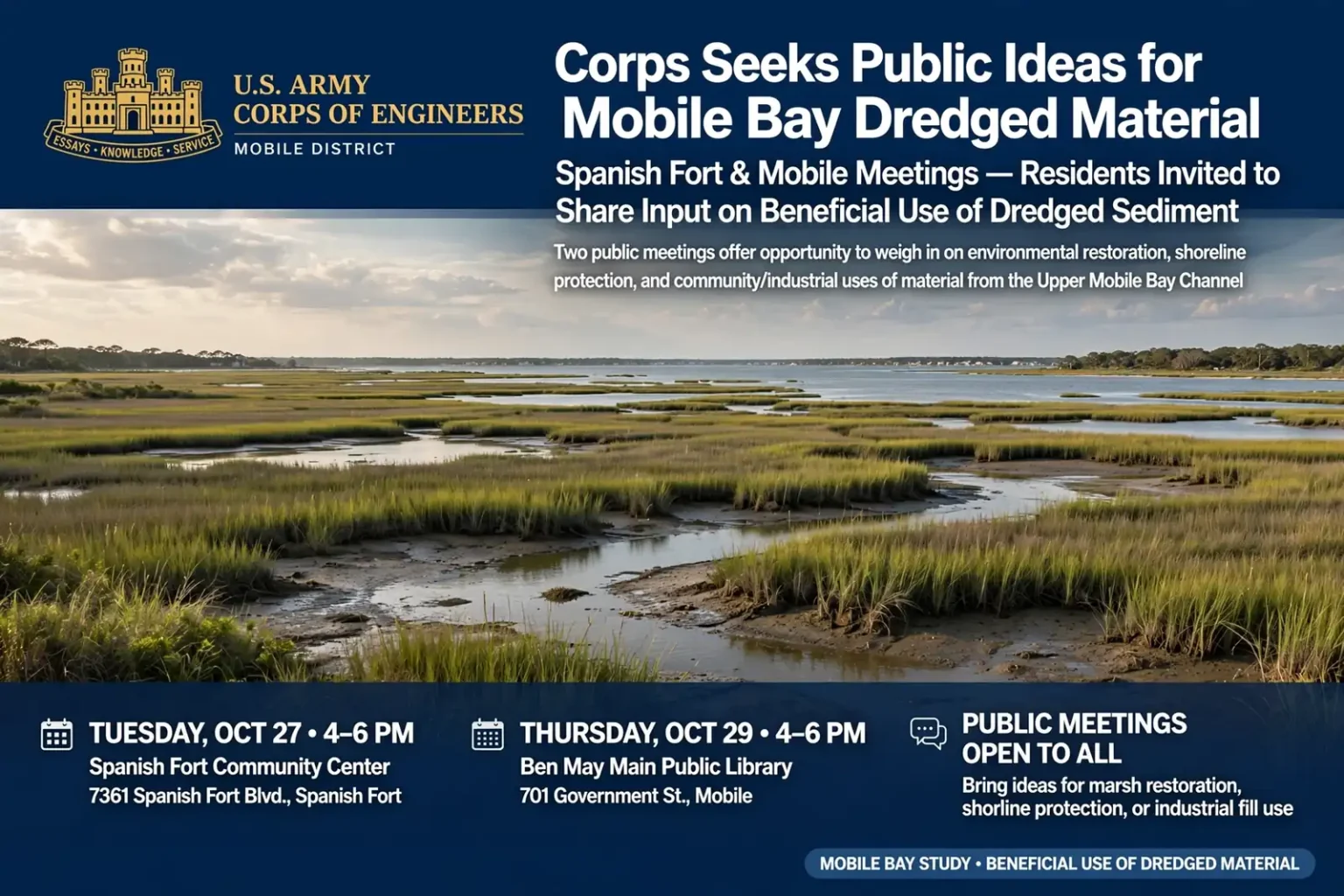
The U.S. Army Corps of Engineers wants to hear from Gulf Coast residents about how sediment dredged from the Upper Mobile Bay Channel could be put to good use, and it has scheduled two public meetings on dredged material reuse for Oct. 27 in Spanish Fort and Oct. 29 in Mobile.
The Corps’ Mobile District is studying ways to reuse dredged material for environmental restoration, community improvements and industrial purposes. One potential use is restoring marshes that have lost sediment over time.
At either meeting, residents can learn about the study, suggest projects and locations, and offer feedback. Both sessions are open to residents, community organizations and other interested parties.
Meeting schedule
- Tuesday, Oct. 27, 4–6 p.m.: Spanish Fort Community Center, 7361 Spanish Fort Blvd., Spanish Fort
- Thursday, Oct. 29, 4–6 p.m.: Ben May Main Public Library, 701 Government St., Mobile
Holding one meeting on each side of the bay gives Baldwin County and Mobile County residents a chance to attend close to home.
What the Corps is asking
The Corps says public input will help it identify opportunities and develop recommendations for future beneficial use of material dredged from the Upper Mobile Bay Channel and Mobile Harbor.
“Beneficial use” is the term regulators use for treating dredged sediment as a resource instead of a waste product. Rather than simply depositing it in a disposal site, the material is used for something that serves the environment or the community. Common examples include:
- Rebuilding marshes and wetlands that have sunk or eroded
- Nourishing beaches and shorelines
- Creating or restoring islands that provide habitat for birds
- Supplying fill material for construction or industrial sites
The study’s three categories, environmental restoration, community improvements and industrial uses, reflect that range. Residents who know of a stretch of eroding shoreline, a disappearing marsh or a site that could use fill can bring those ideas directly to the Corps.
Why dredging never stops
The ship channel that runs from the Gulf through Mobile Bay to the Port of Mobile must be dredged regularly to stay deep enough for cargo ships. Rivers carry sediment into the bay, and currents and storms move it into the channel, so the Corps conducts maintenance dredging to keep depths at their authorized levels.
The Corps maintains the channel at 50 feet in the lower harbor and 40 feet in the upper harbor. The lower bay channel was recently deepened from 45 to 50 feet and partly widened through the Mobile Harbor Modernization Project, which reached its full depth on Oct. 3, 2025. The Alabama Port Authority reported this week that it set a revenue record in its first full year with the deeper channel. Read more about the port’s record year.
All of that work produces enormous volumes of sediment. Democratic gubernatorial nominee Doug Jones, citing the scale of the issue, has said roughly 90 million cubic yards of sediment are expected to be dredged from Mobile Bay over the next decade.
A long-running debate over the mud
Where that sediment goes has been one of the most contested environmental issues on the Alabama coast. The Corps has used a method it calls thin-layer placement, which spreads dredged sediment in open waters of the bay. The environmental group Mobile Baykeeper calls the practice “mud dumping” and argues it harms the bay, including oyster habitat.
The Corps has said thin-layer placement has not been used in Mobile Bay since the channel deepening was completed and is not proposed for the current maintenance dredging cycle. But the agency has also said it is not taking the option off the table and considers thin-layer placement a form of beneficial use, not an alternative to it.
The Save Our Bay Act
Alabama lawmakers weighed in this year with the Save Our Bay Act, which took effect Oct. 1. The law calls for at least 70% of dredged material to go to beneficial use projects such as marsh and shoreline restoration when federal funding is available for the more expensive options. The Alabama Department of Environmental Management has signaled it intends to include the law’s requirements in its concurrence letters for the Corps’ coastal permits. Read more about the dispute.
The issue has also reached Congress and the governor’s race. U.S. Sen. Katie Britt has pushed for a 70% beneficial use provision at the federal level, and U.S. Rep. Shomari Figures has sought to prohibit open-water disposal in Mobile Bay. Read more about how the fight split Alabama’s congressional delegation.
Against that backdrop, the Corps’ request for public ideas on beneficial use gives residents a formal opportunity to weigh in on where the sediment could do the most good.
A wetlands project already under way
One large beneficial use effort is already moving forward in Upper Mobile Bay. The Alabama Port Authority has a permit from the Corps to turn sediment dredged from its own berths into about 1,200 acres of new marsh habitat south of the Causeway. The project is funded with $24 million in RESTORE Act money awarded through the Alabama Department of Conservation and Natural Resources, and Port Authority Director Doug Otto has said it is expected to be finished by Thanksgiving 2027. Read more about the wetlands plan.
That project covers material from the port’s terminals, not the Corps’ channel maintenance. The study now seeking public input focuses on material from the Upper Mobile Bay Channel and Mobile Harbor.
Why marshes matter
Coastal marshes along Mobile Bay have been lost over time to erosion, subsidence and development. Those wetlands serve as nursery habitat for shrimp, crabs and fish, filter water and help buffer shorelines from waves and storm surge. When marshes lose elevation, they can drown and convert to open water.
Adding sediment can raise a marsh back to an elevation where plants can survive. That is why marsh restoration is often at the top of the list when coastal managers look for ways to use dredged material.
How to take part
Residents do not need to be experts to participate. Useful input can include:
- Specific places where shoreline erosion or marsh loss is visible
- Community projects that could use clean fill material
- Concerns about where sediment should not be placed
- Ideas from fishermen, boaters and property owners who know the bay’s shallows and shorelines
If you go
- What: U.S. Army Corps of Engineers Mobile District public meetings on beneficial use of dredged material from the Upper Mobile Bay Channel
- When and where: Tuesday, Oct. 27, 4–6 p.m., Spanish Fort Community Center, 7361 Spanish Fort Blvd., Spanish Fort; or Thursday, Oct. 29, 4–6 p.m., Ben May Main Public Library, 701 Government St., Mobile
- Who: Open to residents, community organizations and other interested parties
- What to expect: Information about the study and a chance to suggest projects and locations and offer feedback