Crash Involving Truck and Trailer Shuts Down I-65 Lane in Escambia County
A single-vehicle crash involving a pickup truck towing a trailer closed a lane on northbound I-65 in Escambia County near the 73 mile marker before ALEA reopened the roadway.
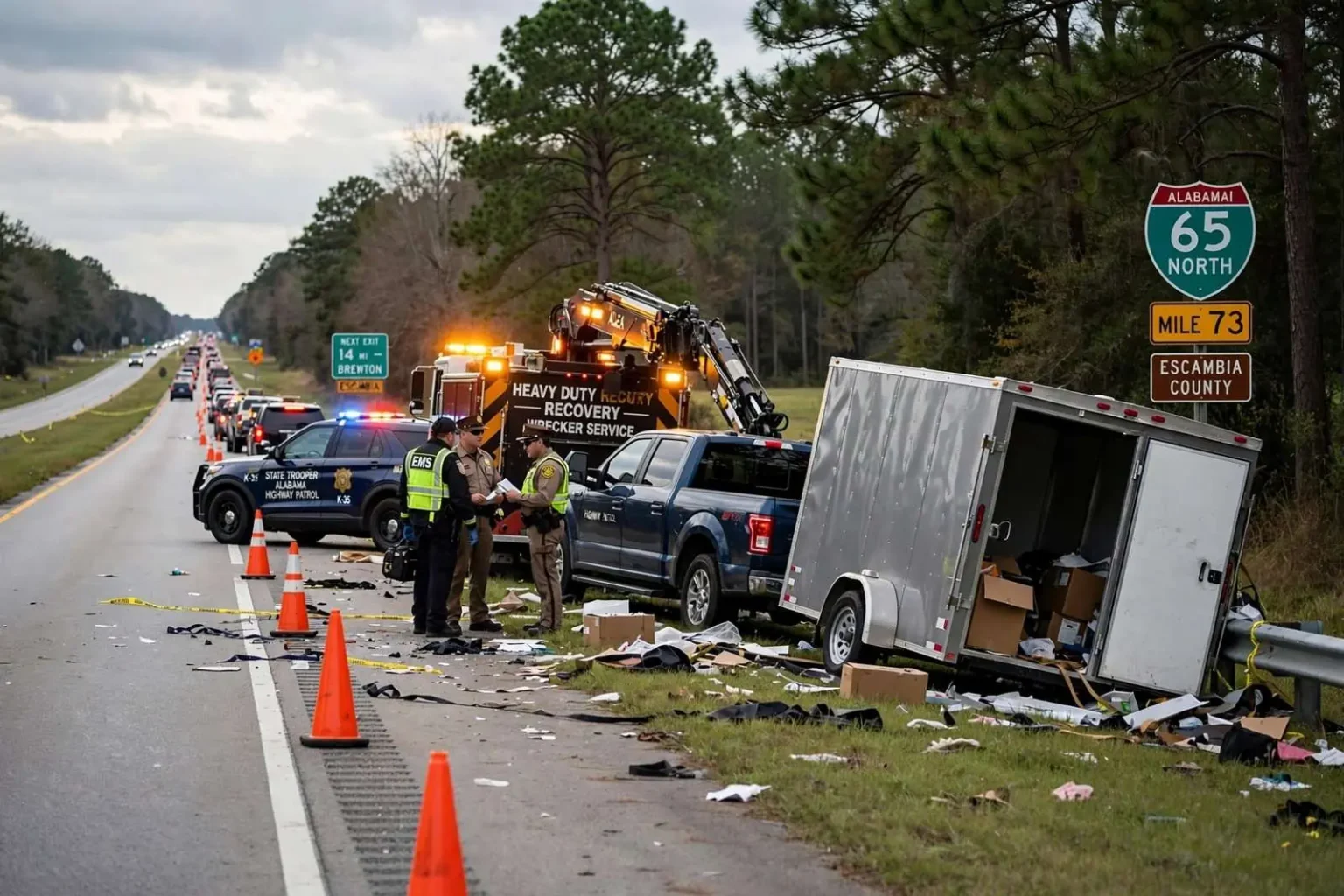
A single-vehicle crash involving a pickup truck towing a trailer forced the closure of a lane on northbound Interstate 65 in Escambia County on a recent afternoon, according to the Alabama Law Enforcement Agency. The wreck tied up one of south Alabama’s busiest corridors during the afternoon and required a full recovery operation before traffic could return to normal.
The crash happened around 1:12 p.m. near the 73 mile marker on I-65 northbound, a stretch of interstate that runs through rural Escambia County between the Brewton area and the Montgomery-bound route north. ALEA said the outside northbound lane was shut down while crews worked to clear the vehicle and trailer from the roadway.
Single-vehicle crashes involving towed trailers present particular challenges for responders. A pickup and trailer combination that leaves the roadway can scatter cargo across multiple lanes, and freeing the rig often requires a heavy-duty wrecker rather than a standard tow truck. Until the wreckage is moved, the affected lane — and sometimes adjacent lanes — remains blocked, turning a momentary crash into an hour-long or longer traffic problem.
Troopers with ALEA’s Highway Patrol Division responded to the scene, where they investigated the cause of the crash and helped direct traffic around the closure while the recovery effort was underway. With only two lanes in each direction on that stretch, funneling northbound traffic into a single lane creates an immediate bottleneck, and troopers stationed at the scene work to keep vehicles moving at a safe speed past the wreckage.
Escambia County’s section of I-65 is classic rural interstate: long sight lines, heavy truck traffic and few interchanges. Drivers traveling between the Gulf Coast and central or northern Alabama cover long distances between exits there, which means a lane closure can strand drivers with limited options to exit, wait out the delay or reroute.
The Alabama Law Enforcement Agency handles traffic enforcement and crash investigation on the state’s interstates through its Highway Patrol Division, with troopers out of posts covering the southwest Alabama region. Crash scenes on I-65 in the county typically draw responses from local volunteer fire departments and county EMS as well, since the interstate runs far from municipal fire coverage in much of Escambia County.
A Corridor That Carries the Gulf Coast’s Traffic
The closure affected a stretch of interstate that carries significant north-south traffic through Escambia County, a corridor frequently used by both local drivers and long-distance travelers moving between the Gulf Coast and inland Alabama. I-65 is the spine of the state’s highway system, running from Mobile north through Montgomery to Huntsville, and the Escambia County stretch is a critical link between the beaches of Baldwin County and the interior of the state.
On any given day, that section carries tourists heading home from Gulf Shores and Orange Beach, freight trucks running between the Port of Mobile and inland markets, and local commuters connecting Brewton, Flomaton and Atmore to jobs along the corridor. When one lane disappears, the effects ripple quickly through all of those trips at once.
Single-lane closures on I-65 in this area can create backups during peak travel times, and drivers were urged to use caution while passing the scene. Afternoon crashes are particularly disruptive because they coincide with the build-up of both school-hour and tourist traffic, and a queue that forms on a rural interstate can stretch for miles before it dissipates.
Safety officials consistently emphasize the “move over” concept at crash scenes. Alabama law requires drivers to change lanes — or slow down when they cannot — when passing stopped emergency, recovery and utility vehicles with lights activated. On a rural interstate where the outside lane is closed and traffic is funneled left, that obligation applies with extra force, since responders work just feet from live traffic moving through the open lane.
Secondary crashes are the other danger at lane closures. Rear-end collisions in the backup approaching a scene are a recurring problem on interstates nationwide, often involving drivers who do not slow until the last moment. That is why troopers and message boards urge drivers to reduce speed well before reaching a visible crash scene rather than braking abruptly at the queue’s end.
How Crash Scenes on Rural Interstate Unfold
The sequence at a crash like this one follows a familiar pattern. First responders secure the scene and care for anyone injured; troopers document the wreckage, skid marks and final resting positions of the vehicles; and a recovery crew rigs the truck and trailer for towing. Only after all of that is complete can the closed lane reopen and traffic flow resume.
Towed trailers complicate each step. Cargo may have to be offloaded before the trailer can be lifted, and if the trailer overturned or broke loose, additional equipment is needed to right it. Depending on what was being hauled, the cleanup can take several hours even for a crash involving no other vehicles.
The 73 mile marker sits in a rural stretch where the nearest full-service interchanges are miles apart, meaning drivers caught in the backup had few opportunities to leave the interstate and find alternate routes. County roads parallel to I-65 in Escambia County are narrow and lightly paved by comparison, so even drivers familiar with the area often choose to wait rather than detour.
By later that evening, ALEA confirmed the scene had been cleared and the roadway reopened to normal traffic flow. The roughly half-day closure — from the early afternoon crash to the evening reopening — is typical for a wreck involving a truck and trailer that requires both investigation and heavy recovery.
What Investigators Consider
No additional details about injuries or the cause of the crash were released by troopers. ALEA generally withholds findings until its investigation is complete, and for single-vehicle crashes the final report may take weeks, particularly if reconstruction specialists are called in to determine speed, restraint use or mechanical factors.
Trailers add their own investigative questions: whether the load was properly secured and within weight limits, whether the hitch and safety chains were correctly attached, and whether a tire failure or sway at highway speed contributed to the loss of control. Any of those factors can turn an ordinary afternoon drive into a lane-closing crash.
Troopers remind drivers towing campers, boats and utility trailers — a common sight on I-65 in every season, as Gulf Coast travelers haul equipment to and from the coast — to check tire pressure and lug nuts on both vehicle and trailer before long trips, to distribute cargo weight properly, and to reduce speed in wind and rain, where light trailers are most prone to sway.
Staying Safe on I-65 Through South Alabama
Crashes like this one are a recurring feature of life on I-65 through south Alabama, where the interstate carries a mix of commuter, tourist and commercial traffic at highway speeds for long rural stretches. Safety agencies repeat the same advice for the corridor: leave following distance, watch for slower trucks entering from rest areas and interchanges, and expect sudden queues from crashes or weather at any hour.
Weather is a particular factor on the Gulf Coast end of the corridor. Afternoon thunderstorms in summer drop visibility quickly, and standing water on the roadway after heavy rain contributes to hydroplaning crashes, including those involving towed rigs that are sensitive to sudden traction changes.
Drivers who encounter a lane closure are advised to move over early, reduce speed before reaching the backup, and stay alert for responders walking near traffic. Real-time conditions on Alabama interstates are available through the state’s traffic information channels, and ALEA posts significant closure information as scenes are worked.
The Escambia County stretch will see more of these events as traffic volumes grow with the region. Between the Port of Mobile’s expansion, the continuing growth of Baldwin County’s beach economy and the steady flow of freight between the Gulf and the Southeast’s interior, I-65’s rural sections are being asked to carry more vehicles every year on pavement that in places is decades old.
For that afternoon, though, the story ended the way most single-vehicle crash stories do: one driver’s misfortune, a closed lane, a careful recovery and investigation, and a roadway reopened to traffic by evening with no lasting effects beyond the delay and the report troopers will file.
Travelers planning trips on the corridor are reminded that closures can happen at any time and that checking conditions before long drives — particularly during holiday weekends and summer afternoons — can save hours of idling in a rural backup with no exit in sight.
For drivers who regularly make the run between Mobile and Montgomery, the lesson of afternoons like this one is practical: build slack into the schedule, keep the fuel tank above half on the rural stretches, and treat any slowed traffic ahead as a reason to brake early rather than a challenge to be threaded. The interstate will reopen; the goal is to still be calm, and unhurt, when it does.