Creola Mobile Home Park Residents Face Eviction After Sudden Land Sale
Residents of a Creola mobile home park were told to move within 45 days after a land sale; low-income families are scrambling for housing.
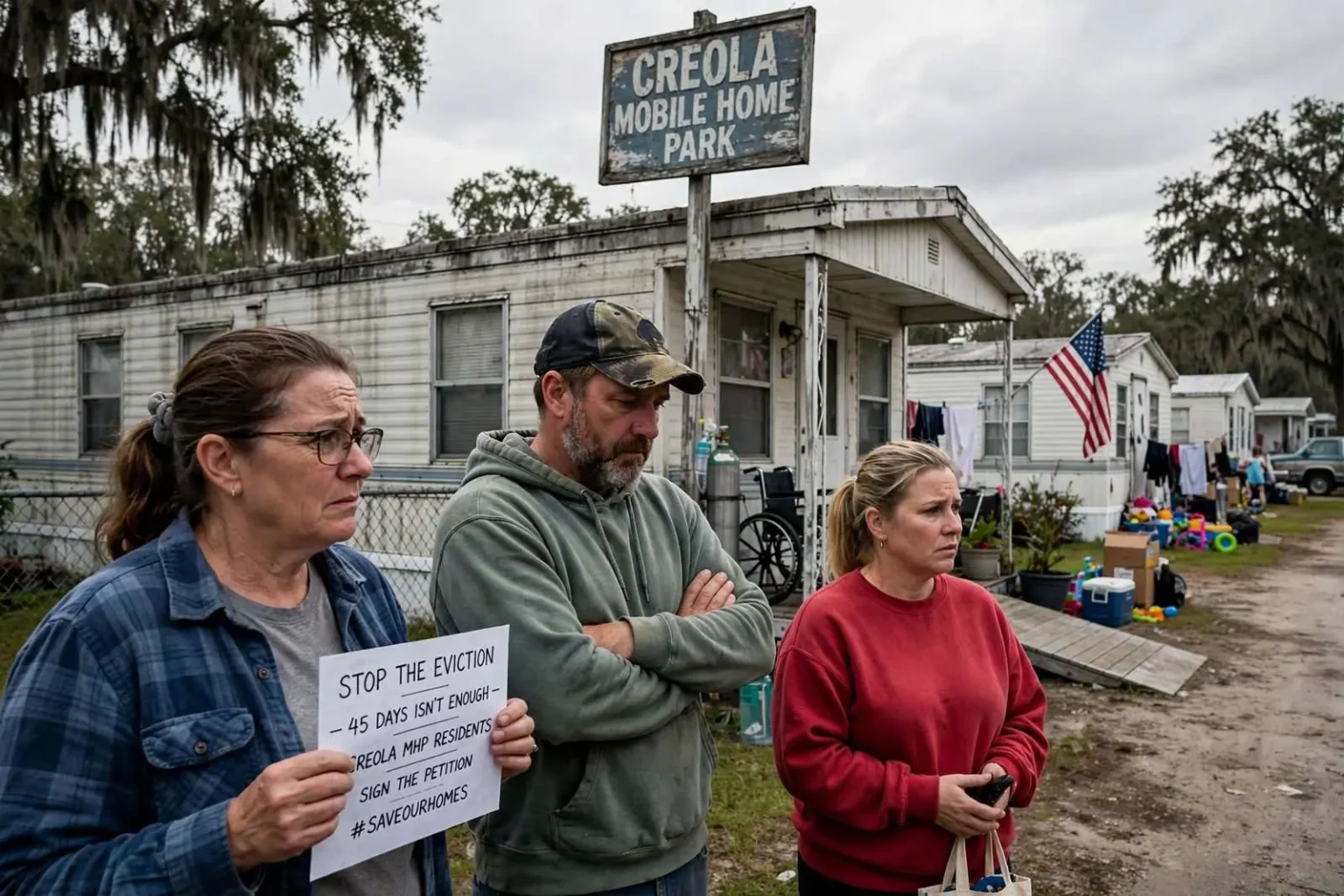
Residents of a Creola mobile home park say they are scrambling for somewhere to go after learning the park is being sold and redeveloped, and that everyone living there will have to move out. Word spread through the community over a weekend, and by the time it reached every lot, the deadline was already hanging over the neighborhood: renters said they received no written notice — only word of mouth that they would need to be out within roughly 45 days.
“It makes us feel sad and upset. We just moved here. We finally found a place we could settle down in,” resident John Baughman said. His sentiment echoed through the rows of homes in the park, where families describe a sudden reversal from relief to panic. Many renters arrived in Creola after searching for affordable housing across north Mobile County, and the park had offered something increasingly scarce in the region: a lot they could afford within commuting distance of Mobile’s job market.
Another renter, Martha Pittman, described a community in crisis. “No one here has a plan, we’re all panicking. I don’t have anywhere to go, most of these people don’t have anywhere to go,” she said. Pittman started an online petition against the closure that drew hundreds of signatures within a single day, a pace that startled even her and signaled how many people outside the park were watching the situation. Residents also prepared to speak at the Creola City Council meeting that week, hoping city leaders might at least buy them time or point them toward assistance.
Pittman noted that many of her neighbors are low-income families, some with disabilities or with children who depend on life-support equipment that complicates any move. Moving a household is difficult under the best circumstances; moving one that includes a medically fragile child means transferring power-dependent equipment, coordinating care continuity and finding housing that can accommodate the need. For those families, the 45-day window is not simply inconvenient — it threatens the stability their health depends on.
A community suddenly uprooted
Creola, a small city strung along U.S. Highway 43 and the Norfolk Southern line at the edge of the Mobile-Tensaw Delta, has long been a pocket of affordable housing in otherwise fast-growing north Mobile County. Mobile home parks like the one at the center of the sale have historically absorbed residents priced out of stick-built neighborhoods, including retirees on fixed incomes, shift workers at the area’s industrial plants and young families starting out. The prospect of an entire park’s population dispersing at once puts pressure on every landlord and relative within driving distance.
The redevelopment of the land adds a familiar Gulf Coast dynamic to the story: property along the corridor between Mobile and Saraland has drawn increasing interest as growth pushes north from the city, and land that once justified modest rents now carries development potential. What that means for the park’s residents is displacement — a pattern seen across the region as inexpensive manufactured-home communities give way to higher-value uses.
A property manager acknowledged the disruption and said the land sale cleared earlier than expected, which compressed the timeline residents were counting on. The manager offered extensions in some cases, along with help finding openings in other mobile home communities. For families juggling deposits, moving costs and medical logistics, the gestures may soften the landing, but they do not change the outcome: for many residents, moving appears inevitable.
The help-finding-a-spot offer runs into a hard regional fact — affordable options for manufactured-home renters in north Mobile County are limited. Parks that accept lot rentals in the area tend to fill quickly, and some impose age restrictions or lot-rent rates that put them out of reach for the lowest-income households. Residents who own their homes outright still face the cost of physically moving a manufactured home, which can run into thousands of dollars and requires a suitable lot to move it to — a double burden that makes abandonment of homes a real risk in closures like this.
Renter James Creel summed up the frustration many expressed as news of the sale traveled lot to lot. “It’s ridiculous that the landlord has to take this kind of action,” he said. The grievance residents return to is not merely that the park is closing, but the way word arrived — through neighbors and rumor rather than a letter with dates and resources attached. Alabama’s landlord-tenant law, the Alabama Uniform Residential Landlord and Tenant Act, sets out notice requirements for terminating month-to-month tenancies, and residents’ accounts suggest they learned of the deadline informally before any paperwork followed.
What residents are owed under the law and what they can practically recover are different questions. Even where proper written notice is given, a month-to-month lot renter generally has no claim to relocation assistance unless a lease or a local ordinance provides one. That gap — legal termination with no safety net — is why manufactured-home park closures have become a recurring flashpoint in local politics across Alabama, and why advocacy groups urge tenants in parks slated for closure to document notices, keep receipts and raise the issue with municipal officials early.
The city council’s role
The scheduled appearance before the Creola City Council gave residents a narrow but real avenue of recourse. Councils cannot stop a private land sale or compel a landlord to extend tenancies beyond what state law requires, but they can press for clarity on the notice residents received, connect displaced families with county and nonprofit housing resources, and ask what the redevelopment plans mean for the city’s tax base and infrastructure. In a city of Creola’s size, a few hundred displaced residents would be a significant share of the population.
City officials also have a practical stake in an orderly transition. Displaced households that cannot find lots nearby may leave the school district, the volunteer-service pool and the local churches that anchor small Mobile County towns, and abruptly vacated mobile homes create code-enforcement and cleanup costs the city inherits. The council meeting promised to be the first public airing of those concerns, with residents hoping at minimum for more time and a list of real alternatives.
The petition Pittman started has a secondary effect beyond its signature count: it creates a public record that the closure was contested, and it gives aid organizations and county officials a point of contact for the affected households. Petitions tied to mobile home park closures elsewhere in Alabama have drawn the attention of area nonprofits and, occasionally, state legislators, though outcomes have typically been mitigation rather than reversal — relocation time, disposal help for abandoned homes, and referrals to lot openings.
For the residents themselves, the immediate arithmetic is unforgiving. A household facing roughly 45 days must find a lot, arrange a mover or abandon belongings, transfer school enrollment and utilities, and come up with new deposits — often a month’s rent up front — before the first paycheck after the move. Families with disabilities face the added work of locating accessible units and transferring medical providers, and those with power-dependent equipment must coordinate with utility companies and medical suppliers to avoid gaps in service during the transition.
What happens next for the neighborhood
Whether the city council meeting produces anything concrete remains to be seen, but the episode has already done one thing: it has put manufactured-home park closures on the agenda in a part of Mobile County where housing pressure keeps building. North Mobile County’s population has grown steadily as Mobile’s suburbs stretch north through Saraland, Satsuma and Creola, and each redevelopment of low-cost housing tightens the market for the residents least able to absorb a rent increase.
Housing advocates point to a few practical paths that cities and counties have used elsewhere when parks close: extending notice periods through local ordinance where state law allows, creating county-level relocation funds, requiring redevelopment applicants to account for existing tenants, and maintaining inventories of available lots so displaced families are not searching blind. None of those measures restores what residents of the Creola park say they had — a place they could finally afford to settle — but each shortens the distance between a sudden notice and a stable landing.
In the meantime, the park’s residents are doing what displaced communities across the Gulf Coast have always done: leaning on each other. Offers of help moving, shared listings of open lots and churches organizing furniture storage circulated alongside the petition in the days after word of the sale spread. The 45 days will run whether or not the city acts, and the residents’ plan, for now, is the one Pittman described in reverse — the one they are building under deadline, together, before the movers arrive.