Crews contain roughly 40-acre woods fire in Coffeeville
Coffeeville Fire and Rescue says a woods fire burned about 40 acres near Hodge Road in Clarke County on Thursday before crews contained it.
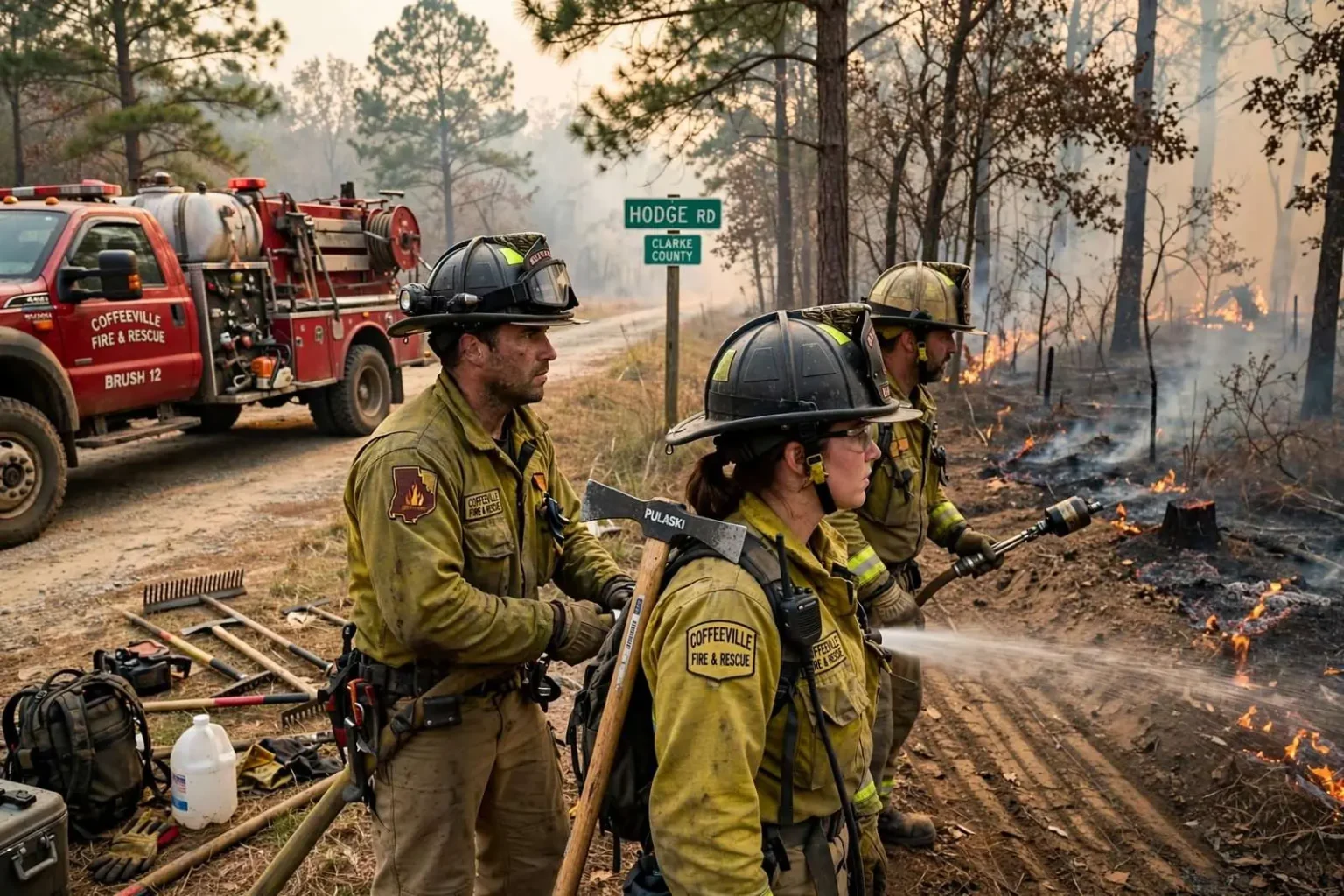
COFFEEVILLE, Ala. – A large woods fire burned roughly 40 acres in Clarke County on Thursday afternoon, according to Coffeeville Fire and Rescue. The fire department said crews were dispatched to Hodge Road just after 2 p.m. Firefighters worked the scene through the afternoon and cleared the area around 5:15 p.m. No injuries were reported in connection with the fire.
The response brought firefighters out to a rural stretch along Hodge Road, where flames were moving through woodland on the outskirts of the Coffeeville area. Crews spent roughly three hours on the scene, cutting fire lines, wetting down the perimeter and working to keep the flames from reaching nearby structures. By the time the scene was cleared around 5:15 p.m., the fire had consumed an estimated 40 acres of timber and undergrowth, and firefighters reported no injuries among residents, responders or anyone else in the area.
Woods fires of this size are a familiar challenge for volunteer departments across Clarke County, a heavily forested county of pine and hardwood stands where timber is the economic backbone. A fire that covers 40 acres can move quickly through dry underbrush, pushed by afternoon wind, and stopping it requires enough hands and water to attack multiple edges at once. That Coffeeville firefighters contained the burn without injuries or reported structure losses counts as the best available outcome for an afternoon call of this kind.
Fighting a Woods Fire on Rural Ground
The tactics for a woods fire differ from a house fire in almost every respect. Instead of attacking a single structure, crews establish a perimeter, using brush trucks capable of driving off-road and raking or plowing lines of bare earth that flames cannot cross. Water supply becomes a central problem in rural Clarke County, where there are no hydrants along most country roads, so departments shuttle water with tanker trucks or draft it directly from ponds and creeks. As the afternoon wore on along Hodge Road, those logistics, moving brush trucks, rotating tankers, and keeping firefighters hydrated in the heat, made up the real work behind the three-hour response.
Weather conditions at the time of the fire played their usual role. Afternoon fires in south Alabama spread with the prevailing southwest breeze and slow or stall when humidity rises toward evening, which is why departments push hard in the early hours of a burn and why a fire contained late afternoon rarely rekindles if the perimeter is properly cooled. Firefighters remained watchful for the smoldering pockets, in stump holes, root systems and thick brush, that can hold heat for hours and reignite the next day, and a follow-up check of the burn area is standard practice after a fire of this size.
The Forestry Commission’s Role
Large woods fires in Alabama often draw the Alabama Forestry Commission into the response, and the agency’s wildland firefighters and heavy equipment complement the work of volunteer departments. The commission operates bulldozers that can cut firebreaks through timber far faster than hand crews, and its dispatch system tracks burn conditions across the state. In many rural counties, the pattern is familiar: the local department attacks the fire’s edge to protect homes while Forestry Commission units plow lines around the broader burn. Whether commission units assisted along Hodge Road on Thursday was not detailed in the department’s account, but their involvement is common in fires approaching the 40-acre scale.
The economics of woods fires ripple through the county beyond the burned ground itself. Timber companies and private landowners facing a burn assess the damage to their stands with foresters, deciding which trees will recover, which must be salvaged, and where replanting is needed, and insurance adjusters handle claims where coverage applies. Fires that escape onto neighboring property raise liability questions that the burn permit system is designed to prevent. For a rural county where timber income supports families, schools and landowner livelihoods alike, a 40-acre fire is a real financial event even when no structures burn and no one is hurt, and the volunteer crews who stop a fire’s spread are protecting more than trees.
Wildland Training and Equipment in Rural Departments
Volunteer departments across Clarke County maintain equipment suited to wildland work alongside their structural apparatus. Brush trucks, light four-wheel-drive rigs carrying water tanks and pumps, are the workhorses of a woods fire, able to reach across fields and down forest tracks where an engine cannot go. Firefighters wear wildland gear that trades some structural protection for lighter weight and better heat dissipation, and they carry hand tools, rakes, flappers and drip torches, that have changed little in design over generations. Training courses through the Alabama Fire College and the Forestry Commission keep those skills current, covering fire behavior, pump operation and the coordinated tactics that keep a perimeter from flanking the crews working it.
The agency also administers the state’s burn permit system, which governs prescribed burning and land clearing fires across Alabama. Landowners in Clarke County use controlled burns extensively to manage timber stands, reduce fuel loads and improve wildlife habitat, and the permit requirements are designed to keep those burns from escaping. When an uncontrolled fire does break out, investigators from the commission work with local departments to trace the origin, a task that matters both for accountability and for identifying the conditions that allowed the fire to spread.
Coffeeville and Its Volunteer Firefighters
Coffeeville sits along the Tombigbee River in the western part of Clarke County, a small town that serves as a community center for the surrounding rural districts. Its fire and rescue department is staffed in the volunteer tradition that covers nearly all of rural south Alabama, where neighbors answer the tones for everything from woods fires to wreck responses and medical calls. Thursday’s fire illustrates the demands that tradition places on them: an afternoon call that pulled responders away from jobs and families for three hours of physically punishing work in smoke and heat, on ground where brush trucks must be driven hard through rough terrain.
The department’s coverage area includes long stretches of forest road where a fire can start far from any structure, and its members train for the specific problems woodland response creates, navigating unmarked drives, finding water sources, and coordinating multiple departments when a burn grows beyond the first-arriving engine’s reach. Mutual aid agreements across Clarke County mean that larger fires draw crews from neighboring communities automatically, and departments in the region have answered each other’s calls this way for generations.
Fires, Fuel and the Local Landscape
The woodlands around Coffeeville and Hodge Road carry the fuel profile that makes south Alabama prone to fires: dense undergrowth of gallberry, wax myrtle and young pines beneath a canopy of mature timber. After dry stretches, that undergrowth cures into a volatile layer that carries fire quickly, and lightning, equipment sparks, debris burns and arson are the usual ignition sources across the region. Clarke County’s timber economy gives landowners a direct financial stake in fire prevention, since a stand damaged by fire can lose decades of growth value in an afternoon, and the sight of smoke over a neighbor’s property draws concerned calls to the fire department quickly.
The Thursday fire’s estimated 40-acre footprint is large enough to be visible for miles but far from the largest woodland burns the county has seen, and the department’s account of a contained scene with no injuries reflects a response that went right. Fires that threaten homes draw additional complications, with crews splitting attention between the flame front and structural protection, and the outcome along Hodge Road suggests the burn stayed within ground that firefighters could control.
What Residents Should Know About Woods Fires
For residents of rural Clarke County, the department’s response offers the standing reminders that recur every fire season. Outdoor burning should follow the state’s permit rules, avoid windy days, and never be left unattended, since the majority of woods fires in Alabama trace back to escaped debris burns. Driveways should be wide and clear enough for fire apparatus, and addresses should be visibly posted so responders can find remote properties quickly. Homeowners in wooded areas are encouraged to maintain a cleared space around structures, trimming back brush and moving firewood away from the house, the simple steps that determine whether an approaching fire meets defensible ground.
Anyone who spots smoke in the area is encouraged to report it promptly with a specific location, since early calls are what allow a volunteer department to catch a fire while it is small. For Thursday’s fire along Hodge Road, the system worked as intended: a quick report, a sustained response, a contained burn, and no injuries. The crews who worked the afternoon heat will respond to the next smoke call the same way, and the community they protect depends on that readiness.