Custody Conditions, Withheld Forensics Dominate Nodine Bond Dispute Ahead of Hearing
Ahead of a Baldwin County hearing, prosecutors and defense attorneys clash over custody terms and unresolved forensic evidence in the Stephen Nodine murder.
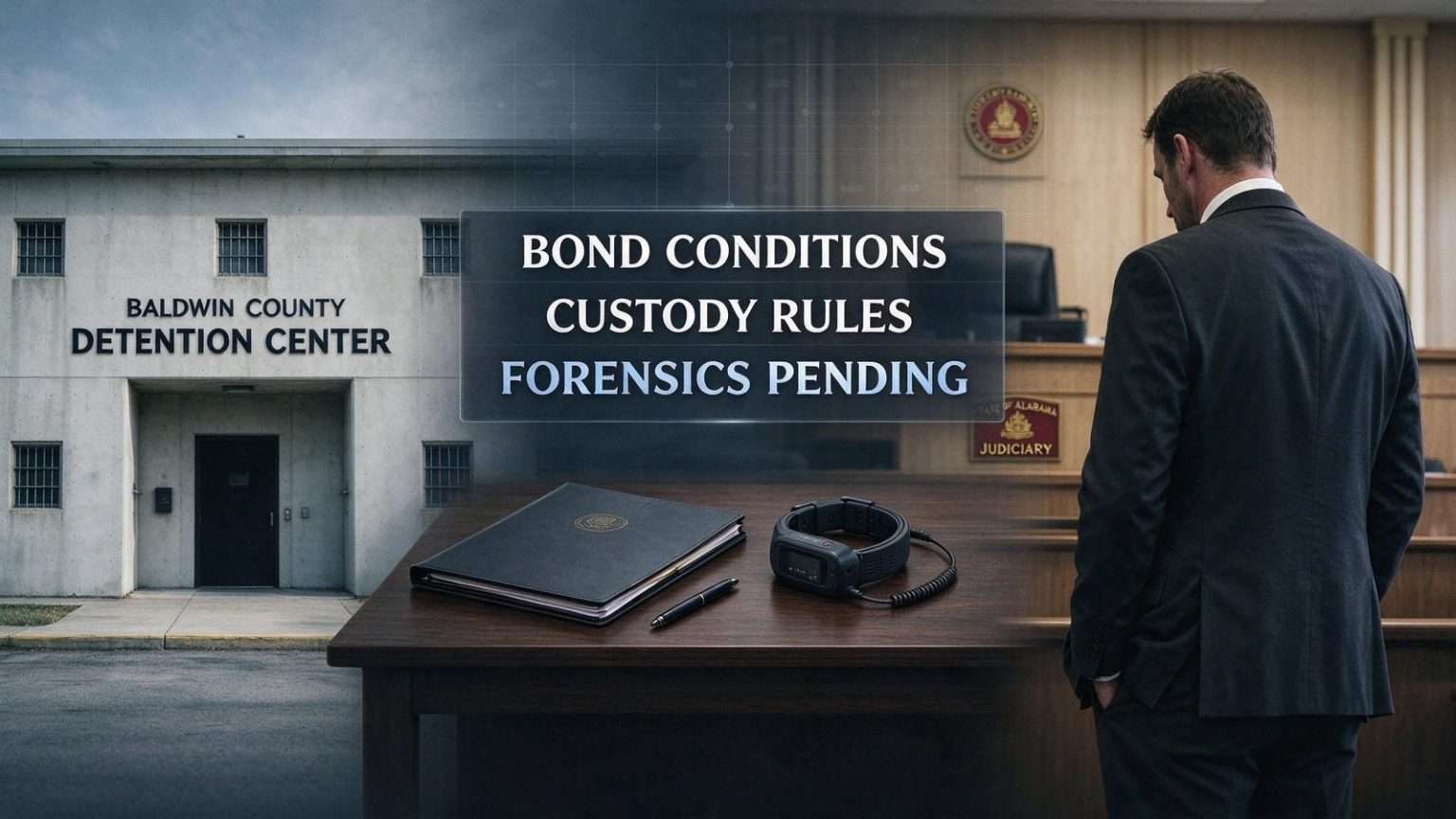
As former Mobile County Commissioner Stephen Nodine awaited trial on a murder charge in the May 2010 shooting death of Angel Downs, attention in the case turned this week to the terms that would govern his release rather than to the underlying facts of the killing itself. Nodine has pleaded not guilty, and both the state murder case in Baldwin County and a separate federal firearms case remained pending as the hearing approached. With a Baldwin County hearing on Nodine’s bond conditions coming up, prosecutors and defense attorneys sparred over several practical questions: who would be an acceptable custodian if Nodine were released to a form of home confinement, what conditions should attach to any such arrangement, and how the case should proceed while certain forensic results remained unfinished.
Bond disputes of this kind are common in high-profile murder cases, but they rarely unfold in public view with this much detail. When a judge agrees to consider release from jail before trial, the terms matter as much as the decision itself: who the defendant lives with, who supervises him, where he may travel, and what happens if any condition is broken. In cases involving former elected officials, those questions carry added weight, because the defense and the prosecution each have strong reasons to define what the arrangement says about the defendant’s standing in the community.
A Dispute Over Custody, Not Guilt
According to court filings and arguments described ahead of the hearing, prosecutors pushed for stricter bond terms, including tighter oversight of any custodian proposed to supervise Nodine outside of jail. The state’s position reflected a basic concern in any serious felony case: that a defendant facing a murder charge should be monitored closely enough that flight or further trouble remains unlikely, and that the person entrusted with supervision should be vetted thoroughly and held to clear reporting obligations. Prosecutors urged caution in part because forensic work in the case remained outstanding.
Defense attorneys, for their part, contested portions of the state’s evidence and argued that Nodine should be released under supervision while the case continued toward trial. They maintained that a supervised arrangement with a responsible custodian would satisfy the court’s interests, and they pushed back against conditions they viewed as excessive for a man who had already complied with the terms set in his separate federal matter. The exchange kept the focus on logistics and oversight rather than on the allegations themselves, a framing both sides accepted for the purposes of the hearing.
The dispute came on the heels of a separate ruling in which Nodine had been freed from federal custody on the firearms charge, a decision his attorneys had cautioned could prove short-lived given that Baldwin County authorities were separately seeking to revisit the bond in the state murder case. That sequence left Nodine’s liberty resting on two parallel tracks, one federal and one state, each moving on its own calendar and each capable of changing his circumstances without notice to the other.
Forensic Results Still Pending
Court proceedings in the case have repeatedly been shaped by evidence that had not yet been finalized at the time of a given hearing, and this stretch of the case was no different. Attorneys on both sides referenced still-outstanding forensic work as a factor in how the custody and bond questions should be resolved, with prosecutors urging caution given the unresolved evidence and the defense arguing that the state’s case remained incomplete. Forensic backlogs are a chronic feature of criminal litigation across Alabama, where laboratory analysis of physical evidence can take months, and where neither side can fully commit to a theory of the case until the results are in.
The pending forensics also complicate scheduling. Trials in Baldwin County’s circuit courts are set against a docket that serves one of the state’s fastest-growing jurisdictions, and continuations tied to laboratory work are a familiar source of delay. Until the outstanding results arrive, both sides must prepare for a trial whose evidentiary landscape could still shift, and the judge must weigh bond questions without the benefit of the complete scientific picture either side says it needs.
The Judge and the Lawyers
Baldwin County Circuit Judge Charles Partin, who has presided over the case, was expected to weigh the custody proposals and bond conditions in the days ahead. Partin’s role in the bond phase is to balance the presumption of innocence against the practical risks of pretrial release, weighing the seriousness of the charge, the defendant’s ties to the community and his record of compliance so far. Whatever conditions he sets will govern Nodine’s daily life until trial, making the hearing one of the more consequential steps short of the trial itself.
As in earlier stages of the case, defense attorneys Dennis Knizley and John Conrad Williams represented Nodine in the state murder proceeding, while Gordon Armstrong had been appointed to represent him in the separate federal matter. The two-track representation reflects how the parallel cases demand different strategies: the state case turns on the Baldwin County evidence, while the federal case stands on its own firearms allegations and its own procedural rules. Coordinating arguments about bond and custody across both tracks has been a running feature of the defense’s work since the arrest.
The prosecution’s side carries its own coordination burden, balancing the Baldwin County district attorney’s murder prosecution against the federal firearms matter being handled separately. Decisions made in one forum inevitably ripple into the other, from the timing of hearings to the conditions of release, and the bond hearing scheduled before Partin represented one of the few moments when those threads came together in a single courtroom discussion.
A Case Still Unfolding
The underlying allegations against Nodine, and the question of his guilt or innocence, remained for the courts to resolve rather than for public speculation to settle. Nodine, who resigned his Mobile County Commission seat amid impeachment proceedings after his arrest, faced a murder charge in the May 9 shooting death of Angel Downs in Gulf Shores, a case that continued to draw close attention across the Mobile and Baldwin County legal community as it moved toward trial. His arrest and the impeachment proceedings that followed had ended a county government career that spanned years on the commission representing Mobile County residents.
For the communities on both sides of Mobile Bay, the case has been difficult to look away from. Downs’ death in Gulf Shores drew immediate attention across the coast, and every hearing since has drawn reporters, spectators and observers from the region’s legal community. The bond hearing ahead was expected to be no different, with the custody question promising a rare public look at the mechanics of pretrial release in a murder case.
What happens next depends largely on Judge Partin’s ruling. If he approves a custody arrangement, Nodine will move from jail to supervised home confinement under whatever conditions the court sets, and the case will proceed toward trial as the outstanding forensic results come in. If he sides with prosecutors and keeps the tighter terms in place, the defense’s arguments about the incomplete state of the evidence will carry into later hearings. Either way, the parallel federal firearms case will continue on its own track, and both courts will eventually have to account for what the other has decided.
How Custody Arrangements Work
Home confinement through a third-party custodian is one of the middle grounds Alabama courts use between outright jail and standard bond. The defendant lives at an approved residence under the eye of a custodian who agrees in writing to report violations to the court, and the arrangement is often paired with electronic monitoring, travel restrictions and check-in requirements. Judges look closely at who the custodian is: a person with a stable household, no legal troubles of their own and a genuine willingness to enforce the rules. That vetting is exactly what prosecutors in the Nodine case sought to tighten, arguing that the proposed custodian should face a higher level of scrutiny and clearer reporting duties before the court relies on them.
Defense teams generally welcome these arrangements because they let a client prepare for trial outside a jail cell, meet with counsel freely and maintain family ties. Prosecutors accept them, sometimes reluctantly, because a supervised defendant is easier to monitor than one released on a standard bond with few strings. The negotiation is therefore less about whether Nodine might be released than about how tightly the screws are set: how many conditions, who signs off, and what consequences follow if a single one is breached.
The Broader Context of the Case
The Nodine case has moved along two tracks since his arrest, and each carries its own rhythm. The federal firearms case was resolved far enough for a ruling freeing him from federal custody, while the state murder charge in Baldwin County remained the weightier matter, with a trial still ahead. Cases that run in parallel like this often produce awkward interludes, where a defendant’s status in one forum has changed but not the other, and Nodine’s attorneys had warned from the start that the federal ruling might be undone quickly by state authorities seeking to hold him on the murder charge.
For Baldwin County’s courthouse in Bay Minette, the case has meant heavy attention for proceedings that would otherwise draw little notice. Courtrooms that typically host routine felony dockets have filled with reporters and observers for each hearing, and the bond fight was expected to be no exception. The outcome will be watched closely not just by those following the case, but by defense attorneys and prosecutors across the region who deal with the same questions of custody, conditions and unfinished forensics in serious felony cases every week.
As the hearing approached, both sides had framed their positions for the record: the state asking for strict oversight and patience until the forensic work is done, the defense asking for supervised release and a schedule that reflects the incomplete state of the evidence. Between those positions sits Judge Partin, whose ruling will determine where Nodine sleeps, who watches him and how quickly the case moves toward the trial that will ultimately answer the only question this hearing cannot: what happened on May 9, 2010, in Gulf Shores.