
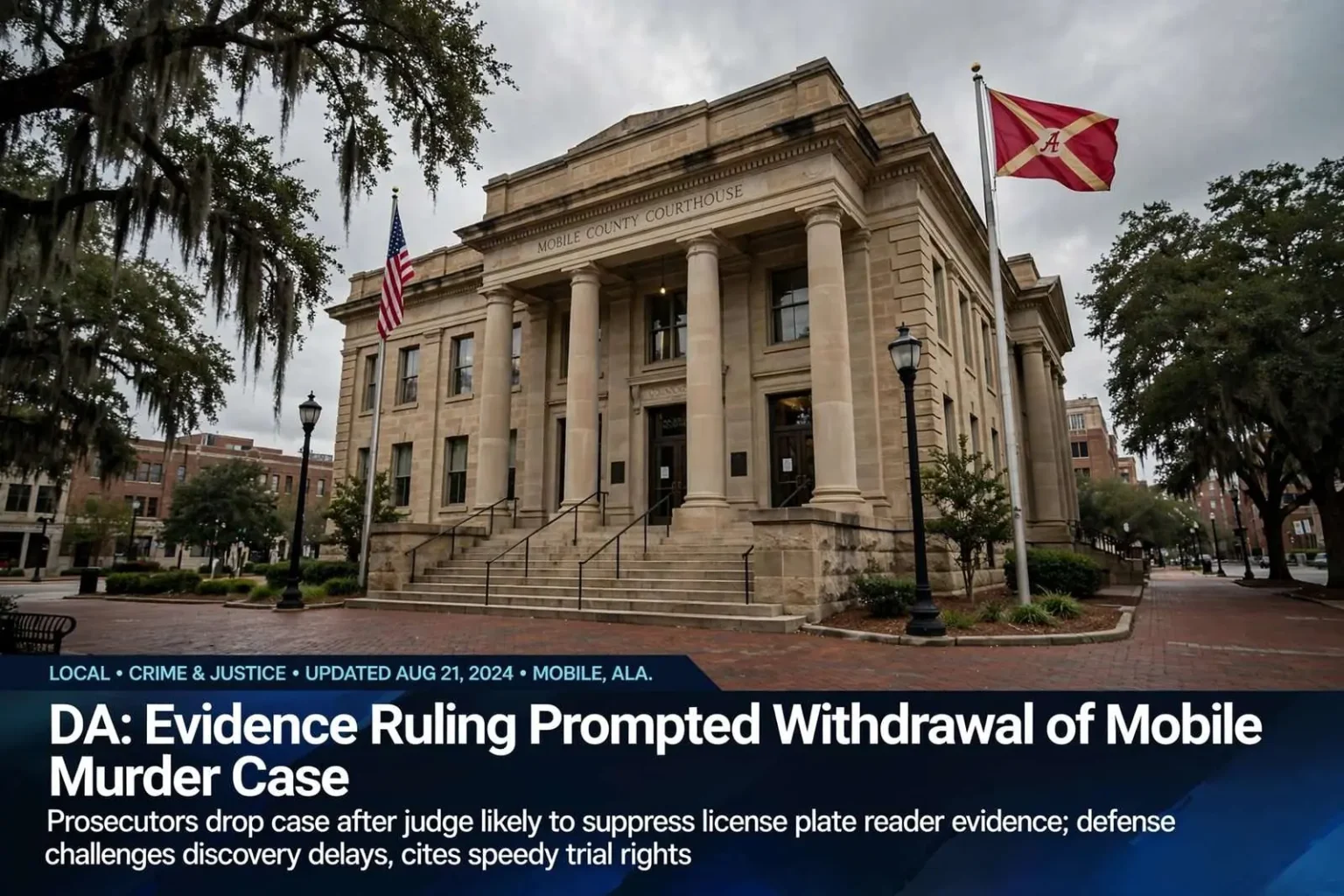
MOBILE, Ala. — Mobile County District Attorney Keith Blackwood said Wednesday that his office decided not to go to trial this week in a murder case out of concern that a key piece of evidence would not be allowed. Chase Dearman, an attorney who represents Haratio Donzell Stewart, objected to a photograph from a license plate reader that prosecutors contend places the defendant at the scene at Maison De Ville apartments near the McGregor Square shopping center on Christmas Eve in 2023.
Dearman told Mobile County Circuit Judge Brandy Hambright that he did not receive a photograph of the license plate until days before the trial was to have begun. Blackwood said prosecutors produced video from the device months ago but asked for the case to be dismissed out of concern that the evidence would not be permitted at trial. “It looked like that the court was gonna suppress that evidence,” he said. “That would have been fatal to the prosecution, and so the decision was made to go this route.”
The dispute centers on automatic license plate readers, cameras mounted at intersections and along roadways that capture and store images of passing vehicles. Police agencies across Alabama have expanded their use of the devices in recent years, and defense attorneys have increasingly challenged the photographs they produce, arguing over how and when the material is turned over to the defense. Late discovery of such evidence, as Dearman described it here, typically draws motions to exclude it under the rules governing criminal procedure.
Prosecutors allege that a spray of bullets from Stewart’s gun claimed the life of Jabyron Nettles, a former Murphy High School football player, and severely wounded Jelaysia Smith. By voluntarily withdrawing the case before jury selection, Blackwood said prosecutors preserved their right to bring it back in the future.
A Speedy Trial Fight
Stewart’s lawyer is crying foul, arguing that doing so would violate his client’s right to a speedy trial. The right, protected by both the U.S. and Alabama constitutions, is among the most litigated safeguards in criminal law, and defendants routinely object when the state seeks to pause or restart a case after long delays.
Dearman said he does not want to comment before a hearing on Aug. 26 related to his request that Hambright reconsider her decision. In a court filing, Dearman wrote that allowing prosecutors simply to withdraw the case and reinstate it later would “merely be side stepping the Court’s sanctions.” He added that the reason prosecutors could move forward was due to the state’s “own malfeasance.”
Dearman wrote that, in addition to the license plate reader issue, the Mobile Police Department failed to record an interview detectives conducted with Smith the day after the shooting. He also noted that the judge previously postponed the trial because the state had not provided the defense with a copy of the contents of Stewart’s phone.
The defense filing contends that prosecutors do not have a single witness who can testify that Stewart knew the victims, was present during the shooting or even had any motive to shoot them. “The Defendant lost three years of his life being charged with murder,” the filing states. “He served at least one year in jail and the remaining on home arrest.”
Those arguments set up the question Judge Hambright will weigh at the Aug. 26 hearing: whether a voluntary withdrawal — which leaves charges intact and allows refiling — amounts to the same as the sanctions the court had imposed, or whether it is a legitimate prosecutorial choice. Courts have generally allowed the state to nolle prosequi charges and refile them, though judges retain discretion over the terms under which a case returns to the docket.
New Information and Police Conduct
Blackwood defended the conduct of Mobile police, particularly regarding the defendant’s phone. He said cellphone extractions can take a long time to complete, noting that the volume of data on modern phones and backlogs at forensic labs can delay the production of contents to the defense long after a case is charged.
He added that temporarily withdrawing the case would allow investigators time to look into new information provided by Nettles’ family. “That will give more time for us to be absolutely sure that all of these issues that the defense raised on the morning of trial are dealt with in a manner that will satisfy the court,” he said.
Blackwood’s office has pointed to that family-provided information as the other half of the calculation: with new leads to run down and the evidentiary questions unsettled, prosecutors concluded that a trial this week risked either an acquittal on weakened evidence or a reversal of the case on appeal. The withdrawal, in his telling, converts an imminent trial into an open investigation with the charges still available.
The case has also drawn attention to how evidence moves between the Mobile Police Department and prosecutors. Defense attorneys have increasingly pressed Mobile County courts on discovery compliance — the obligation of the state to hand over police reports, recordings and electronic evidence in time for the defense to use them — and the Stewart case has become a prominent example of what happens when those obligations are contested on the eve of trial.
The Monitoring Controversy
Stewart gained notoriety in 2024 when the company in charge of his electronic monitoring allowed him to go places prohibited by a judge. The judge revoked Stewart’s bond after determining that he violated the conditions of his release by going to a casino in Mississippi and a shoe store in Saraland.
It is one of the cases that ultimately led the court system to put the Mobile County Sheriff’s Office in charge of electronic monitoring. The shift followed scrutiny of how private monitoring vendors tracked — or failed to track — defendants released on bond, and it moved responsibility for the program into a public agency under the authority of the courts.
For Stewart, the events add another layer to a case that has already cost him three years. Whether the murder charge returns to a Mobile County courtroom now depends on the Aug. 26 hearing, the state’s follow-up investigation and the court’s ruling on the defense’s request — and, ultimately, on whether prosecutors decide they can put the case before a jury with the evidence they have.
The shooting that began the case occurred on Christmas Eve 2023 at the Maison De Ville apartments, a residential complex near the McGregor Square shopping center in west Mobile. The date and setting made the case a painful one locally: a holiday evening shooting that killed a young man known to many in the city’s sports community and left another person seriously wounded.
Nettles’ connection to Murphy High School football made his death resonate beyond the neighborhood. Murphy is one of Mobile’s largest public high schools, and its athletic program has produced players recognized across the region for decades. News of the case has drawn attention from former teammates and community members who followed the court proceedings as they moved through the system over three years.
The legal mechanism at the center of the dispute — a voluntary withdrawal of charges before trial, sometimes called a nolle prosequi — is a routine tool of prosecution, but its use in this posture is what makes the case unusual. Prosecutors typically seek a nolle prosequi when witnesses become unavailable, evidence weakens or new investigation is needed. Defense attorneys typically resist it when it appears to be used to escape a sanction or reset the clock on a defendant’s speedy trial rights.
Judge Hambright’s earlier decisions in the case — the postponement over the phone contents and whatever sanction preceded this week’s motion — remain part of the record the Aug. 26 hearing will revisit. Dearman’s filing asks her to reconsider the withdrawal altogether, effectively asking the court to force the state to trial on the existing evidence or to impose consequences for the discovery failures rather than letting prosecutors step back and regroup.
Blackwood, for his part, has maintained that the move was made in the interest of ultimately presenting a complete case. His office has suggested that the withdrawal is not an abandonment of the charges against Stewart but a delay intended to resolve the evidentiary issues raised on the morning of trial — the license plate reader photograph, the unrecorded interview and the phone extraction — before attempting to prove the allegation a second time.
The outcome will be watched closely by defense attorneys and prosecutors across Mobile County, because it tests how much latitude the state has to withdraw and revive a case after a court has sanctioned it for discovery failures. Whatever Hambright rules, the hearing will set the terms on which one of the county’s most closely followed murder cases proceeds.


