

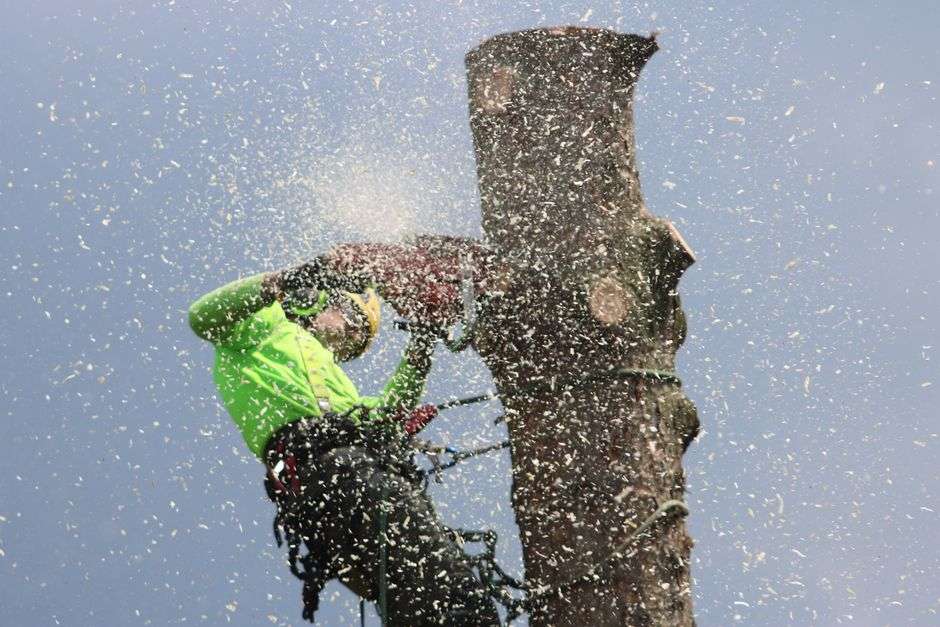
The equipment gives it away before the name does: bucket trucks, debris trucks, and spider lifts working the neighborhoods of Daphne, Montrose, Fairhope, and Point Clear, almost always attached to the same standard of tree work. Chris Francis Tree Care has grown from a boy pushing a lawnmower down Captain O’Neal Drive into one of the Gulf Coast’s most credentialed tree care operations — led by an arborist who holds a master’s degree in the field.
From lawns to limb work
Chris Francis was born in Pascagoula, where his father Mike worked at Ingalls Shipbuilding, but both parents came from Daphne originally, and the family returned to Baldwin County by way of South Carolina, Tennessee, Montrose, and Fairhope. He never got an allowance, so he mowed lawns — pushing a mower down Captain O’Neal Drive and Beall Lane until neighbors hired him for their yards. By the time he graduated from Fairhope High School in 1996, he had a real business and had hired his friends to run it.
The detours came next: a formative, occasionally rough stretch in Hawaii; business coursework at the University of Alabama; a semester through an exchange program at California State University, Dominguez Hills, chosen for its proximity to the ocean; and a degree in business administration with an economics and finance concentration from the University of South Alabama. There was also the raft. With friends Jason Williams and Clint Harper, Francis built a 10-by-20-foot wooden raft named Huck’s Revenge and floated it 28 days down a river system to the Fairhope Municipal Pier, nearly going over the first dam and getting fed by riverside strangers along the way.
Certifications as a strategy
On January 1, 2001, he relaunched as Chris Francis Landscapes. The pivot to trees came from frustration: subcontracted tree crews trampled the landscapes he installed, so he offered to handle their cleanup for a fee — until the tree side of the business outgrew the landscape side. Hurricane Ivan in 2004 put the young crew to work, and by 2006 the tree division was competing with established firms. Daphne’s then-city arborist, Marshall Parsons, invited him to an arborist conference, and trainer Fred Kapp gave him the pitch that stuck: become a certified professional, and you will never have to be the low bidder.
The credentials accumulated. He earned International Society of Arboriculture certification in 2008 — the year he married Chelsea Hargett — which qualified his firm for jobs like protecting a state-champion live oak from a damaging construction project. In 2015 he became a Board Certified Master Arborist, the ISA’s highest credential. Still hungry for training, he completed a Master of Science in Arboriculture and Urban Forestry from the University of Central Lancashire in England between 2018 and 2021, juggling the degree with a growing company, two children, youth soccer, COVID, and Hurricane Sally. Few practicing arborists in the world hold one.
Trees as infrastructure
Francis’s professional obsession is low-impact development — the principle that a developed site should function hydrologically like the forest it replaced. Leaves intercept rain, leaf litter filters it, and roots absorb it, recharging groundwater instead of sending floods and erosion downhill. Clear-cut a lot, he warns, and nothing slows the water down. Tree protection, in his view, is about saving root systems, which sit close to the surface and spread far beyond the canopy — not tying a ribbon around a trunk.
His advice to builders and homeowners is consistent: bring an arborist in before construction starts. Planning around root zones, he says, preserves trees that are expensive or impossible to repair afterward, and a lot of the work is simply education about where roots run.
A company built like a career
Chris Francis Tree Care has grown into a full-service operation: pruning, removal, plant health care on a monthly preventive schedule, canopy lighting installed with air excavation tools that avoid root damage, lightning protection — including for the live oaks at the Country Club of Mobile — and consultations for commercial and municipal contracts alongside residential work. Spider lifts keep climbers out of dangerous trees, a safety director enforces the top priority, and the company runs training programs, climbing competitions, and offshore fishing trips to keep the team together.
The employment model is deliberate: paid holidays, vacation, health care, an IRA match, and a published career ladder. “We pay well and want our people to know they are part of a team,” Francis says, “but we also want them to come home with all their fingers and toes.” Twenty-five years after a lawnmower on Captain O’Neal, the kid who could not sit at a desk has turned tree care into a profession — and Baldwin County’s oaks are the beneficiaries.