

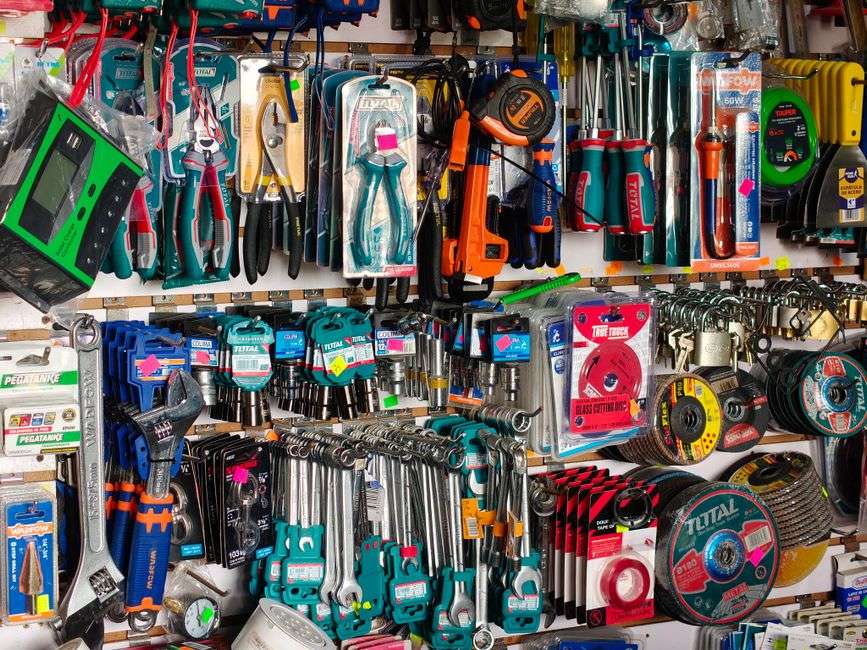
Not every second act begins with a splash, but Steve Ascik’s began with a name he couldn’t shake. Sitting at PJ’s Coffee near his future store in Spanish Fort — and later, on a golf weekend in Gulf Shores with college buddies — the former senior vice president kept circling back to the same three words: “Ace is the Place.” Two hardware stores later, the phrase has proved prophetic for the Eastern Shore.
Ascik owns Eastern Shore Ace Hardware, with locations in Spanish Fort and Daphne, and his path from global marketing executive to hometown hardware owner is a study in how careers bend toward the places people love. It also says something about Baldwin County itself: a market where locally owned stores can outcompete the big boxes by knowing their neighbors.
From Selma to the world’s boardrooms
Ascik is from Selma and graduated from the University of Alabama with a marketing degree. His business career ran primarily through sales and marketing, and his specialty was growth — boosting sales everywhere he landed. The centerpiece was a twenty-year stint with a world-renowned sunglasses company, where he helped take the business from $12 million in sales to more than $320 million as a style marketer working with licensed brands. The job took him around the world: meetings with manufacturers, licensors like Disney and Revlon, and major retail chains across North America and Europe.
He finished that run as Senior Vice President of Marketing and Procurement — “a troubleshooter,” in his words, deployed whenever the company acquired another business. “Anytime I wanted something to spice up my life, I was given an opportunity,” he has said. “I had a blast.” When the company was bought out, he stayed another year to help with the transition. At 51, having worked since age 11, he was not ready to retire.
A corporate recruiter steered him to a manufacturing company in Robertsdale — a town he already knew something about, having spent boyhood summers at Camp Cullen in Point Clear, where he still remembers the camp song. He and his family moved from Ormond Beach, Florida, to Fairhope in 2014. A short time later, he moved on from the position and began weighing what came next. His wife, Alisa, taught at Bayside Academy, where their daughter was in high school. Her instruction was simple: “Find something you really want to do, but we want to stay here.”
Why hardware — and why here
The answer had been sitting in front of him for years. Ascik had watched the Ormond Beach Ace Hardware go from mediocre to great, and the transformation caught his attention. He called Ace’s business development manager — who happened to be based in Daphne — and began exploring what an Eastern Shore store would take. He studied his options for six months, decided in August, and opened the Spanish Fort store that December of 2015.
He has said he never fully understood how much “local” matters until he ran a local business after years of national and international work. “People in this area will really support you,” he says. “We are so glad we are here.” Customers confirm the dynamic from the other side: the store has built a following on friendly, knowledgeable service, a clean and well-organized floor, and items a typical big-box run might not carry — like the custom wharf chairs that once made a Point Clear household very happy.
The cooperative behind the counter
Ace Hardware itself has a century of history behind Ascik’s stores. The company traces its roots to the early 1920s, when a group of Chicago-area hardware store owners — Richard Hesse, E. Gunnard Lindquist, Frank Burke, Oscar Fisher, and William Stauber — pooled their buying power to bypass the middlemen who drove up prices on every item. They incorporated as Ace Stores in 1928 and named the company after the World War I fighter pilots known as “aces.” When big home-center chains began squeezing independent retailers in the 1970s, Ace’s retailers took full control, restructuring the business as a retailer-owned cooperative — today the largest hardware cooperative in the world.
The model matters at the local level. Wholesale sales crossed $1 billion in 1985 and $5 billion in 2015, then climbed roughly a billion dollars a year to surpass $9 billion in 2022 — Ace reached $10 billion in 2025, the company’s best year ever — with more than 5,700 locally owned stores worldwide. Every Ace store operates independently. “The beauty of Ace Hardware is you do what you do, and they will support you in any way they can,” Ascik says. He reserves particular praise for CEO John Venhuizen, who led the brand’s rebuild at a time when market share and customer recognition were slipping. “Ace made bold and progressive moves to turn it around. I’ve never seen anything like it.”
Two stores and a growing map
The Spanish Fort location hit its stride, and Ascik began looking for a second challenge. “Most of the growth seems to be on the eastern side of the Eastern Shore between Malbis and Fairhope,” he observed. When no suitable property turned up to lease, he bought land on Highway 181 near County Road 64 in Daphne and built a new store from the ground up, opening on June 1, 2023. The site placement was deliberate: next to Allegri Farm Market, a destination in its own right, and positioned to intercept shoppers headed north to the big-box stores. “In both cases, new customers are surprised by the selection we have here,” he says.
What customers find inside reflects both the cooperative’s reach and Ascik’s merchandising instincts. His stores stock around 32,000 items, and if something is not on the shelf, Ace’s distribution warehouse in Loxley — which carries more than 120,000 items and serves four states — can have it in short order. The grills alone tell the story of a store tuned to Gulf Coast life: Big Green Egg, Weber, and Traeger all on the floor, alongside Benjamin Moore paint and a serious spring focus on fertilizer, seed, mulch, and live goods. More than half of the store’s Ace Rewards customers are women, a demographic shift Ascik notes you might not have expected at a hardware store a generation ago.
The Daphne store carries that same personality into a fast-growing corridor. Between the two locations, Ascik’s stores now serve a stretch of the Eastern Shore that runs from the Causeway communities north of Malbis down through Spanish Fort and Daphne toward Fairhope — some of the busiest retail territory in Baldwin County, and ground zero for the county’s population boom. Being close to Allegri Farm Market gives the Daphne store steady weekend foot traffic, and Ascik describes the store as an intercept point for shoppers who would otherwise drive past locally owned retail on their way to a big-box run. “In both cases, new customers are surprised by the selection we have here,” he says.
Hiring for “helpful”
Ask Ascik what his stores actually sell, and the answer is not grills or paint. “Our primary offering is always ‘Helpful,'” he says — the brand promise that Ace has branded itself around for decades, and the standard he hires to. His three requirements for employees: you must really like helping people, really enjoy working as a team, and really like staying busy. He has had little trouble finding staff, praises his high school co-op employees, and says the stores aim to create a positive work environment for people who enjoy the work itself.
That people-first approach is, in his telling, the thing that surprised him most after a career spent far from home. “Every day we get comments from customers thanking us for just being here,” he says. In an era when hardware shopping is a chase down an aisle of a 100,000-square-foot warehouse, a clean neighborhood store where somebody walks you to the right bolt has proved to be a durable competitive advantage.
Ascik admits the leap from senior executive to two-store owner was bigger than it looked. “It’s a different animal,” he says. “I had to transition from delegating tasks to actively participating, and it took me 18 months to get really comfortable.” But eight years and two stores in, the verdict is unchanged: “I’ve loved it ever since.” For the Eastern Shore, the presence of two locally owned hardware stores — backed by a century-old cooperative and run by a neighbor — is part of what keeps a growing suburban corridor feeling like a community.