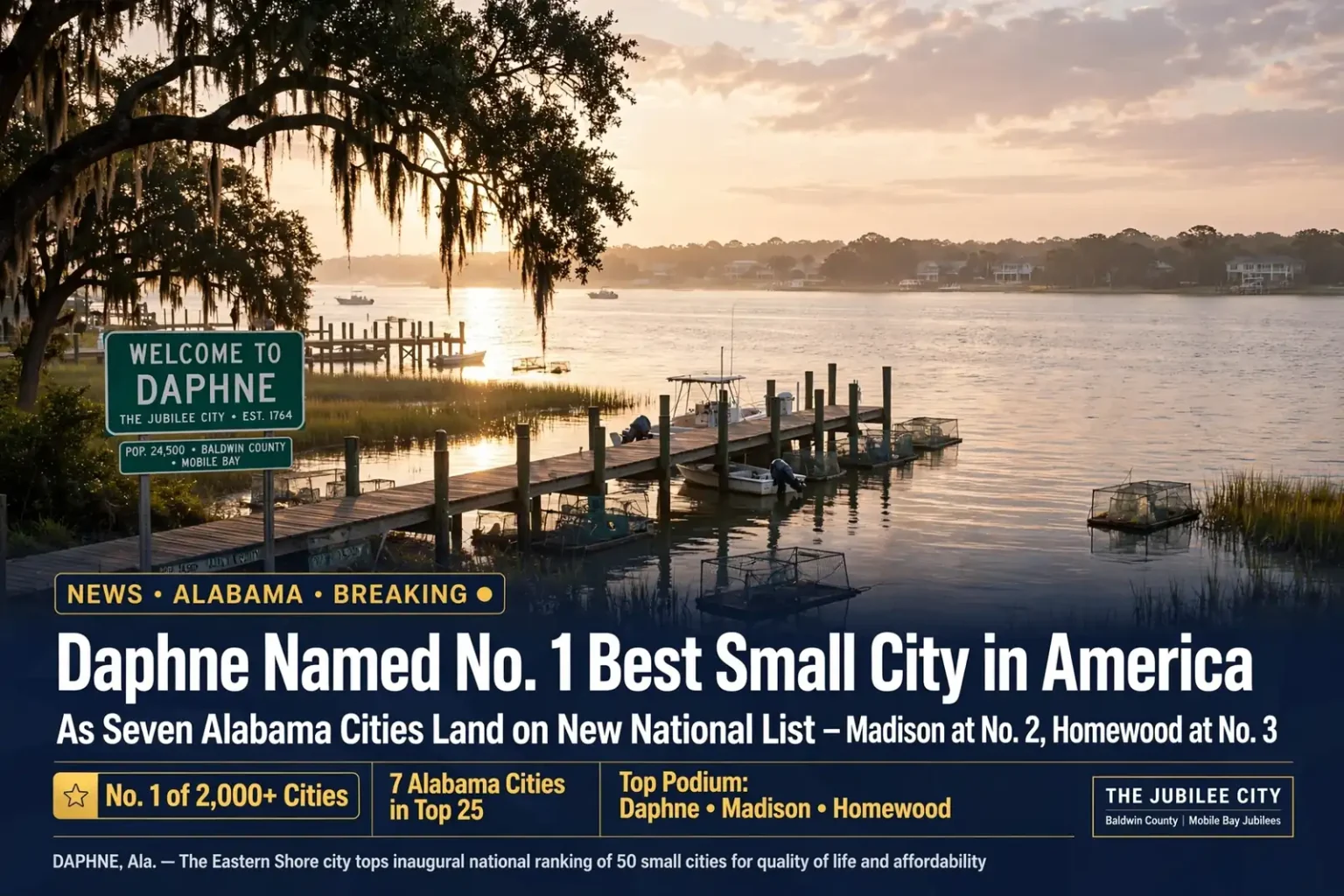
DAPHNE, Ala. — The Jubilee City has a new title to add to its welcome signs. Daphne has been ranked the No. 1 best small city in America on a new national list that evaluated more than 2,000 communities, and it is far from the only Alabama city celebrating. Six others from across the state made the inaugural ranking of 50 cities, including the two that finished directly behind Daphne.
With Madison at No. 2 and Homewood at No. 3, Alabama swept the top three spots. Enterprise, Florence, Opelika and Dothan also earned places in the top 25, giving the state seven cities on a list that spans 25 states.
What the Top Ranking Means for Daphne
For residents of the Eastern Shore, the news puts a national spotlight on a Baldwin County city better known regionally for its bay views, its small-town feel and the natural phenomenon that gave it its nickname. Daphne is called the Jubilee City because of the jubilees that occasionally occur along its stretch of Mobile Bay, when flounder, shrimp and crabs crowd into the shallows near shore, often before dawn on summer nights. Mobile Bay is one of very few places in the world where jubilees are known to happen with any regularity, and the phenomenon has become a point of local pride.
The ranking was designed to identify places that deliver a high quality of life while remaining affordable, which suggests Daphne scored well on both measures. The city sits along Interstate 10 and U.S. 98 on the eastern side of Mobile Bay, with Mobile a short drive across the bay and the beaches of Gulf Shores and Orange Beach within reach to the south. That location gives residents access to the jobs, health care and entertainment of a larger metro area while keeping the pace of a smaller community.
Daphne is part of Baldwin County, which has been among the fastest-growing counties in Alabama in recent years. Public schools in the city are part of the Baldwin County Public Schools system. The city’s parks, bayfront access and neighborhoods have drawn new residents from across the country, and the ranking is likely to add to that interest.
Seven Alabama Cities Make the Cut
Alabama’s showing is notable for both its depth and its geographic spread. The seven cities stretch from the Gulf Coast to the Tennessee Valley, and from the Birmingham suburbs to the Wiregrass.
- Daphne (No. 1): Baldwin County city on the Eastern Shore of Mobile Bay.
- Madison (No. 2): Fast-growing city next to Huntsville in North Alabama, closely tied to the region’s aerospace, defense and technology economy centered around Redstone Arsenal.
- Homewood (No. 3): Walkable Jefferson County suburb just south of Birmingham and home to Samford University.
- Enterprise (No. 11): Coffee County city in the Wiregrass, known for its Boll Weevil Monument and its close ties to the Army aviation center at nearby Fort Rucker.
- Florence (No. 14): Lauderdale County city on the Tennessee River in the Shoals area and home of the University of North Alabama.
- Opelika (No. 16): Lee County city with a historic downtown, neighboring Auburn in East Alabama.
- Dothan (No. 25): Houston County hub of the Wiregrass region and host of the annual National Peanut Festival.
Two of the seven, Enterprise and Dothan, sit in the southeastern corner of the state, while Daphne gives the Gulf Coast its representation. With cities finishing first, second and third, Alabama claimed the entire podium.
How the Ranking Was Built
The list is the first of its kind from its organizers, who set out to find the 50 communities offering the best quality of life at a cost that ordinary households can manage. To be considered, a city had to have between 15,000 and 75,000 residents. More than 2,000 cities fell within that range and were evaluated.
Each city was measured against nearly 100 individual data points. The analysis was done in partnership with Applied Geographic Solutions, known as AGS, a firm that provides demographic and geographic data. Those measurements were sorted into eight broad categories: health, education, safety, the economy, the environment, transportation, amenities, and housing along with the overall cost of living.
What those categories generally capture
Organizers did not publish every individual measurement in their announcement, but categories like these are common in quality-of-life rankings and generally look at familiar questions. Economic measures often consider job availability, income levels and the health of local businesses. Housing and cost-of-living measures typically weigh home prices and rents against what local households earn, which is central to a ranking built around affordability.
Amenities usually refer to the things that make daily life enjoyable, such as parks, restaurants, shopping, recreation and cultural attractions. Transportation measures tend to look at commute times and how easily residents can get around. Environmental factors can include air quality, green space and natural features, while safety categories commonly draw on crime data.
Education measures often reflect the quality of local schools and the education levels of residents, and health categories generally consider access to hospitals, doctors and other medical care. Taken together, the categories are intended to give a well-rounded picture of what it is like to live in a place, rather than focusing on a single factor such as price or size.
The same organizers produce a broader annual ranking of the best places to live in the country, and Huntsville earned the top spot on that list earlier this year. The small-city ranking uses a similar set of categories but focuses on places whose size can cause them to be overlooked.
Organizers said the goal was to honor smaller cities that give residents a great deal but often get passed over because of their size. They said anyone searching for a close-knit community that is both livable and affordable can use the list to find 50 strong choices across the country.
Who Else Made the Top 25
Outside Alabama, the top 25 included cities from the Midwest, the Northeast, Texas and Tennessee. Grouped by state, the other 18 cities in the top 25 were:
- Texas (5): Pflugerville (No. 9), Friendswood (No. 10), Rockwall (No. 18), Wylie (No. 19) and Cibolo (No. 21)
- Ohio (2): Dublin (No. 4) and Mason (No. 7)
- Illinois (2): Edwardsville (No. 13) and Downers Grove (No. 17)
- New Jersey (2): Bergenfield (No. 15) and Fort Lee (No. 20)
- Wisconsin (2): Mequon (No. 12) and Brookfield (No. 23)
- Missouri (1): Chesterfield (No. 5)
- Pennsylvania (1): Bethel Park (No. 6)
- Indiana (1): Westfield (No. 8)
- Minnesota (1): Minnetonka (No. 22)
- Tennessee (1): Germantown (No. 24)
With seven cities in the top 25, Alabama had more entries in that group than any other state, ahead of Texas with five.
Why Small Cities Are Getting More Attention
Rankings like this one reflect growing national interest in smaller communities. In recent years, rising housing costs in major metropolitan areas and the spread of remote and hybrid work have led many families and retirees to look at cities where homes are more affordable, commutes are shorter and neighbors are more likely to know one another.
Cities in the 15,000 to 75,000 population range often occupy a middle ground. They tend to be large enough to support a variety of shops, restaurants, parks and medical services, yet small enough to keep traffic, housing prices and the pace of life manageable. Many, like Daphne and Madison, sit on the edge of a larger metro area, giving residents easy access to big-city jobs and amenities while living in a smaller hometown.
For city leaders, a high national ranking can be a useful tool for recruiting businesses, attracting new residents and encouraging tourism. It can also bring added pressure, as fast-growing communities work to keep infrastructure, schools and services in step with population growth.
What Residents Should Know About Rankings
Lists like this rely on large data sets and a specific set of measurements, so results can differ from one ranking to another depending on the categories chosen and how each is weighted. A city’s position reflects how it compares on those measures at a point in time rather than a judgment of every aspect of life there.
Still, landing at No. 1 out of more than 2,000 eligible cities is a significant recognition, and the strong performance of so many Alabama communities suggests the state’s smaller cities compare well on cost of living and quality of life.
For people weighing a move, a ranking is best used as a starting point. Visiting a city, talking with residents, checking commute routes, touring neighborhoods and looking closely at schools, housing prices and insurance costs can reveal details that no national data set fully captures. On the Gulf Coast in particular, prospective homeowners often factor in flood zones and homeowners insurance rates, which can vary widely from one neighborhood to the next.
What Comes Next
Because this is the first edition of the small-city ranking, this year’s results will serve as a baseline for future lists, and Alabama cities will have a chance to defend their positions in coming years. In the meantime, Daphne joins a growing roster of Baldwin County communities drawing national attention for their quality of life.
Residents and visitors who want to learn more about what the city offers can explore Daphne’s parks and bayfront, its local events calendar and city services through the City of Daphne’s official website.