Daphne Courthouse Security Officers Uncover Drugs in Car With Toddler Inside
Daphne police arrested a Bay Minette man and a Spanish Fort woman on drug charges, including felony chemical endangerment of a child, after finding marijuana, paraphernalia and methamphetamine in a car that carried a toddler to the courthouse.
Two Baldwin County residents are facing felony charges after Daphne police said they discovered marijuana, drug paraphernalia and methamphetamine in a vehicle that had been used to transport a 3-year-old child to the Daphne municipal courthouse.
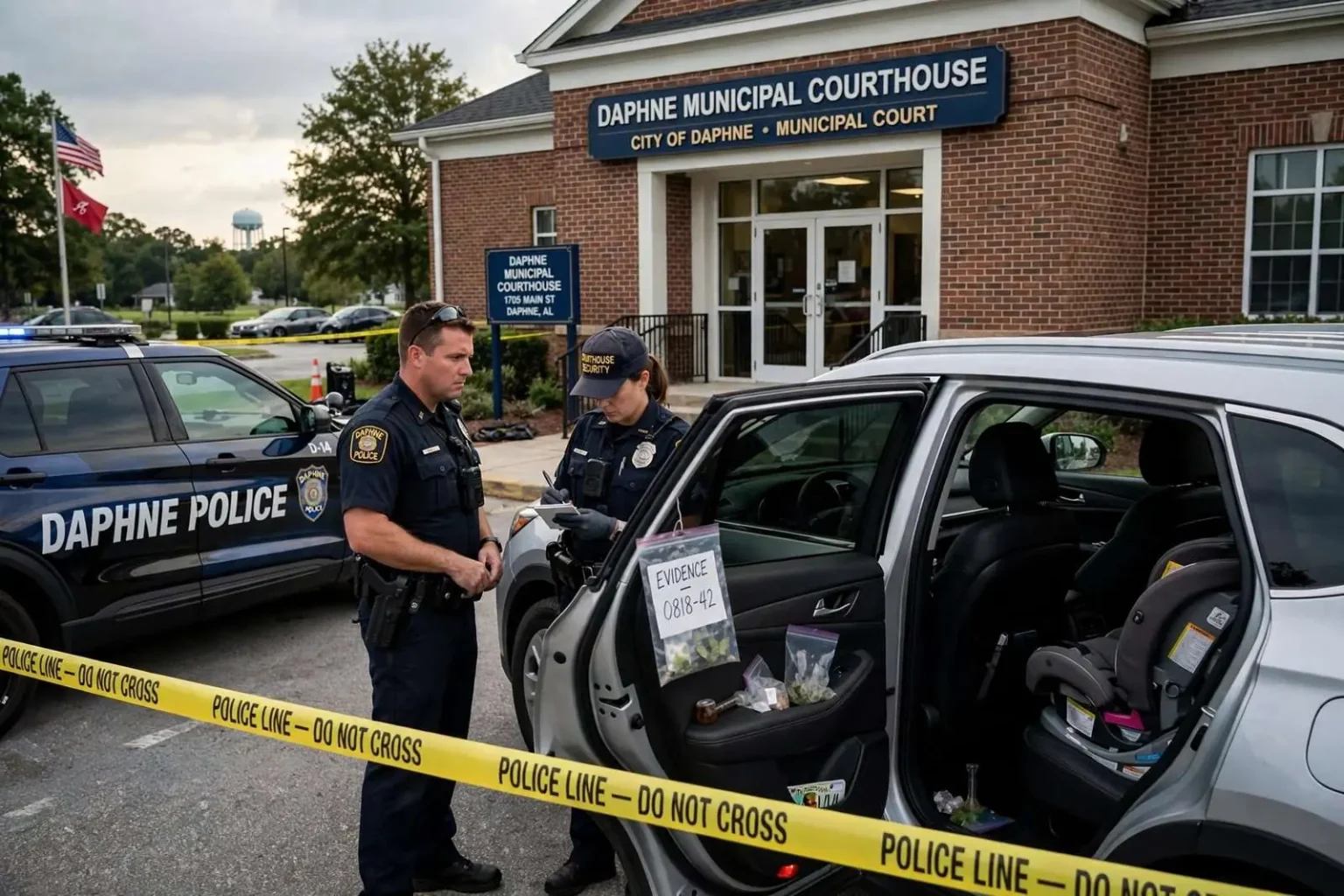
According to a Daphne Police Department news release, the incident unfolded just before 5:30 p.m. on Aug. 18, when patrol officers working a court security assignment noticed a man smoking marijuana inside a parked vehicle in the courthouse lot. Court security details are a routine part of the department’s patrol workload, with officers assigned to watch over the building, its parking areas and the steady stream of defendants, witnesses and family members who move through the property on court days.
Officers identified the man as 30-year-old Cody Cordell Hicks of Bay Minette. After making contact with Hicks, officers conducted a probable cause search of the vehicle and said they found marijuana and drug paraphernalia stashed beside a car seat — the seat that had carried the child to the courthouse that afternoon.
The Daphne municipal courthouse handles the city’s municipal court docket, which convenes regularly to take up traffic violations, ordinance cases and misdemeanor matters. On any given court day the lot fills with drivers appearing before the judge, many of them accompanied by children and other family members, and security officers are stationed to keep order inside the building and across the surrounding grounds.
Vehicle owner found inside courthouse
The vehicle’s owner, 25-year-old Autumn Rose Barker of Spanish Fort, was inside the courthouse at the time, attending her own court proceedings with her 3-year-old child. When officers approached Barker, they said she smelled strongly of marijuana. Barker admitted that methamphetamine found in her purse belonged to her and that the drugs had been transported in the car near her child, according to police.
The discovery transformed what began as a routine security observation into a multi-count felony case, and it placed the child at the center of an investigation that now involves both prosecutors and state child welfare authorities. Officers documented the location of each item seized, noting in particular that the drugs recovered from the vehicle were stored directly beside the child’s car seat.
The charges
Hicks was arrested and charged with felony possession of marijuana and possession of drug paraphernalia. Barker faces a longer list: felony possession of a controlled substance, felony chemical endangerment of a child, second-degree possession of marijuana and possession of drug paraphernalia.
Both were booked into the Baldwin County Corrections Center following their arrests. The facility in Bay Minette serves as the county’s main jail, housing defendants awaiting trial as well as those serving sentences on misdemeanor convictions, and it processes the arrest paperwork for law enforcement agencies across Baldwin County, from Daphne and Spanish Fort to Fairhope, Foley, Robertsdale and the county sheriff’s office.
Bond and initial appearances in felony cases originating from municipal arrests are typically handled within days of booking, after which the cases are prepared for presentation to the district attorney’s office for review.
Chemical endangerment under Alabama law
The most serious charge Barker faces, chemical endangerment of a child, is a felony under Alabama law that applies when a child is exposed to an environment where controlled substances are present, used or sold. The statute was written to reach situations in which adult drug activity places children at risk, whether inside a home or in other settings such as a vehicle, and prosecutors do not have to show that a child suffered physical harm — only that the exposure occurred.
Because the charge is a felony, a conviction can carry prison time, and the presence of methamphetamine — a controlled substance treated especially harshly under state law — typically raises the stakes. The law has been applied in cases across Alabama involving methamphetamine labs, drug paraphernalia within a child’s reach and vehicles where drugs were being used or stored near minors, and it has become one of the more frequently used tools prosecutors rely on when children are found alongside illegal substances.
Legal observers have long noted that Alabama’s chemical endangerment statute is among the broadest of its kind in the nation, covering exposure itself rather than requiring proof of injury, and district attorneys across the state have used it consistently in cases where children were recovered from vehicles or residences alongside drugs.
The marijuana charges, explained
Alabama law divides marijuana possession into degrees. Second-degree possession, one of the counts Barker faces, is generally treated as a misdemeanor for a first offense, while first-degree possession — the felony charge Hicks faces — applies when aggravating circumstances are present under state law, such as a prior conviction or the presence of other factors spelled out in the statute. Paraphernalia charges, meanwhile, cover items used to store, consume or conceal controlled substances and routinely accompany possession counts in arrests of this kind.
The distinction matters at sentencing. A felony drug conviction can affect employment prospects, housing applications and the right to possess a firearm, while a misdemeanor conviction typically carries lighter penalties. Both defendants will have those questions resolved in court, where prosecutors must prove each count beyond a reasonable doubt and defense attorneys may challenge the legality of the vehicle search and the handling of the evidence.
From arrest to booking
After the arrests, both defendants were transported to the Baldwin County Corrections Center, where they were processed, photographed and held pending initial court appearances. In Alabama’s court system, arrested defendants typically appear before a judge within days of arrest, at which point bail is considered and felony cases are set on a track that can lead to a grand jury review and, ultimately, circuit court.
Because the alleged offenses were discovered at the municipal courthouse but involve felony charges, the case is expected to move through the Baldwin County court system rather than remaining solely in municipal court, where judges handle ordinance violations and misdemeanor matters. felony arrests made by municipal police follow the same path as those made by the sheriff’s office, with the district attorney’s office deciding what charges to present to the grand jury.
Child released to a family member
Police said the child was released to a family member who was not involved in the incident. That decision reflects a standard priority in Alabama law enforcement practice: when a parent is arrested and a child is present, officers work to place the child with a responsible relative rather than taking the child into state custody on the scene.
The case will also be reported to the Alabama Department of Human Resources, which routinely reviews cases involving child endangerment allegations to determine whether further action or support services are needed. The department’s family services division can offer counseling, parenting support and safety planning, and it can pursue court involvement if investigators conclude a child cannot safely remain in a home. Referrals from police departments are a common starting point for those reviews, and the agency’s findings run on a separate track from the criminal case even though developments in one can influence the other.
In cases like this one, social workers typically interview the family member who took the child, assess the home environment and weigh the nature of the allegations before deciding what, if any, follow-up is warranted. The agency may close the matter, offer voluntary services or seek court oversight depending on what the review finds.
What happens next in court
For the defendants, the next steps follow Alabama’s standard felony path. After an initial appearance and the setting of bond, felony cases arising from municipal arrests are prepared for presentation to a Baldwin County grand jury. If the grand jury returns an indictment, the cases move to circuit court for arraignment, pretrial motions and, if no plea agreement is reached, trial before a judge or jury.
Defense attorneys will have the opportunity to challenge the probable cause search of the vehicle and the other evidence officers gathered, and prosecutors will rely on the police report, the items seized and the statements attributed to the defendants in the department’s news release.
Court security’s expanding role
The case also underscores the role court security officers play beyond keeping order inside a courtroom. Officers assigned to courthouse duty watch parking areas, screen for weapons and prohibited items and stay alert for signs of impairment or illegal activity among the people coming and going. Incidents discovered in courthouse lots are handled like any other street-level investigation, with the same search and arrest standards applying.
Baldwin County has seen steady drug-related enforcement activity in recent years as its population has climbed, with methamphetamine cases in particular drawing attention from municipal departments and the sheriff’s office across the county. Officials have repeatedly urged residents to report suspected drug activity, noting that tips from observant neighbors — and, in this case, alert officers assigned to courthouse duty — often provide the first break in such investigations.
For Daphne, a city of more than 27,000 residents along the eastern shore of Mobile Bay, the episode was an unusual one: a routine court day interrupted by a drug investigation that ended with two felony arrests, a child safely placed with relatives and a referral to state welfare authorities for review.