UPDATE, Nov. 12: The Mobile Heart Walk, where the Daphne referee whose heart stopped during a game on Oct. 11 served as the event’s honorary heartbeat, brought in $200,133 overall. Together, USA Health and the campus of the University of South Alabama raised $23,005, the second-largest total of any participating organization. Details on the fundraising follow below, along with the reunion between the referee and the USA Health cardiologist who helped save him; earlier reporting is included.
DAPHNE, Ala. — A youth soccer referee is alive after his heart stopped during a game because people on the sidelines started CPR within moments and used a defibrillator that was close at hand.
The 48-year-old, who has refereed local soccer for years, collapsed in cardiac arrest in the second half of a game on Oct. 11 at the Al Trione Sports Complex in Daphne. He has said he became light-headed all at once and never had the chance to blow his whistle, and that the next thing he remembers is waking up on the ground surrounded by people.
Bystanders act within moments
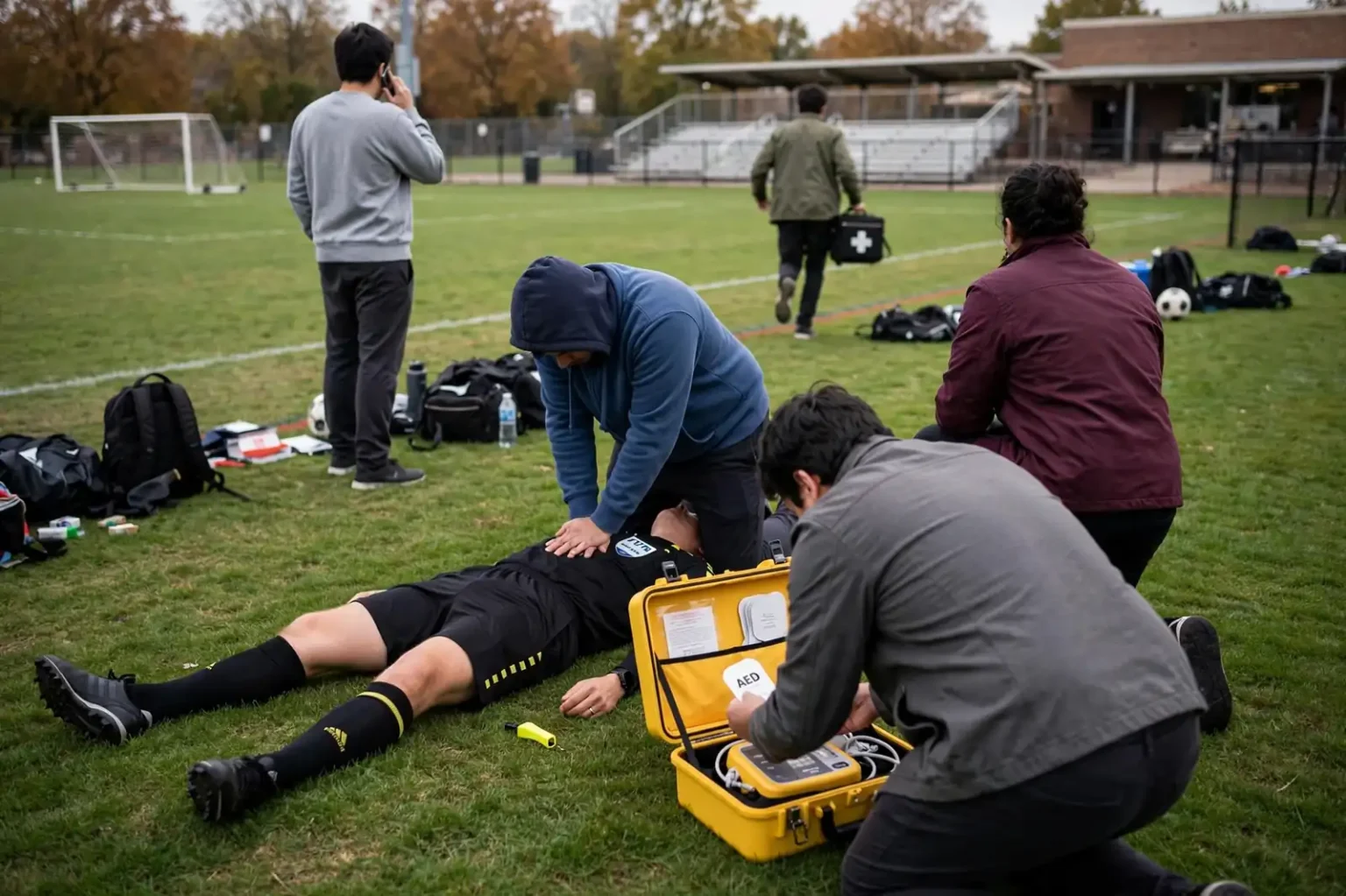
Witnesses rushed onto the field and began chest compressions right away, while someone else grabbed an automated external defibrillator, or AED, from a nearby concession stand. Among those who responded was a cardiologist with USA Health who happened to be watching a game on an adjacent field.
The cardiologist has said everyone on the scene handled each step exactly as it needed to be handled, performing CPR correctly and getting the AED on the referee to deliver a shock, and that this is likely what saved his life.
The referee’s wife has said the quick response is the reason her husband is still alive, because the people around him did not stop or hesitate before acting.
Roughly 90% of people who suffer cardiac arrest outside a hospital do not survive, which is why help in the first minutes, before paramedics arrive, matters so much. That figure matches what the American Heart Association tells the public, as South AL News reported from the Baldwin Heart Walk: nine in 10 people who have a cardiac arrest outside a hospital do not survive, and most of the time it is because no one nearby performed CPR. Nationally, just about 10.5% of adults who receive care by emergency medical services for an out-of-hospital cardiac arrest survive to be discharged from the hospital. The association says immediate CPR combined with an AED can double or triple a person’s chance of surviving.
Blockages found, bypass surgery performed
After the collapse, doctors found a 75% blockage in the referee’s left anterior descending artery, an artery sometimes nicknamed the widow maker because it supplies a large share of the heart’s blood flow, along with two additional blockages, for three in all. He had double bypass surgery.
He has since shared his story at the Baldwin County Heart Walk, and he hopes it persuades more people to learn hands-only CPR. He has urged residents to learn the skill because waiting for an ambulance is not enough and an emergency like his could happen to anyone.
Reunion at the Mobile Heart Walk
The referee and the cardiologist met for the first time since the emergency at the Mobile Heart Walk on Nov. 7, where the referee led the walkers as the honorary heartbeat of the event, keeping time on a drum that stood for the steady rhythm his heart nearly lost. The cardiologist and others on the scene performed CPR and had an AED on him no more than 24 seconds after he fell, and video captured the moment he went down on the field.
At the reunion, the referee described himself as one of the lucky ones. He credited a long chain of circumstances for his survival, including a cardiologist nearby, the first responders, an athletic trainer on the sideline and an AED that reached him within seconds. He also expressed thanks to the responders and to all who backed his recovery or prayed on his behalf.
His wife has said the location made all the difference, and that the outcome could have been very different had the emergency happened at home.
The cardiologist described the response that day as essentially flawless: the people around the field knew CPR, knew where the AED was kept and acted in time. He used the reunion to repeat his call for more people to learn lifesaving skills, saying CPR is simple to learn and can save a life.
Recovery and paying it forward
The referee has said his recovery is on track. He reports feeling well, making steady progress in cardiac rehabilitation and noticing the pain in his chest gradually healing.
He plans to keep telling his story and to urge others to train in CPR and get comfortable using AEDs, in the hope of sparing another family the heartbreak of a sudden cardiac arrest. He has said he wants to spread awareness, help save someone else’s life and pay forward the help he received.
Heart Walk fundraising tops $200,000
The Mobile Heart Walk raised $200,133 overall for the American Heart Association. The campus of the University of South Alabama and USA Health combined for $23,005, which ranked second among all participating organizations.
USA Health’s own fundraising for the walk has grown sharply. From 2022 through 2025, the health system raised a combined $11,942.44. This year alone, it brought in $15,403.55 from June through the walk in November, more than its total for the previous four years put together. Additional donations were still coming in after the event.
What hands-only CPR involves
The American Heart Association teaches hands-only CPR for adults in two steps: call 911, then push hard and fast in the center of the chest until help arrives. Compressions should come at a rate of 100 to 120 per minute. The association distinguishes between a heart attack, in which blood flow to part of the heart is blocked, and cardiac arrest, in which the heart suddenly stops beating effectively. In either case, the first step is to call 911, and in cardiac arrest, starting CPR right away can make the difference.
Training resources and course sign-ups are available through the American Heart Association and the American Red Cross.
About the Mobile Heart Walk
The Mobile Heart Walk was held Saturday, Nov. 7, at the University of South Alabama, with activities and CPR demonstrations planned to begin at 8 a.m. ahead of the walk. USA had set a goal of more than 20 registered teams from the university and USA Health. Information about the event and donations is available through the American Heart Association’s Heart Walk site.
The Baldwin Heart Walk at OWA Parks & Resort in Foley raised a little more than $165,000 as of Oct. 24 against a goal of $210,000, with donations still being accepted for about six more weeks at that time.