Daphne Search & Rescue Christens New Vessel ‘Impact’ With Help From Local Women’s Giving Group
Daphne Search & Rescue christened its newest vessel, a $160,000 sonar-equipped boat named 'Impact' in honor of the women's giving group Impact 100, which helped fund the purchase.
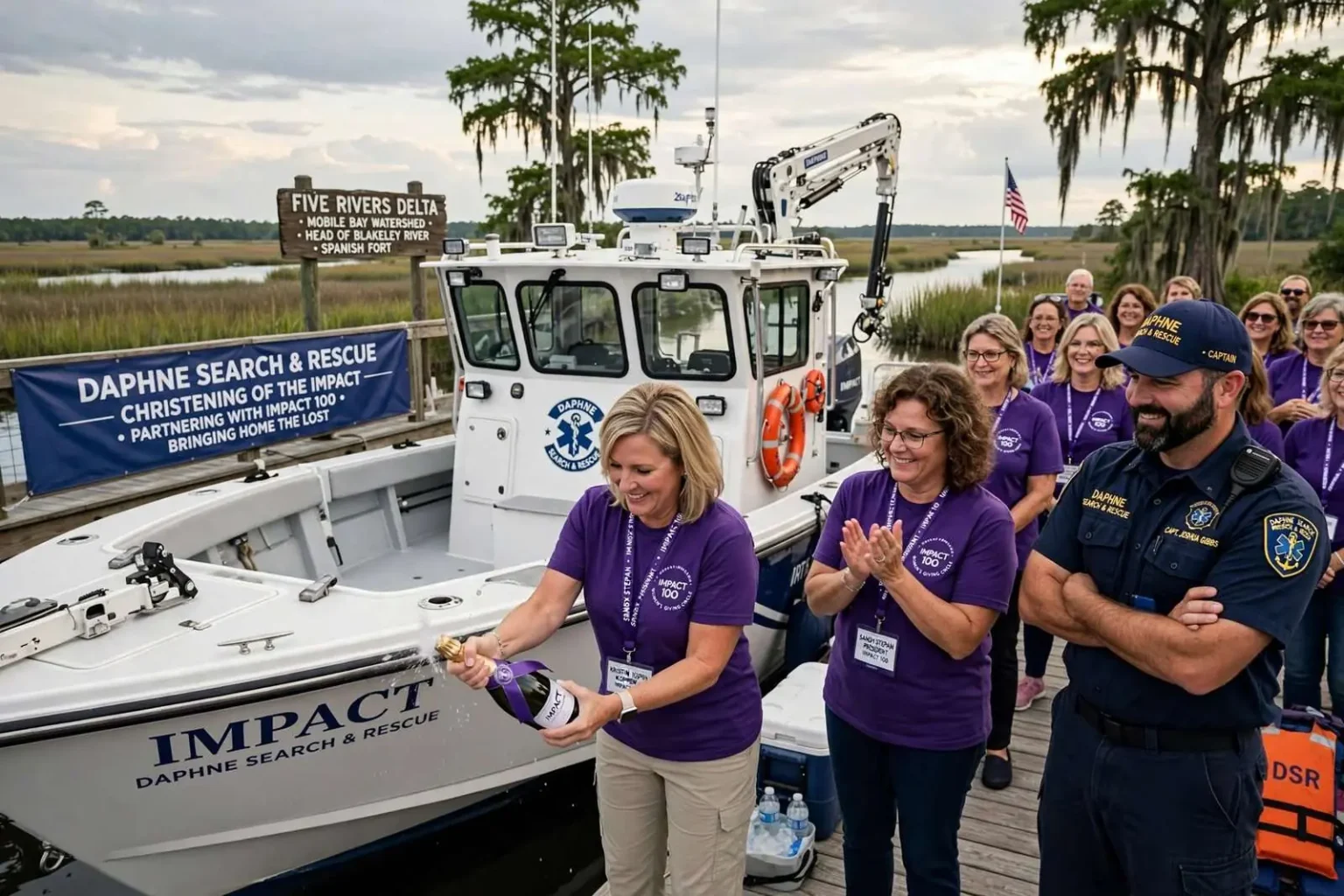
Daphne Search & Rescue marked a milestone this week, formally christening and naming the newest boat in its fleet during a ceremony at Five Rivers Delta. The 28-foot Scully vessel was christened by Kristin Koppen of Impact 100, the all-women’s giving circle that helped fund the boat’s purchase.
The christening served as both a celebration of the new equipment and a tribute to Impact 100’s ongoing support of the volunteer rescue organization.
“They are an amazing team. I am honored to work with them. Can’t tell you how important it is that they do what they do for our area. We are so blessed to have them,” Koppen said.
The setting was fitting. Five Rivers, where the Mobile Bay watershed’s channels converge at the head of Blakeley River near Spanish Fort, is one of the busiest and most deceptively demanding stretches of water in south Alabama. Kayakers, anglers, boaters and paddlers fan out from the delta’s access points every weekend into a maze of creeks, bayous and open bay where currents, weather and tide can turn a routine outing into an emergency with little warning. It is exactly the kind of environment where the difference between a rescue and a recovery often comes down to how quickly a properly equipped crew can get on the water.
Daphne Search & Rescue’s ability to respond to emergencies on the water owes much to Impact 100, whose members vote each year to direct pooled donations toward local nonprofit projects.
A Name That Reflects a Partnership
In recognition of that support and the two groups’ shared mission, the vessel was given a name meant to reflect both: “Impact.”
“The name was a surprise! We are thrilled. We want to make an impact in our community — that’s what our organization is all about — supporting these non-profits. Obviously, this is going to make an impact in the work that they do, and it’s such an honor and a privilege to help support them,” said Sandy Stepan, Impact 100’s president.
The giving circle’s model is simple and powerful: members contribute to a pooled fund, then vote as a group on which local nonprofit projects receive the grants. That structure lets the organization make gifts large enough to fund transformative purchases — a boat, a sonar system, a building renovation — that small nonprofits and volunteer agencies could rarely afford on their own. For a volunteer outfit like Daphne Search & Rescue, which operates on donations rather than a government budget, that kind of support is not a luxury. It is the difference between what the organization wishes it could do and what it actually can.
This isn’t the first time Impact 100 has backed Daphne Search & Rescue’s work. Back in 2015, the group funded the organization’s first sonar unit, a purchase that helped Daphne Search & Rescue stand up its Advanced Sonar Team.
The new boat, which the crew has already had in service for roughly a year, builds on that investment. It has already been used in emergency responses, including the search earlier this month for missing teenagers in Greene County.
That deployment illustrated why a capable vessel matters even far from home waters. Search-and-rescue calls do not respect county lines, and when a community needs eyes on a river or lake quickly, volunteer teams with the right equipment are often asked to travel. The Scully’s size and range let the Daphne crew bring its sonar capability to waterways across west Alabama, not just the ones in its backyard.
Captain Joshua Gibbs of Daphne Search & Rescue said the vessel’s design gives crews capabilities they didn’t have before.
“One thing that this does it has the ability to make us more effective in our job. It’s an enclosed cabin — so it’s got an air conditioner, it’s got heat. Waves crash over the front of the boat — it doesn’t affect the operators inside. The sonar system we have on the back actually has a hydraulic gantry — that extends out and shuffles back in to where we don’t even have to get out to launch or pull it in,” Gibbs explained.
Each of those features translates directly into search time. An enclosed, climate-controlled cabin means operators can stay on task through summer heat, winter cold and rough water without exhaustion cutting the search short — a serious consideration on Mobile Bay, where afternoon chop and sudden storms are a fact of life. The hydraulic gantry means sonar can be deployed and retrieved from inside the vessel, saving minutes on every pass and keeping crew members out of the water’s edge during dangerous recoveries. In searching, minutes compound: a crew that spends less time handling gear spends more time actually looking.
A Game-Changer Under the Water
The boat, now valued at more than $160,000 before factoring in its sonar equipment, is expected to be a significant asset as the organization works to live up to its motto, “Bringing Home the Lost.”
“So we’re able to have discrimination here in the water to see what is on the bottom at a level that a lot of other units and teams don’t have and that’s a game-changer when you are looking for something lost in the water,” Gibbs said.
The “discrimination” he described is the heart of modern side-scan sonar work. The technology paints a picture of the bottom of a river, bayou or bay, allowing trained operators to distinguish a submerged vehicle from a log, a mailbox from a barrel, and to pinpoint objects that would be invisible from the surface. On the muddy, debris-strewn bottoms typical of the Mobile-Tensaw Delta and Mobile Bay, where visibility below the surface is often measured in inches, sonar is not merely helpful — it is often the only practical way to search at all.
Daphne Search & Rescue also thanked the Alabama Association of Rescue Squads and several local vendors for their help outfitting the Impact.
The association plays a quiet but important role across the state, linking volunteer rescue squads and search-and-rescue units, coordinating mutual aid and training standards, and giving small organizations a larger network to lean on when a call exceeds their resources.
Part of a Wider Safety Net
Daphne Search & Rescue is one of several volunteer search-and-rescue organizations serving Baldwin County waterways, working alongside law enforcement and the U.S. Coast Guard on water emergencies across Mobile Bay and the surrounding delta system.
The division of labor is familiar to anyone who has followed a major water search on the Gulf Coast. Sheriff’s deputies and municipal police departments typically lead investigations and secure scenes; the Coast Guard brings assets for the open bay and Gulf; and volunteer teams supply specialized equipment and trained operators who can stay on a search for as long as it takes. Baldwin County’s waters make that partnership essential: the county has more shoreline than any other in Alabama, from the beaches of Gulf Shores and Orange Beach to the Eastern Shore’s bayous, the Weeks Bay estuary, and the vast delta wetlands at its northern edge.
Volunteer organizations like Daphne’s also fill a gap that formal agencies cannot. A department’s dive team or marine patrol unit has its own jurisdiction’s calls to answer; a volunteer team can commit to an extended search in a neighboring county, hold a scene overnight, or bring sonar to a river two hundred miles away — as the Impact’s Greene County deployment showed.
The addition of a purpose-built, sonar-equipped vessel is expected to improve response times and search capability for years to come. Every hour a crew spends fighting its own equipment is an hour not spent searching; the Impact was designed to erase that trade-off.
For the organization’s volunteers, the christening closed a chapter that began with a sonar grant nearly a decade ago and opened another with a boat built around the mission. For Impact 100’s members, watching the vessel bear their name was a visible answer to the question every giving circle eventually asks: what did our dollars actually become? In this case, the answer floats — an enclosed cabin, a hydraulic gantry, a sonar picture of the bottom — and answers calls from the delta’s narrow creeks to the open water of Mobile Bay.
And for families who one day find themselves waiting on a shoreline, scanning the water for a missing loved one, the name on the bow is a promise that someone is coming with the best equipment the community could give them, built on a partnership between a rescue crew that refuses to stop searching and a giving circle that believes in backing them up. “Bringing Home the Lost,” as the organization’s motto puts it, is easier said than done — but with the Impact, it is now done with better tools than ever before.