

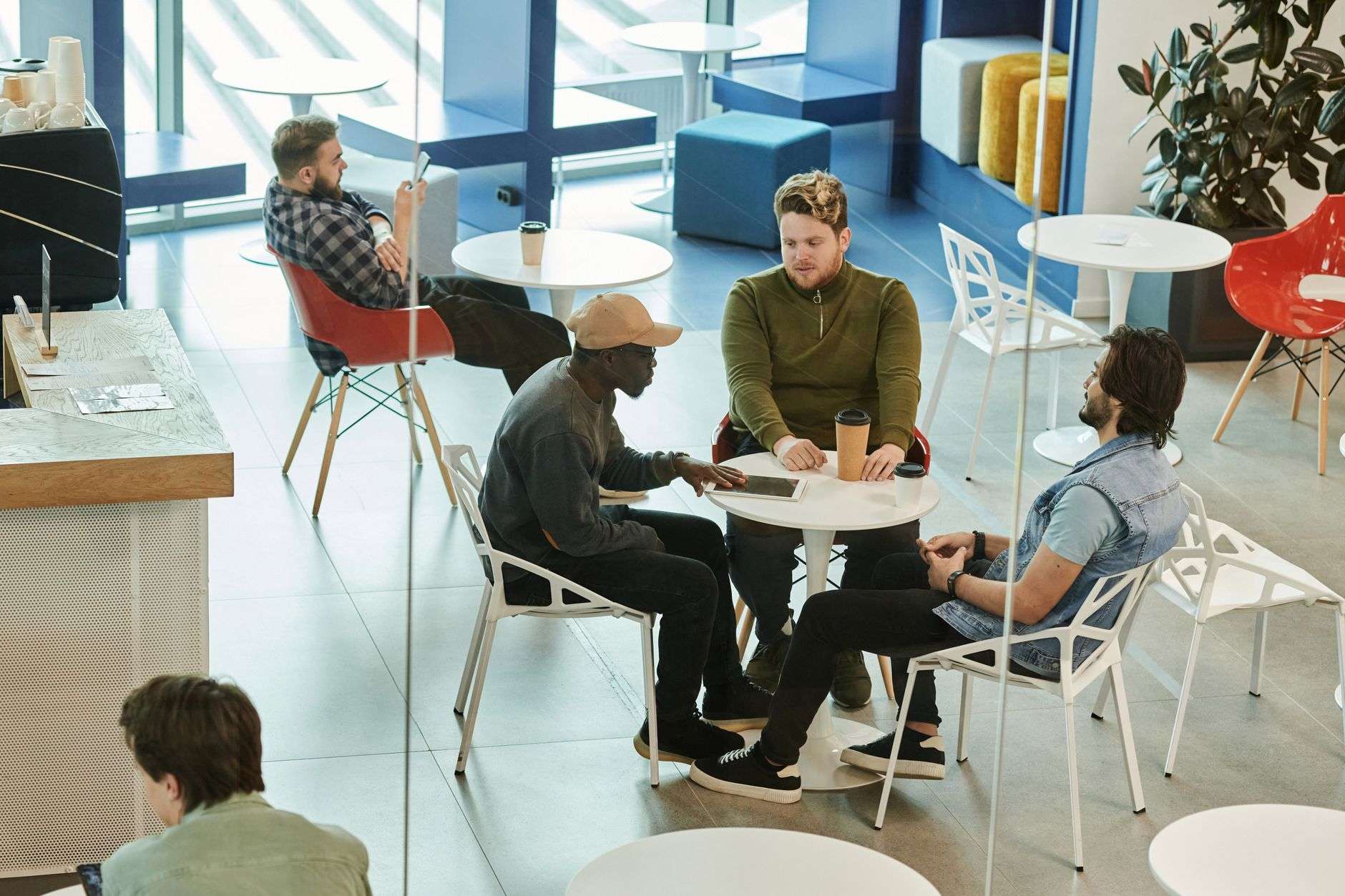
With Mobile’s special primary election just around the corner, a downtown coffee shop became the setting for the city’s newest attempt at grassroots voter education this week.
Business owner Kimberly Knight and community organizer Reggie Weaver hosted the first “Civics & Conversation” forum on Thursday, July 25, at Great Day Latte in downtown Mobile, inviting residents to talk through how to navigate the upcoming 2026 fall elections.
The gathering was designed as an introductory conversation rather than a deep policy debate, giving attendees a chance to ask basic questions about how elections work in Alabama and to voice frustrations about local politics more broadly. Those who attended included Mobile District 1 City Councilman Cory Penn, along with community organizers representing USA Health, Stand Up Mobile, and Dream Defenders Mobile.
Many of the residents who showed up said their motivation for attending came down to two recurring frustrations: a lack of understanding around how local government actually functions, and a sense that Mobile’s civic and political organizing efforts remain too scattered to have real impact.
Weaver used the session to walk through the basics of how different types of elections work and to open a broader discussion about strategy for the months ahead. He began by breaking down the difference between Alabama’s open primary system, in which voters must choose either a Democratic or Republican ballot in order to help nominate candidates, and run-off elections, which are triggered whenever no candidate clears 50 percent of the vote outright.
Weaver pointed to exactly these kinds of procedural details as one of the quiet barriers keeping residents from engaging more fully with the voting process. In a state where party labels dominate the general election ballot, the decision voters make in a primary — and even the choice of which party’s ballot to pull — often determines who actually holds office, particularly in districts where one party’s nominee is heavily favored in November.
How special elections break the usual pattern
From there, Weaver explained how special elections differ from regular election cycles. Special elections are called specifically to fill a vacancy in an office, while this year’s general election will ultimately pit the Democratic and Republican nominees against each other in a standard head-to-head race.
He singled out the upcoming Alabama special primary on August 11 for U.S. House Districts 1, 2, 6 and 7 as a particularly confusing case for many voters.
“This [upcoming] special election is even different,” Weaver told the group, before laying out exactly how the ballot access rules play out locally. “If you live in Mobile and you’re a Democrat…you can only vote for a Republican for this August 11th election,” he explained, a quirk of Alabama’s special election rules that left several attendees visibly surprised.
The explanation landed because it ran against what most voters assume the rules are. Under Alabama law, parties decide for themselves whether to participate in a special election by holding a primary or by qualifying candidates through other means. When one party opts into a special primary and the other does not, every voter — regardless of registration — receives the ballot that is actually being offered. The result is the situation Weaver described: Mobile Democrats weighing in on a Republican nominee, not because their own party is irrelevant, but because it chose a different route onto the ballot for that particular contest.
Once Weaver opened the floor, the conversation shifted from procedure to lived experience. Several attendees described feeling like the demands of daily life, from housing costs to access to healthcare, already consume most of their energy, leaving little bandwidth to also decode the mechanics of when, how and for whom to vote.
Attendees said the session helped them understand for the first time just how much of that burden comes down to the technical rules governing Alabama elections rather than a simple lack of interest in voting.
That distinction — between disengagement and exclusion by complexity — has become a recurring theme among civic organizations working in Mobile and across the state. Turnout gaps between high-profile national contests and municipal or special elections are well documented, and organizers argue that the gap is fed by confusion over registration deadlines, ballot styles and the tangled calendar of primaries, run-offs and special contests that Alabama voters are asked to track.
The frustration over scattered organizing was another thread running through the evening. Attendees pointed to a landscape in which neighborhoods, nonprofits and advocacy groups each run their own efforts — health outreach through USA Health-affiliated networks, community advocacy through Stand Up Mobile, youth and justice organizing through Dream Defenders Mobile — often duplicating work or missing each other’s events entirely. The forum was framed as a first step toward connecting those threads rather than replacing any of them.
The people in the room
The presence of District 1 Councilman Cory Penn gave the discussion an added dimension, putting a sitting city official in the same small room as residents airing grievances about the system he serves in. Penn represents the district that covers much of downtown and portions of Mobile’s older neighborhoods north and east of the central business district, an area where questions about housing, development and public services dominate constituent conversations.
For the organizers represented in the room — from hospital-community outreach to direct-action groups — the value of the night was less about any single procedural lesson than about the format itself: a neutral, walk-in setting where questions about government could be asked without a campaign, a party or a podium standing in the way.
Great Day Latte, the downtown shop that hosted the gathering, fits a growing pattern of civic programming built around small businesses rather than institutions. Coffee shops, libraries and community centers have increasingly become the default venues for political education events, precisely because they lower the stakes. There is no sign-in sheet, no press table and no requirement to declare a position before walking through the door.
Why the timing matters
The forum arrives during an unusually dense stretch on Alabama’s election calendar. The August 11 special primary for the state’s four U.S. House districts — including District 1, which runs along the Gulf Coast and takes in Mobile and Baldwin counties — will be followed by whatever run-offs the results produce, and then by the November general election that includes Mobile’s own municipal races on the 2026 fall ballot.
Each step carries its own rules, its own deadlines and its own opportunities for a voter to sit out accidentally. A resident who skips the special primary in August might assume the next chance to weigh in on the same office comes in November, only to find that the contest was effectively settled weeks earlier in a run-off with a fraction of the turnout.
That is the kind of trap Weaver and Knight are trying to defuse ahead of time. By walking a small group through the mechanics before the calendar hits, they are betting that a better-informed core of voters will carry the knowledge outward — to family, coworkers, church groups and neighborhood associations — faster than any official outreach campaign could.
Knight and Weaver closed out the evening by inviting the group back for the next installment of Civics & Conversation, scheduled for August 6, positioning the coffee shop series as an ongoing effort to keep Mobile residents engaged as the city moves through a heavy stretch of primary, special and general elections this year.
The August 6 date is not accidental. It lands five days before the special primary, early enough to still change how the people in the room vote, and late enough that the material — ballots, dates, districts — will be fresh rather than abstract. Organizers of voter education events across the state have learned that sessions held weeks before an election tend to fade; those held in the final stretch convert directly into turnout.
A broader moment for civic education
The forum also reflects a wider reality about how political information now reaches Alabama voters. Traditional coverage of election mechanics — the kind of procedural detail Weaver spent the evening explaining — rarely reaches casual news consumers, while social media fills the vacuum with fragments that are often wrong or incomplete. Grassroots formats like Civics & Conversation are an attempt to rebuild that foundation person by person, with room for follow-up questions that no broadcast or post can offer.
The organizers’ emphasis on basics is deliberate. Sessions about policy positions assume a shared understanding of how government works; sessions about how government works assume nothing at all. By starting with the mechanics — open primaries, run-offs, special election rules — the series is aimed at the floor of civic knowledge rather than the ceiling of political debate, a choice that keeps the room open to voters of any party or none.
What comes next for the series
If the series continues to grow, its challenge will be scaling without losing the intimacy that made the first session work. Forty people in a coffee shop can ask a councilman a direct question; four hundred in an auditorium generally cannot. Whether the next installments remain deliberately small, spawn neighborhood-level spinoffs or partner with existing organizations to widen their reach will shape what Civics & Conversation ultimately becomes — a one-time experiment or a fixture of Mobile’s civic calendar.
For the residents who attended the first session, the takeaway was a practical one: Alabama’s election rules are knowable, the calendar is public, and the difference between an engaged voter and a frustrated bystander often comes down to a single evening spent asking how the system actually operates. The next opportunity to do exactly that is set for August 6, back where it started — at a table in downtown Mobile, with the ballots of 2026 still ahead.
Between now and then, the organizing groups represented at the forum are expected to carry the conversation into their own networks, from USA Health’s community outreach channels to the neighborhood bases of Stand Up Mobile and Dream Defenders Mobile. For a city whose civic energy has long been described as scattered, the first Civics & Conversation session offered at least one modest proof of concept: a room full of strangers, a councilman without a microphone, and a clear explanation of why the next ballot will not look the way most voters expected it to.