Downtown Mobile Bar Hosts Monkeypox Vaccine Event Aimed at LGBTQ+ Community
B-Bob's bar in downtown Mobile is partnering with the Mobile County Health Department to offer a monkeypox vaccination event aimed at the LGBTQ+ community.
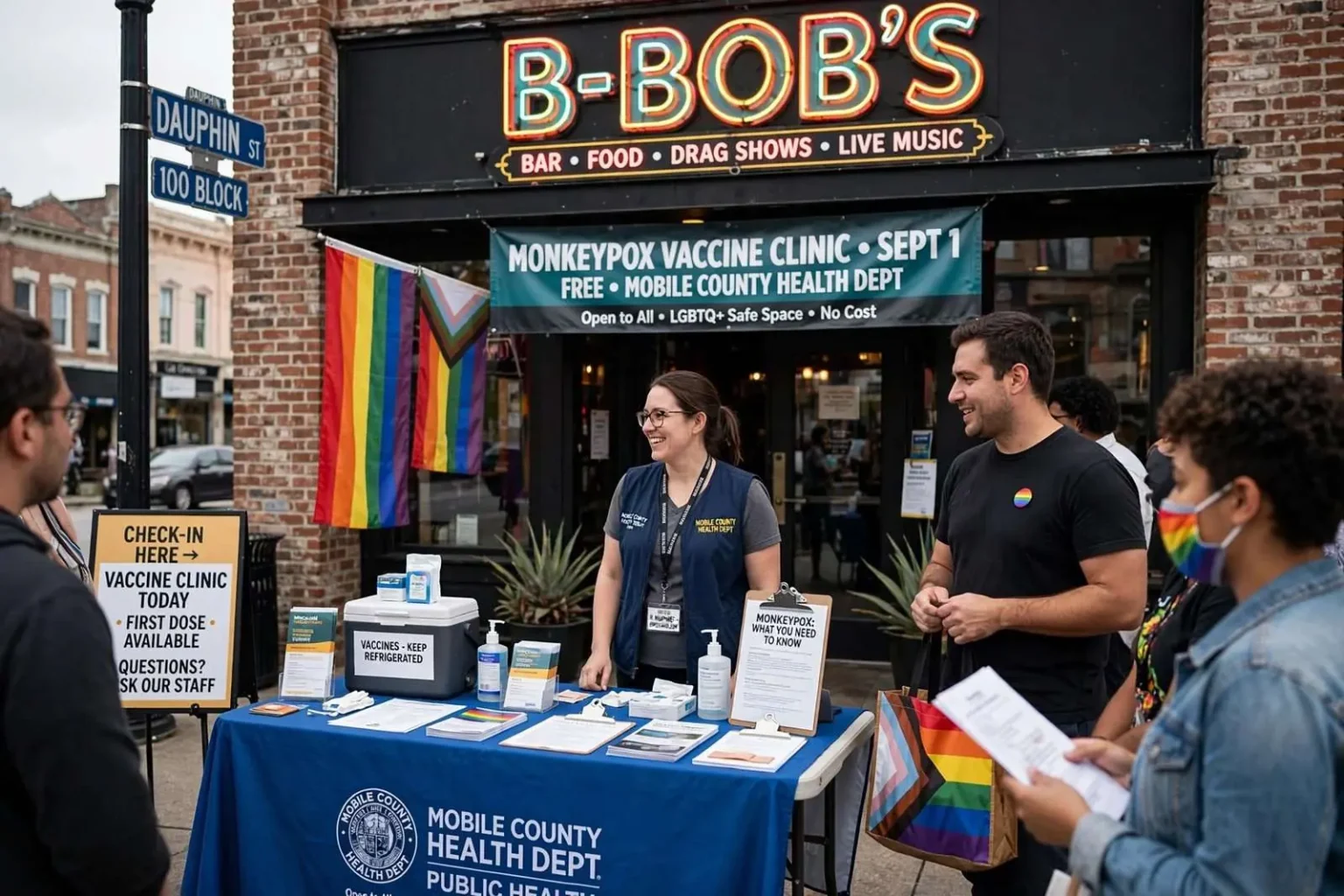
A well-known downtown Mobile bar is becoming a monkeypox vaccination site, with the goal of reaching people who might not otherwise feel comfortable showing up for a shot. Jerry Ehlen, owner of B-Bob’s, said the bar is partnering with the Mobile County Health Department to offer monkeypox vaccines in what he describes as a safe, familiar environment for the LGBTQ+ community. The arrangement turns a neighborhood institution on Dauphin Street into a public health outpost for an outbreak that health officials have struggled to reach with conventional clinic settings.
“The CDC has indicated that the LGBTQ+ community is a target audience for the monkeypox,” Ehlen said. “This is an LGBTQ+ safe space. So we wanted to open it up to people of the community, so they have a safe place to go.” His reasoning reflects a strategy public health workers have used for decades: meet people where they already are, in places they trust, rather than asking them to walk into a clinic where they may fear being judged or exposed.
Rendi Murphree of the Mobile County Health Department said the current outbreak has disproportionately affected gay, bisexual, and other men who have sex with men. “Anyone is at risk of contracting monkeypox,” Murphree said. “But in the current outbreak, 95 percent of the people who are getting monkeypox are gay, bisexual or other men who have sex with men.” The department, which has run HIV and STI outreach in the community for years, framed the event as a continuation of that work rather than a one-time response.
Murphree noted that monkeypox can spread through fluids, kissing, and skin-to-skin contact with someone who is infected. The virus produces a distinctive rash and flu-like symptoms, and health officials emphasize that close, prolonged contact — not fleeting encounters — drives transmission. Understanding those routes, officials say, is the first step in both prevention and treatment, since early vaccination after an exposure can reduce the severity of illness.
Why a bar, and why now
Although the event is designed with the LGBTQ+ community in mind, Ehlen said anyone who wants a vaccine is welcome. That openness mirrors guidance from federal and state health officials, who have stressed that the outbreak’s current demographics do not define the virus’s reach — anyone who has close contact with an infected person can contract it. Public health teams across the country have adopted the same posture, targeting outreach without restricting access.
The Mobile County Health Department, which will distribute the doses, hopes to vaccinate at least 100 people. The supply of vaccine has been constrained nationally during the outbreak, with doses arriving from the federal stockpile in limited allotments and jurisdictions competing to deploy them before exposure networks widen. Local health departments have prioritized first doses for those at highest risk while scheduling follow-up clinics as supply improves.
A second session on September 29 will be limited to second doses for those who received their first shot on September 1. Individuals seeking a first-time vaccination will not be eligible at the followup event. The two-dose schedule is a critical detail: the vaccine’s full protection builds only after the second shot, weeks after the first, so health departments have worked to pair initial clinics with guaranteed follow-up appointments.
For the bar’s owner, the calculation was straightforward. B-Bob’s has been a fixture of the Dauphin Street entertainment district for years, a place where the community gathers for drag shows, fundraisers and neighborhood events. Hosting a clinic, Ehlen suggested, is the same role in a different form — a familiar door that people already walk through, now offering something that could protect their health.
What the vaccine does, and what to expect at the clinic
The vaccine being offered is administered as a two-dose series, with the second shot given several weeks after the first. Recipients typically receive the injection in the upper arm or shoulder, and appointments at events like this one are usually brief — registration, a short health screening, the shot itself and a short observation period. Health department staff on site can also answer questions about symptoms, exposure timelines and testing for people who are unsure whether they need protection.
Officials urge anyone who develops an unexplained rash, particularly one accompanied by fever, chills, swollen lymph nodes or exhaustion, to contact a health provider promptly and to isolate until evaluated. Monkeypox is rarely fatal in the current outbreak, but it can be painful and can spread through households, so early identification matters both for treatment and for containing transmission. Close contacts of confirmed cases may be eligible for post-exposure vaccination, which works best within days of the exposure.
Hosting the clinic at a bar also serves a practical purpose for the health department: visibility. The event itself broadcasts a message to people who may have heard about the vaccine but assumed the process was complicated, expensive or unwelcoming. The doses are provided through public health channels, meaning there is no cost barrier of the kind that deters people from seeking care through private providers.
The larger response in Mobile County
The Mobile County Health Department, Alabama’s oldest county health department, has served as the backbone of the local response to the outbreak, coordinating with the Alabama Department of Public Health and the CDC on case investigation, contact tracing and vaccine allocation. Its epidemiology team interviews confirmed cases to identify close contacts and offers those contacts vaccination, a labor-intensive process that depends heavily on people coming forward quickly.
Community organizations and businesses have played a supporting role in that effort, and the partnership with B-Bob’s fits a national pattern. Across the country, health departments have run vaccination clinics at Pride festivals, nightclubs, bathhouses and community centers, pairing shots with education about symptoms and risk. The model came out of the HIV/AIDS era, when public health learned that stigma drives outbreaks underground and that trusted venues can bring services into the open.
Local leaders have emphasized that no one should read the venue as a limit on who is welcome. As Ehlen and Murphree both made clear, the doors are open to anyone who wants a vaccine — members of the LGBTQ+ community, their friends and families, and anyone else in Mobile County who has questions about their exposure risk. The September 1 session aims to put at least 100 first doses into arms, and the September 29 session will complete the two-dose series for those who started, closing the loop on the protection the clinic set out to provide.
Staying informed as the outbreak evolves
Health officials encourage residents to follow the Mobile County Health Department’s public channels for updates on vaccine availability, additional clinic dates and changes in eligibility. During the outbreak, allocation guidance has shifted as the federal supply changed, so departments have stressed checking current information rather than relying on announcements from earlier in the summer. People who miss the B-Bob’s sessions can still contact the department directly to be connected to other vaccination opportunities in the county.
For individuals weighing whether to attend, the department’s guidance is simple: if you have had close contact with someone who has monkeypox, or you are part of a social network where cases are circulating, vaccination is worth the time. The two-dose series means the decision made on September 1 extends to the September 29 follow-up, and staff on site will schedule that appointment before recipients leave.
The partnership between a downtown bar and a county health department is a small piece of a much larger response, but it captures what officials say the moment requires: lowering every barrier between people and protection. In a season when a new disease name has spread faster than the virus itself, the event at B-Bob’s is an attempt to replace rumor with facts, fear with a familiar doorway, and an outbreak’s momentum with a hundred vaccinations and a follow-up date on the calendar.
How the sessions are organized
The September 1 event runs like a compact clinic rather than a bar night. Staff from the health department set up registration and vaccination stations inside the venue, and volunteers help move people through the line. Attendees do not need to be customers or regulars, and organizers have stressed that the setting is simply a familiar landmark for a community that the outbreak is hitting hardest. People with questions about symptoms or recent exposures can ask them on site, where nurses and epidemiology staff are on hand.
The September 29 follow-up is deliberately restricted. By limiting the second session to people who received their first dose on September 1, the department ensures that everyone who started the series can finish it on schedule, without first-dose demand crowding out second doses. That approach protects the integrity of the two-dose timeline, which public health experts say is essential to the vaccine working as intended. Anyone who missed the first session will have other opportunities through department clinics as allocations continue to arrive in Alabama.
Between the two dates, the department will track how many of the targeted 100-plus vaccinations were completed and adjust future outreach accordingly. If the model works in Mobile — as it has in cities across the country — additional community venues could follow, each one widening the circle of people protected before the outbreak has a chance to expand. For now, the county’s newest vaccination site is a bar with a long history of serving its neighborhood, and its owner says that is exactly the point.