Drone Flyovers and Online Critics Complicate Shark Research at Alabama Deep Sea Fishing Rodeo
Marine researchers at the Alabama Deep Sea Fishing Rodeo say a drone flyover and pushback from online activists complicated their annual shark research, even as scientists defend the decades-old program.
The Alabama Deep Sea Fishing Rodeo markets itself as the largest fishing tournament in the world, and while it remains a beloved Gulf Coast tradition, the event’s revived practice of catching and dissecting sharks for scientific research has drawn renewed criticism from online activists. At this year’s rodeo, which wrapped up Sunday, sport, science and animal rights activism collided.
The rodeo, staged each summer on Dauphin Island by the Mobile Jaycees, dates to 1929 and has grown into a three-day event that draws hundreds of anglers and tens of thousands of spectators to the island’s docks. For most of its history it has served a dual purpose: a competition with prize money across dozens of fish categories, and an impromptu harvest of marine specimens that scientists have mined for decades of data on Gulf fish populations.
“Sharks have become more than the fish they are,” said Marcus Drymon, a professor at Mississippi State University and a judge at the rodeo. “They’ve been elevated as a species. Yet they are still managed as a harvestable resource, just like a red snapper.”
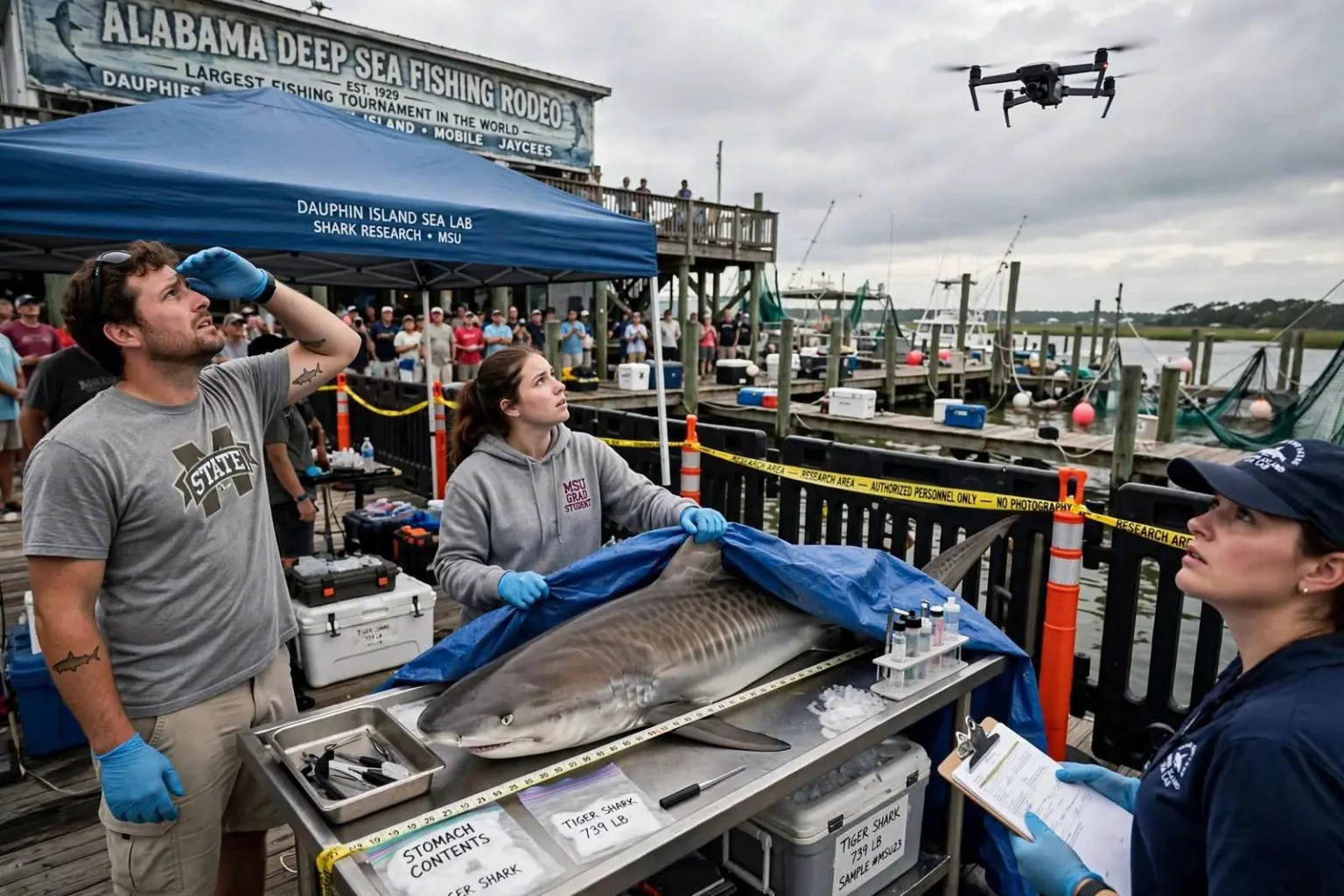
Photography and filming in the area where sharks are caught and dissected is prohibited at the rodeo, though that hasn’t stopped people from trying to get pictures. On Saturday, a mystery drone flew over the rodeo docks, prompting research students to pause their work and cover the shark from which they were taking samples.
“[It] can come across to the public as if we’re hiding what we’re trying to do,” Drymon said. “Nothing can be further from the truth. We want to be out showing our work…but for the safety of our scientists and for their privacy and wellbeing, we’ve chosen to barricade the area where we’re doing the science.”
Drymon said he has had his cellphone number released online and has received threats from critics of the research practices. Cody Ward, vice president of publicity for the rodeo, deferred questions about the no-film policy to Drymon but said the event, organized by the Mobile Jaycees, supports Drymon’s research and enforces the policy for the safety of researchers and participants alike.
The critics arrive
Among the critics this year was a social media personality and videographer who traveled from Switzerland to document what he described as the event’s practices. He was removed from the rodeo Friday after allegedly attempting to film, according to Drymon, though he said he did not have a camera out when he was escorted off the grounds. He said this was his third year attending the rodeo.
The clash illustrates how fisheries science now unfolds in front of a global audience. A practice that once took place with little notice beyond the island now reaches millions of viewers through short videos and photo posts, stripped of the sampling protocols and permits that frame it. Researchers argue the result is a distorted picture; activists argue the restrictions themselves prove something is being concealed. The drone flyover — an aircraft no one claimed — showed how far some critics were willing to go to get their own footage of a barricaded work area.
For the Mobile Jaycees, the young-service organization that has run the rodeo for generations, the dispute is an unwelcome addition to an event they stage largely through volunteer labor. The organization channels tournament proceeds into community programs across the Mobile area, and its leadership has historically treated the science partnership as part of the rodeo’s public identity — a claim to contribute something beyond spectacle to the Gulf it fishes. Managing that identity while scientists barricade their work from the public eye is the balancing act the next few summers will test.
Which sharks, and why
Two species of shark are eligible for the rodeo: the tiger shark and the bull shark, both of which inhabit the coastal waters of Alabama and other Gulf states. A qualifying shark must measure at least 80 inches in “fork length,” from the tip of the snout to the fork in the tail fin.
The two species are not arbitrary choices. Tiger sharks and bull sharks are large, wide-ranging predators that sit near the top of the Gulf of Mexico food web, and both are known to venture into bays, passes and river mouths — waters that people share with them every summer. Studying what they eat, where they travel and how their populations are doing provides information that applies far beyond the tournament docks, informing federal stock assessments and public safety decisions along the entire northern Gulf coast.
According to Sean Powers, senior marine scientist at the Dauphin Island Sea Lab and a rodeo judge, both shark populations in the Gulf remain relatively healthy and can safely support limited fishing. Once anglers bring the sharks ashore and they are weighed, scientists quickly take samples to study everything from diet to migration patterns.
The process, which involves removing organs and cutting sections of fin, is graphic, and Drymon said activists have shared photos of the dissections on social media in ways he believes mislead the public about the scientific purpose behind the work.
“It’s not fair to the graduate students that are behind the scenes doing the science, it’s not fair to the scientists who are donating their time, and mostly it’s just inaccurate,” Drymon said. “It’s a hallmark of fisheries science, taking samples from dead animals.”
That is the standard model for fisheries research worldwide. When a fish is legally harvested, scientists examine stomach contents to learn what the species feeds on, take ear bones and vertebrae to estimate age and growth, and collect reproductive tissue to gauge how healthy the breeding population is. Virtually everything regulators know about managing a fishery — catch limits, size limits, seasons — rests on exactly this kind of sampling. A tournament that concentrates large, legally caught specimens in one place offers researchers a volume of material they could never assemble from their own surveys.
The rodeo’s shark sampling program has produced years of data used in federal assessments of Gulf shark stocks, and Dauphin Island Sea Lab researchers have built much of their regional shark research program around tournament and survey work. For the graduate students, the dockside lab is also field training: few laboratory exercises replicate the pace and mess of processing a 700-pound predator in August heat.
A century of changing attitudes
Sharks around the world were heavily hunted through much of the 20th century, first for their skins and later, following the release of the film “Jaws” in the 1970s, as a target of growing recreational interest, according to the National Marine Fisheries Service. Shark fishing today is heavily regulated in the United States, though roughly a third of shark species worldwide remain threatened or endangered, according to the Save Our Seas network.
Neither the bull shark nor the tiger shark is listed as endangered, though both are classified as “near threatened” due to worldwide population declines.
Federal management of sharks has tightened considerably since the 1990s, when Congress directed the commerce department to develop fishery management plans for Atlantic and Gulf sharks. Commercial harvests are limited by quotas and permits, recreational anglers face size and bag limits and reporting requirements, and certain species are off-limits entirely. Within those rules, tournaments may include shark divisions, and the rodeo’s two-species format — with its 80-inch minimum — reflects both the science and the regulations that govern the fishery.
Drymon said he believes he and his critics share a genuine reverence for sharks, even if they disagree on methods.
“I’m guilty [of revering sharks],” he said, pointing to a tattoo of sharks on his arm. “There’s been this change in people’s attitudes. If a shark is harvested, even though we’re talking about just a handful of individuals, that has become a very emotive issue.”
The shift he describes is real and measurable. A fish that was once marketed mainly for its fins and hide is now the subject of documentaries, ecotourism ventures and classroom curricula, and public sympathy for sharks has grown to the point where even a handful of tournament landings can generate an international reaction. Scientists and anglers argue that emotion is a poor substitute for stock data; conservation groups counter that public pressure is what forced regulators to act in the first place. Both positions have a claim on the history.
What is not disputed is the scale. Only two species are eligible, only fish above 80 inches qualify, and the total number of sharks taken at the rodeo is small compared with commercial landings in the same waters. Whether that number is acceptable — and who decides — is now argued as much on social media as in any fishery management council meeting.
The leaderboard
As of the rodeo’s conclusion Sunday night, the heaviest tiger shark weighed in was 739 pounds, and the heaviest bull shark weighed 478.6 pounds, according to the tournament’s leaderboard. Awards were handed out Monday evening.
By the standards of recent decades, those are substantial fish, the kind of animals that once defined Gulf Coast tournament legends and that researchers prize precisely because big, old predators carry long records of the ecosystem’s history in their bodies. The rodeo will return next summer, the scientists will return with it, and on the evidence of this year — barricades, drones and all — so will the cameras.