

I’ve never met any of the Beatles. But I did once talk to Ringo Starr on the phone — for about eight minutes — and it remains one of the great thrills of my writing life. With his 85th birthday arriving on Monday, July 7, it seems like the right moment to tell the story of how that conversation happened, how close it came to never happening at all, and what the world’s most famously genial Beatle said when a small-town Alabama freelancer got him on the line.
The backstory starts with my side career as a freelance correspondent for Mobile’s newspaper. I wasn’t on staff — I was paid by the article — and I worked directly with Lawrence Specker, the entertainment editor, a total pro who was easy to work with and generous with assignments. Most of my pieces ran in the Bay Weekend entertainment section, which published every Wednesday: advance stories about upcoming concerts at the Saenger Theatre in Mobile or the Wharf Amphitheater in Orange Beach, built around short phone interviews with the performers. Over time those interviews added up to a pretty remarkable list — Charlie Daniels, Aaron Neville, Michael McDonald, Ricky Skaggs, Gary Rossington, Dewey Bunnell of America, Robert Lamm of Chicago.
So in early 2012, when Lawrence forwarded me a press release about Ringo Starr and His All-Starr Band coming to the Wharf that summer, and asked — surely already knowing the answer — whether I’d be interested in talking to someone in Ringo’s band, I said yes without hesitation. Neither of us seriously believed it would be Ringo himself on the line. It didn’t matter. Asking anyone what it’s like to play in a band with Ringo Starr is a great assignment, and his All-Starr lineups were always stacked with musicians who had done extraordinary things — the 2012 edition featured Rundgren, Rolie, and Lukather alongside Richard Page, Mark Rivera, and Gregg Bissonette, part of a tradition dating back to 1989, when Ringo first assembled a rotating cast of rock stars for what became one of the longest-running touring franchises in rock.
“Please hold for Ringo”
As the show approached, the publicist asked which band members I’d most like to interview — mentioning, almost in passing, that Ringo himself was a possibility. That stopped me in my tracks, but I kept my expectations grounded. When asked to list my top three choices, I went with the realistic picks: Todd Rundgren, Greg Rolie of Santana and Journey, and Steve Lukather of Toto. Any of them would have made a fine story.
Then came the scheduling comedy. Our deadline was June 25; the publicist went quiet; the deadline passed with nothing. Two days later, the inbox held the bombshell: Ringo might be available the following day, for five to seven minutes on the phone. The Bay Weekend section had already gone to press without him, so now the hope was to get the interview, write it fast, and run it elsewhere in the paper before Ringo’s showtime the following Wednesday. Lawrence gave the features editor a detailed heads-up and headed off for the holiday weekend.
The call didn’t happen that Thursday. It didn’t happen Friday. On Saturday, as I was getting ready to drive from Fairhope to Navarre, Florida, to play a gig as the bass player for Sugarcane Jane, my cell phone rang — and I heard the publicist say the five words every music writer dreams about: “Please hold for Ringo.”
I pulled out of the driveway routine, sat down at my computer, and prepared to type every word he said — a habit I’d learned years earlier from a newspaper colleague, Ken Fink. Ringo was cordial, upbeat, and efficient. What struck me, within his very first answer, was that he was completely locked in — present in the conversation, not phoning it in like a superstar who had done ten thousand interviews and couldn’t be bothered.
What he said
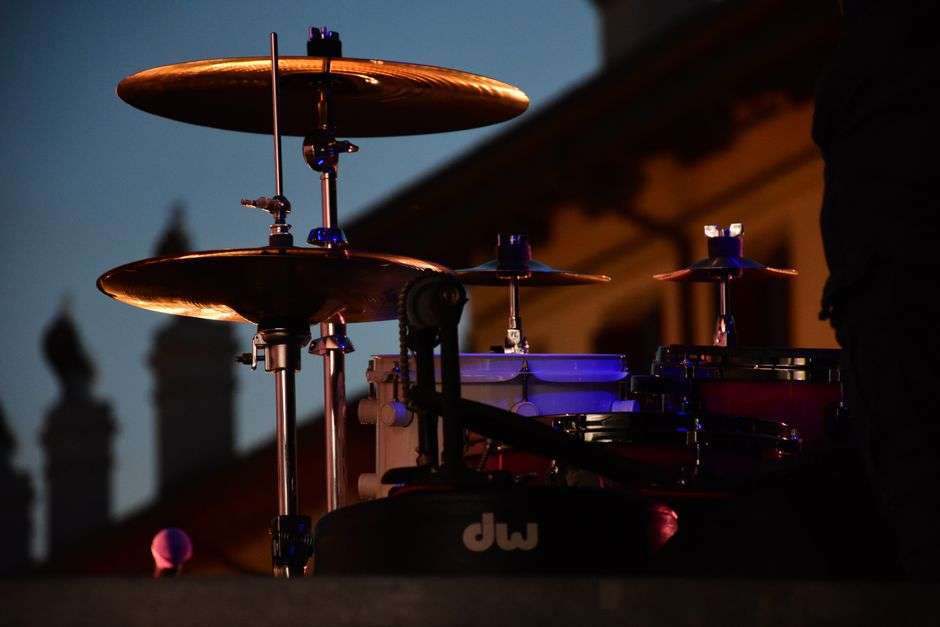
My first real question was the obvious one: why, after everything, was he still out there performing when he could be off enjoying retirement anywhere in the world? His answer has stayed with me for more than a decade: “Since I was 13, I’ve wanted to play drums, and that’s what I’m doing. I’m going to play as long as I can still hold the sticks. I’m doing what I’ve always wanted to do.” There was no rehearsed weariness in it, no PR gloss — just a man stating the plain facts of his own happiness.
If my math is right, he had been holding those sticks for some 72 years when he said it. His birthday was a week away, so I asked about the ritual he had made his own: every July 7 at noon, he asks people everywhere to stop what they’re doing and say or think “peace and love.” Did he really believe it did any good? “It creates a moment when we’re not thinking about feeding the dog, not thinking about violence or anything, just thinking about peace and love,” he said. “And how can that be a bad thing?”
Eight minutes later it was over. I raced to Florida, told my bandmates — Anthony Crawford and Savana Lee of Sugarcane Jane — why I was running late, and got what felt like a hero’s welcome. Such is the power of the Fab Four. Anthony asked how it went, then asked to hold my cell phone for a moment, which still makes me laugh. Then he delivered the line that has stuck with me ever since: “Ringo was the coolest Beatle.”
I had never thought of it that way. It’s hard to disagree.
The years since: still holding the sticks
Thirteen years after our conversation, everything Ringo told me that Saturday has held true. He joined the Beatles in 1962 — 63 years ago now — and has never really stopped. In January 2025 he released “Look Up,” his first country album in more than fifty years and his first full-length album since 2019, produced and co-written by T Bone Burnett and featuring guests including Alison Krauss, Billy Strings, and Molly Tuttle. The record debuted at No. 1 on Billboard’s country chart and earned him his first top-ten album on the publication’s all-genre sales chart — and at 84, he made his debut at the Grand Ole Opry. Nine Grammy Awards, two inductions in the Rock and Roll Hall of Fame, a knighthood in 2018, and an honorary doctorate from Berklee sit on the shelf, but the touring continues: he and his band played Tuscaloosa just last Tuesday night, on the road again.
The birthday tradition has grown, too. Ringo began dedicating July 7 to peace and love in 2008, and the moment has since spread to events around the planet — with support, at various points, from NASA — a remarkable runway for two words spoken at noon. His devotion to the drum chair has been the through-line of it all. Beatles fans have known since 1965, when he sang the Buck Owens hit “Act Naturally,” that country was in his blood; “Look Up” finally gave that affection a full album. And the Peace Sculpture of his own design stands in permanent display in a Beverly Hills park, an odd footnote to a career that began in the docks and dance halls of Liverpool.
Looking back, the eight minutes hold up better than most longer conversations I’ve had. Part of it, surely, was luck: the interview almost didn’t happen, arrived two days late, and lasted barely longer than a couple of songs. But the real reason it lasted was Ringo himself — the man who answered a nobody correspondent’s questions as carefully as if he were being paid by the word, and who genuinely could not understand why anyone would stop playing drums while they could still hold the sticks.
“Peace and love,” Ringo, on your 85th birthday. Thank you for the music — and for what turned out to be eight minutes of your time that I won’t forget.