

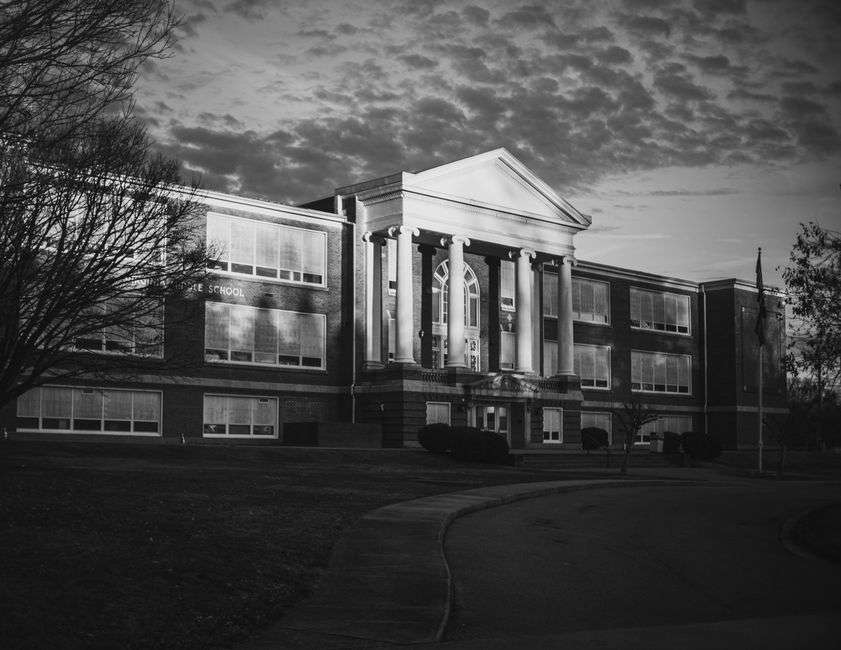
At 1000 Main Street in Daphne, a single building holds one of the most consequential stories in Baldwin County’s history: for more than six decades, the school that stood on this ground was the only local public high school open to Black students in the county. Today the surviving structure is the Baldwin County Black Education Museum, and the volunteers who keep it open are determined that the generations who passed through it — as students in the 1920s or as teachers in the 1960s — will not be forgotten.
Beginnings in the 1880s
The story starts in the years after the Civil War, when Black families across the South set about educating their children with little or no public support. In Daphne, the Eastern Shore Missionary Baptist Association — an association of local Black churches — purchased 18 acres of land on Main Street, and the first school building went up to serve African American children of the community. In 1892, the Association constructed a dormitory so that Black children from across Baldwin County, and from surrounding counties, could board and attend.
The Association funded the educators and administrators itself — a fact worth sitting with. Decades before the county took responsibility for Black students’ education, the schools on this ground were built, staffed, and paid for by the Black church community that needed them.
From Academy to Training School to High School
In 1916, the school, dormitory, and land were deeded to the Baldwin County Board of Education, and the school was renamed the Eastern Shore Colored Industrial School. In 1927, it was renamed again — the Baldwin County Training School — and its mission sharpened: to give Black students throughout the county, and those from neighboring counties, a public high school education.
From 1889 to 1950, it was the only local high school for Black students’ education in the area. An entire generation of Black Baldwin County leadership — teachers, veterans, business owners, church leaders, parents — passed through these classrooms, many of them boarders far from home during the dormitory years. The school operated until mid-century, when the era of desegregation reshaped public education, and the original wood-frame building remains as the last physical piece of the campus.
The Foundation and the First Reunion
In 1991, former students and community members formed the Baldwin County Training School Heritage Fest Foundation, earning 501(c)(3) status that same year. The mission, as the foundation states it, is “to research, restore, accurately interpret and preserve the rich heritage and excellent contributions of our ancestors and ensure its proper interpretation in American history.”
The “Fest” in the foundation’s name is not an annual festival but a reunion tradition. The first one, on July 5, 1991, came with low expectations — organizers figured a hundred attendees would be lucky. Instead, 497 people signed up to attend that first year. The gatherings have continued periodically ever since, part family reunion, part historical convocation.
In 1997, the Foundation awarded its first scholarship to students whose ancestors had attended the school under any of its names — a direct line from the founders’ sacrificial investment to the grandchildren’s futures.
The Museum, Dedicated in 2009
The Black Education Museum itself was dedicated and opened to the public on July 1, 2009, the result of a partnership between the Foundation and the Baldwin County Board of Education — the same board that had accepted the deed in 1916. Inside, the museum preserves photographs, documents, and artifacts from every era of the school’s life: class rosters with students’ names still legible, diplomas, photographs of teachers and graduating classes, and the equipment of a mid-century county school.
The museum’s leader, Mrs. Gartrell Agee, embodies the continuity the museum exists to honor: she was a student at the school, then spent 20 years teaching math at Fairhope Elementary School, followed by 18 years as a principal at what was then Fairhope Intermediate School. She can point to her own name on the old school roster — the point the museum makes better than any plaque.
The Legacy Walk and What Comes Next
One project underway is the museum’s “legacy walk,” built from brick pavers purchased by former students, or in memory of family members who attended the school across its various names. Each brick is a small act of documentation — a family’s proof that its people were here, learned here, and went on to build lives across the county.
Preservation of the building itself is the museum’s long-term challenge, as it is for every small volunteer-run historic site: the wood-frame structure that survived the 20th century needs steady care to survive the 21st. The Foundation’s volunteers, led by educators like Agee, continue the work — collecting oral histories, welcoming school groups, and keeping the doors open.
The museum stands on Main Street in Daphne, a short walk from the city’s bayside parks. For visitors, it is the essential counterpart to the county’s better-known histories: the story of a community that, when the public system would not educate its children, built a school, staffed a dormitory, and produced generations of graduates — then preserved the evidence, brick by brick.
The Boarding School Years
The 1892 dormitory is the detail that best captures what the school meant. Baldwin County in the 1890s had no public high schools to speak of for Black students anywhere else — no buses, no car pools, no consolidated campuses. For a family in Bon Secour or Bay Minette that wanted a child educated past the primary grades, the choice was the dormitory in Daphne or nothing. Boarders lived on the grounds during the school term, cared for by the school community, studying in the evenings in a county where, for their families, reading and writing had often been self-taught or Sunday-schooled.
Across the South, this pattern — church- and community-built schools preceding public systems — was the standard route by which Black communities created educational opportunity in the decades after Emancipation. What makes Daphne’s story notable is how completely it worked: the institution the churches built in the 1880s was still graduating county students into the mid-20th century, under three names and a changing society.
Why the Museum Matters Now
The Black Education Museum does double duty as archive and meeting hall. For the families whose names fill the rosters, it is genealogy made physical — grandparents’ class photographs, teachers’ names, the buildings themselves. For students and scholars, it documents an institution that most county histories long omitted: the museums and historical markers that tell Baldwin County’s story only recently grew to include it, thanks to the volunteers who pushed for accurate interpretation.
That is the foundation’s stated purpose, after all — not nostalgia but accuracy. The school’s graduates went on to teach in the county system that once excluded them, to lead churches and businesses, to serve in the military, and to raise the families that now run much of the county’s civic life. The museum keeps the receipts: the rosters, the bricks, the building, and the stories of people like Mrs. Agee, who went from student at a segregated training school to principal of an intermediate school two miles down the road.