Retired Marine Gen. Gary Cooper Reflects on Breaking Barriers Ahead of Griot Award
Ahead of receiving the 2017 Griot Award, retired Maj. Gen. Gary Cooper recounts a life shaped by segregation in Mobile, service in Vietnam and decades of breaking racial barriers in the Marine Corps and government.
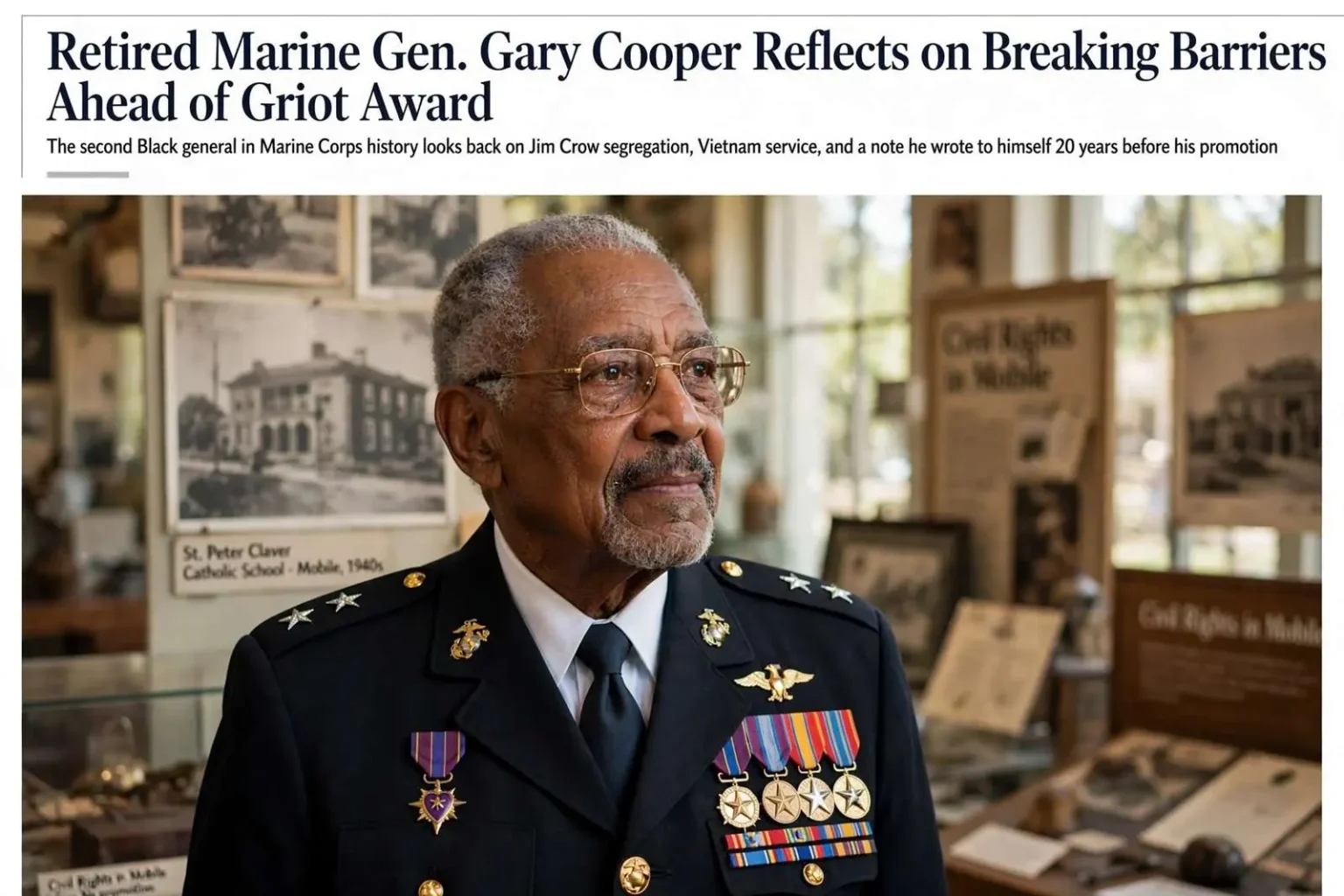
Retired Maj. Gen. Gary Cooper can still recall the dusty roads of the poor Mobile neighborhood where he grew up, and the segregated Catholic school, St. Peter Claver, where a Dominican nun told her all-black classroom that the white residents who supported segregation were “crazy,” and that there was “room at the top” for those who kept pushing forward. Cooper has said that lesson stayed with him throughout a Marine Corps career that would eventually make him just the second African-American general in the Corps’ history.
“I can remember once being aboard a ship in the Pacific, trying to think of what I wanted to do,” Cooper said. “I loved the Marine Corps. I loved that uniform, but I knew we had no black generals.”
Remembering the nun’s words, he wrote himself a note, “Cooper, did you make it?”, and sealed it away. Decades later, when he learned he had been selected for general, he had his daughter open the note.
“When they called me to tell me I had been selected for general, I had my daughter open it and, of course, what did it say? ‘Cooper, did you make it?’ and that was 20 years before that I had written that note,” he said.
A childhood shaped by Jim Crow
Cooper’s Marine Corps career and his sacrifices in Vietnam didn’t shield him, or his family, from the realities of segregation in Mobile. Even his birth was affected: because no hospital in Mobile at the time would admit black women for childbirth, Cooper was born in his mother’s hometown of Lafayette, Louisiana.
“So, mother went home and I was born at my grandmother’s house in the same bed that she and her sisters and some of my cousins were born in,” Cooper said. “I was the oldest of six.”
Segregation also touched his siblings. Cooper’s father attempted to enroll his son William at the all-white McGill after William, who had a fair complexion and straight hair, was initially admitted. School officials later discovered William had come from St. Peter Claver, a black school, and expelled him.
“Three, four, five weeks later they looked and saw he came from St. Peter Claver, a black school, and they expelled him,” Cooper said. “The bishop told my daddy that not only was he pissed off at him that he wouldn’t allow any of his children to go to any of the Catholic schools in Mobile, and my daddy ended up sending all of my siblings out of town to go to school because he didn’t want to send them to the public schools.”
Cooper’s brother, A.J., who later became mayor of Prichard, ended up attending school in Illinois as a result.
The prejudice Cooper encountered as a child echoed into the next generation. After returning to Mobile following college and more than a decade in the Marine Corps, Cooper recalled his daughter Shawn, who would go on to become a Marine Corps officer herself, being barred from swimming with her team at a country club meet because of her race.
“She goes out to the country club and they won’t let the team swim because she was on the team,” Cooper said. “There are a lot of stories like that. I can remember when I got home, the swimming pools were closed. No black kids had any swimming pools.”
Cooper also ran into the machinery of Jim Crow-era bureaucracy when he remarried in the 1970s and was handed a “colored marriage register” to sign at the local probate court.
“They give me a colored marriage register to sign,” he said. “I tell the guy [at the front counter], ‘I’ve got five rows of ribbons, I fought in Vietnam and I got to sign a … colored marriage registry.'”
He signed it that day because the wedding reception was already planned, but he didn’t forget the encounter. Years later, when the local probate judge sought Cooper’s approval as a state legislator to retire, Cooper made his support conditional.
“I said ‘only one way,'” Cooper recalled. “I said, ‘let me see your last copy of the colored marriage registry’ and he said, ‘colonel, it’s all over.’ That was the end of the colored marriage registry.”
A path to Notre Dame and the Marine Corps
As a teenager, Cooper met the Most Rev. Fulton J. Sheen, then archbishop of New York, when Sheen visited Mobile to help Cooper’s parents, both Hampton University graduates, raise money for a hospital. During that visit, the archbishop asked young Cooper whether he had considered the University of Notre Dame and offered to write him a letter of recommendation.
“He told me to check on it and if I should ever decide to go, he would write me a letter,” Cooper said. “I still have the letter he wrote recommending that I go to Notre Dame. I got an academic scholarship.”
Cooper, from a devout Catholic family, enrolled at Notre Dame and graduated in 1958. According to Kendal Weaver, a former Associated Press reporter and author of the Cooper biography “Ten Stars: The African American Journey of Gary Cooper, Marine General, Diplomat, Businessman and Politician,” the university’s president, the Rev. Theodore Hesburgh, made a point of ensuring Cooper and the two other African-American students in his class felt welcome, viewing their presence as important to the school’s integration efforts.
Cooper’s decision to join the Marine Corps traced back to a childhood trip to the Harlem theater in Mobile’s Down the Bay neighborhood, where he watched “The Sands of Iwo Jima” starring John Wayne.
“Man, I went one day and I saw ‘The Sands of Iwo Jima’ with John Wayne,” he said. “I figured anyone that tough, Cooper wanted to be like him. So, that’s how I chose to be a Marine, but I had never seen a black Marine officer.”
At the time Cooper commissioned, there were only six black officers among roughly 20,000 in the Marine Corps. He began his career as an infantry officer, at one point becoming the first African-American to command a Marine detachment aboard a ship.
“I was the first [African-American] to command a Marine detachment aboard a ship,” Cooper said. “For two years, I was on the USS Chicago and then from there I went to another place and then I got orders to Vietnam.”
Vietnam and a return home
Offered a role as a supply officer in Vietnam, Cooper instead requested a meeting with his commanding general to push for an infantry assignment, understanding that combat experience mattered for future promotion.
“I requested mast,” he said. “I wanted to see the commanding general.” He explained his reasoning this way: “So, I knew you didn’t meet any generals who were supply officers or motor transport officers. They all had Purple Hearts and ribbons from fighting. So, I knew when I went to Vietnam that if I wanted to be a Marine, in fact, I wasn’t even thinking about being the first, or second or third black, I was thinking about being a hell of a Marine.”
Cooper was wounded twice in Vietnam, earning two Purple Hearts, and after being pulled from combat he served as a civil affairs officer working to win over civilians in Vietnamese villages, including partnering with a doctor to repair children’s cleft palates.
After roughly 12 to 13 years of active duty, Cooper returned to Mobile to help run his family’s business, Christian Benevolent Funeral Home, following his father’s death. He led a reserve unit out of Municipal Park before being called back to lead Marine Corps personnel efforts, eventually becoming just the second black general in Marine Corps history.
From the Alabama Legislature to Washington
Back home, Cooper was persuaded to run for the state Legislature, defeating Pat Edington in a race where, he joked, he was considered the conservative candidate thanks to his ties to the Red Cross and his military service. In the Legislature, Cooper pushed for prison reform, describing conditions at the time in stark terms.
“It was filthy,” he said of the prisons. “The food had pig eyes in it and there was feces all over the place. It was horrible.” He said he was never able to make much headway on the issue, one that he noted continues to challenge the state, along with what he called the problem of harsh sentencing for minor drug offenses.
Gov. Fob James later appointed Cooper to lead what is now the state Department of Human Resources, at the time the largest cabinet post ever held by an African-American in Alabama, though not the first cabinet appointment overall; that distinction belongs to Jesse Lewis, appointed by Gov. George Wallace. At DHR, Cooper said he worked to improve how the agency’s roughly 5,000 employees treated the public and launched a training initiative called the Opportunities Industrialization Center, which provided eight weeks of job training.
“We started having packed classes,” Cooper said. “About 90 percent of the youngsters we got jobs for because employers were interested in people who wanted to go to training and weren’t demanding to get paid [for the training].”
Cooper’s tenure at DHR ended after a falling-out with Gov. James, who sought deep budget cuts to the agency that Cooper felt broke earlier promises; Cooper said he was ultimately fired.
He went on to work as a vice president of marketing at Volkert Engineering before being appointed assistant secretary of the Air Force under President George H.W. Bush, where he pushed the branch’s promotion boards toward more equitable treatment of women and minorities. He was later considered for secretary of the Navy under President Bill Clinton, and though that appointment never materialized, fellow Mobile native Alexis Herman, then U.S. secretary of labor, helped connect him to a different post: the first black U.S. ambassador to Jamaica.
While serving in Jamaica, Cooper said he was moved by the poverty, hunger and violence many Jamaicans faced daily, and worked to improve education on the island, including supporting an orphanage fundraising organization that still exists today.
“I’d see these little children and I’d want to bring five or 10 of them home with me,” he said. “I worked to do some good things and some good things we did. It was a wonderful experience. We met a lot of great people, from Angela Bassett to Jimmy Carter, just on and on. It was sad, though, in many ways.”
A Griot Award for a life of storytelling and service
The Dora Franklin Finley African-American Heritage Trail has named Cooper the third recipient of its Griot Award, a title drawn from the West African tradition of the griot, or oral historian. DFFAAHT board president Karlos Finley said Cooper’s life exemplifies the trail’s mission.
“Gen. Cooper, as a human being, is the kind of person we can look up to,” Finley said. “His intestinal fortitude and refusal to take ‘no’ for an answer is surely something our kids can look up to.”
Cooper will receive the award at a reception on Friday, March 10, from 6 to 9 p.m. at the History Museum of Mobile, 111 S. Royal St. The Dora Franklin Finley African-American Heritage Trail includes more than 40 sites in and around Mobile tied to African-American history, from the story of the Clotilda’s survivors to the desegregation of the city’s schools, and trail organizers say they are working to expand access to guided tours for students and civic groups.